
Veteran actor Greg Hicks climbs Ibsen’s tower at the Arcola
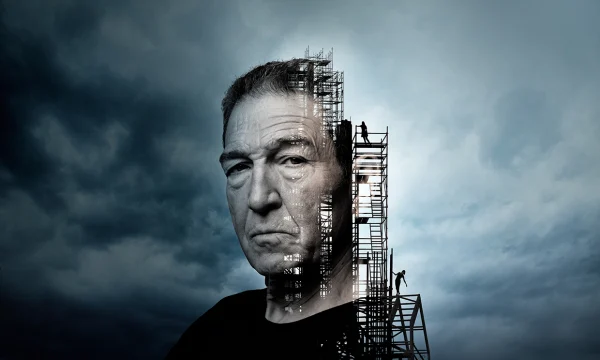
Midway through the second week of rehearsals for Henrik Ibsen’s The Master Builder at the Arcola Theatre, Greg Hicks unburdens himself on the phone to the Hackney Citizen, likening the production to “really peeling one of the best onions in the world.”
Pull back the skins and there’s further to go: “It’s the inside of Ibsen’s head, heart, soul. So it’s not going to be straightforward.”
For Hicks, the lead role of Halvard Solness, a celebrated architect terrified of being overtaken by the younger generation, lands close to home. “I’m an older man looking back on a long career. And… in some ways, I fear the eclipse of my story. And of course, this play is about that.”
He is quick to quip that he feels this “not with any degree of bitterness.” He believes age has made him better suited to the part.
“I’m more vulnerable as a human being and that suits this role because he is vulnerable.”
This is Hicks’s sixth or seventh production at the Arcola, which he calls “a very trusting building,” and a place where he can “open myself” (creatively). He describes it as “a cavalier and maverick organisation, and I mean that in the most thrilling sense of both of those words.”
He trained at Rose Bruford College from 1971 to 1973.
“I thrived there. I did flourish.”
He still remembers the campus at Lamorbey Park, where “some kind of magic occurs.” I concur, having studied at the same drama school in 2013.
Hicks then joined the Royal Shakespeare Company in 1976, and what followed was a varied and illustrious career ranging from Agatha Christie’s Marple to Macbeth and many more in between.
Elusive diamond
Hicks sees the difference between Shakespeare and Ibsen in the structure.
“The language of Shakespeare is its own construct. It’s like architecture.”
The Master Builder is “elusive, like a diamond. You might turn it to a slight angle and it changes.”
He praises David Edgar, “one of my favourite contemporary playwrights,” whose version has “a brilliantly modern feel without taking away the spirit of the original text.”
The two first worked together 50 years ago on Edgar’s play Destiny.
The task here, Hicks says, is to communicate the play “as if it’s being discovered in 2026 in the Arcola Theatre” while still catching “the real depth of Ibsen’s dilemma.”
Theorising out loud to a rapt audience of one (me), he sees Ibsen himself in the play far more than Shakespeare appears in his own work.
The play is “definitely inside of [Ibsen’s] psychic entrails.” It is also “deeply spiritual.” Solness “challenges God… He feels his punishment arriving from that challenge to God.” When Solness climbs his tower, “screaming at God, or singing to God, or talking with God,” the act is “hugely brave. But also hugely… risky.”
Hicks knows the struggle personally: “I wrestle with the divine, almost on a daily basis, really. Not in a very dramatic way, but sometimes in a quite discreet way.”

Into this comes Hilde, who arrives “like a streak of lightness.” She is “such a free spirit… completely uncageable.”
In a post-MeToo climate, Hicks accepts that the relationship, in all its complexity, “does sit differently in 2026 than it might have done in 1956… or 1892.” He refuses to reduce it to a problem. “I don’t like that word, ‘issue’. There is a situation which is full of questions.”
Crucially, he says, “it’s not a play about victims,” and “were it a play about victims, it would be a much lesser play.”
In his view, “She is a force of nature… And he’s a force of nature.”
But what can the play say about the times we live in?
It is about “knowing as much as you possibly can about your own motives,” a “self-reflective… imperative” that Hicks thinks might help a country in a state he calls “utterly perilous.” Audiences, he warns, will be “constantly wrong-footed,” and he calls that “its genius.”
Hicks has played Engstrand in Ghosts, “a marvellously corrupt wheeler and dealer,” and has appeared in An Enemy of the People. Solness, though, “is the most difficult for sure.”
In his words: “This will separate the man from the boy.”
The Master Builder runs from 16 October until 21 November at the Arcola Theatre.
You can book tickets here.