
Hackney free schools – the debate continues
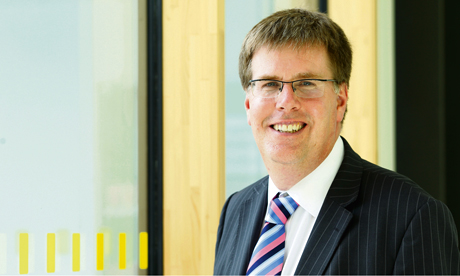
Accountability concerns: Urswick School's headteacher, Richard Brown
As two of Hackney’s new free schools kick-start their recruitment drive for September 2013, fresh demands for democratic accountability are being made.
Hackney New School will be a ‘mainstream music-focussed’ secondary school, with plans for an 11-hour day. The school’s founder, Philippa De’Ath, said: “There still aren’t enough excellent school places and that is very strongly echoed by parents. There is definitely a need for a smaller school with more of a focus on the individual.”
Meanwhile, the Stem Academy is targeted at 16 to 19-year-olds with aspirations in science, technology, engineering and maths (STEM subjects) and places emphasis on apprenticeships on Old Street’s ‘Silicon Roundabout’.
The programme director, Dennis Quilter, said: “There’s insufficient education in the economy that enhances people’s knowledge of skills in [STEM] areas. We have a critical shortage of home grown scientists and engineers in the UK.”
In October last year, the Mayor of London, Boris Johnson, who has no formal powers over education, announced plans for a London-wide tier of control with a dedicated unit at City Hall called ‘new schools for London’ to secure new sites for free schools, along with the ‘London curriculum’ to promote teaching excellence and tackle underperformance.
London Councils, a cross-party organisation chaired by the mayor of Hackney, Jules Pipe, has demanded that rather than power at a centralised level, “the essential role of local councils” must be recognised.
It is a view echoed by many councillors and teachers alike, who believe the new school model is potentially damaging to a flourishing educational environment.
Green party London Assembly Member Darren Johnson said: “Instead of appointing himself as a free schools tsar, Boris Johnson should recognise that schools perform most effectively when they are accountable to local authorities and are firmly rooted in local communities.”
Mr Johnson called it a “hit and miss approach”, saying: “Well-established London schools are in danger of being sidelined and starved of funds by the Mayor’s decision to throw money at untested start ups.”
Richard Brown, headteacher of Urswick School, expressed concern that lack of local accountability could lead to free schools and their students floundering: “Schools in Hackney have a safety net, if things go wrong then there is the council’s Hackney Learning Trust to help that school to improve,” he said.
“Who is meant to support free schools, which have set themselves up as a completely independent model? If it all goes wrong, it is going to go wrong badly and it is going to affect a particular group of children, which I don’t think is fair.”
Some of the rationale behind the openings is to satisfy predicted shortfall of school places. London Councils has estimated that there will be a shortage of 90,000 places in London by 2015.
Henry Stuart, one of the founders of the Local Schools Network – a campaigning group for local state schools – said that Hackney New School in particular would not meet a need in the area.
He said: “I understand the school is to be in either De Beauvoir or Dalston. Both are within walking distance of around six good or outstanding secondary schools.
“There are two gaps in provision in Hackney. The first, in the south-east of the borough, will be met by the second Mossbourne School in 2014. The second is in the north-east. Any school genuinely seeking to meet the need would set up there.”
But Hackney New School believes it will provide an important addition. Ms De’Ath said they were motivated to launch the school after reading that 15 per cent of children go to secondary school outside of the borough. She said: “I’ve been amazed at how far away people go to school. I think that we can keep some of those kids in Hackney and thus improve all of the good social stuff around us.”
Mr Brown argued: “There is almost a total parity of children coming in as well as out of the borough. This is a perfect example of taking a statistic and pretending that there is a problem where there isn’t.
“If you think about the geography of inner London, boroughs are very close to each other so you will always get some students who go out of Hackney to be educated. That is not about there not being decent schools in Hackney, that’s about where they happen to live.”
Boris Johnson should recognise that schools perform most effectively when they are accountable to local authorities Evidence?
Richard Brown confuses accountability with a failure regime for free schools.
Free schools will be as “accountable” as any other school – and, in my view, more so. We will be particularly accountable to parents, ultimately our most important clientele. We are just less “accountable” to Local Authorities than maintained schools (but as accountable, or not, as Academies) – but what does this really mean? It means, for instance, that we don’t have to follow the financial reporting regime of the Local Authority. Instead, the personal responsibility of the accounting officers of a school as well as its audit committee is greatly increased. There is a very tight framework of supervision – and, in return for this, we have more freedoms, too, for instance in relation to carrying over any surplus balances from one year to the next. It would be odd to describe this regime as “lacking in accountability”.
As far as educational performance is concerned, free schools are, of course, subject to exactly the same Ofsted inspection regime as any other state-funded school. So free schools are also directly accountable to Ofsted.
We hear questions about “accountability” all the time. In 90% of the cases, I wonder whether those who raise the question have ever seriously thought about what it means. A free school cannot hide behind a Local Authority – we are all on the hook, personally and as an independent Academy Trust. There are no other schools that are more directly exposed to the consequences of the decisions they make. Do I, as a co-founder and future chair of Hackney New School, feel an intense responsibility to all those who will entrust their children to our care? Absolutely. For anyone to claim otherwise is just absurd (and I am not suggesting that Richard Brown has made any such claim, to be sure). The creation and management of a free school is, in the final analysis, a deeply moral project that creates a long string of obligations. Sceptics should remember that (although I know that Henry will never be persuaded!).
It would be very odd for any free school, including like Hackney New School, not to work with the Local Authority in an entirely cooperative spirit. We are very grateful, for instance, for the help we have received for our admissions process this year. There is no reason, nor would it make any sense, to have an antagonistic relationship.
However, I also know that the board of Hackney New School, and its leadership team, will have all the expertise and commitment we need to make the school a success. We will always have more information about the particular issues that need to be resolved and the challenges that HNS will face. Richard Brown should have more confidence in a decentralised delivery model. If it were the case that, to be a successful school, it is a necessary and sufficient condition to be a local authority-controlled school, there would be no need for other school models. But we all know that’s not the case – “necessary and sufficient”…..these are very strong conditions: Hackney’s history in the 1980s and 1990s provides ample demonstration for why these maintained schools often do not satisfy those conditions.
Of course, there is a risk of failure. That’s the central feature of life – events in the future are very hard to predict, and life is full of risks. Shall we therefore not try? No. Is there no risk that Urswick School could fail? Of course, there is. And if it all goes wrong, will it go wrong badly? How can one know? And would it affect a particular group of students? Yes, by definition, it would. Would this be unfair? What do you mean by fairness? It would be bad for the children, no doubt.
Our objective is to do something good. Goodness does not have one home only.
AB can you offer any evidence that with parity of resources and intake schools perform more effectively when they are NOT accountable to local authorities?
“The massive release of data by the Department for Education (over 200 pieces of data on each of over 5,000 secondary schools) makes possible a thorough analysis of how well different types of school have performed. The evidence is clear and overwhelming: Academies have not been the success story that their supporters have claimed. Instead there is a clear record of under-performance.
The overall figures have long been clear, for the key measure of % achieving 5 A-Cs at GCSE including English and Maths:
Academies: 47%
Non-academies: 60%
The data now includes a figure for the % achieving 5 A-Cs including English and Maths but without counting non-GCSE qualifications like Btecs. Here the difference is even more stark:
Academies: 34%
Non-academies: 54%
The gap is huge but this is an unfair comparison. We know that the raw % pass rate (though currently Ofsted’s favoured figure) is closely related to the ability of the students at entry. We know that schools in disadvantaged areas tend to achieve lower % for 5 A-Cs and we know that the early academies were more likely to be in disadvantaged areas. So does this explain the discrepancy?
The answer is a resounding no. To analyse this, I split the data into five comparison groups according to the % of students on free school meals. The first group, the most advantaged, is of schools where less than 10% are on FSM and so on up to the most disadvantaged where more than 40% are on FSM. Academies still perform worse than comparable non-academies.”
Ms De’Ath says “There is definitely a need for a smaller school with more of a focus on the individual.” But such schools already exist – in the private sector.
Leaving aside the merits or otherwise of small schools, the crucial point here is that free schools can only afford to be small if they get what is effectively more funding per pupil than existing schools. Find me an existing state school that wouldn’t appreciate the levels of funding that are keeping these small free schools open!
Free schools are getting the same funding per pupil as state schools. Emma Bishton is wrong. You can look it up here: https://www.education.gov.uk/a0073853/revenue. The only difference is that they get a cash grant for services that maintained schools are being provided with for free by their local authority. Once they have spent this on procuring the relevant services – from the local authority or elsewhere – their remaingin funding per pupil is the same as for maintained schools.
Free schools may be getting the same per-pupil rate as other schools in their locality, but they must also be in receipt of other funds not available to existing schools (whether academies or not) – and therefore in effect funded at higher levels than existing schools. Otherwise we wouldn’t have two Free (secondary) schools in Suffolk with only around 100 pupils each (over three year groups). The free schools in question have refused to disclose their operating budgets even though existing schools would be obliged to.
Happy to debate that if you can specify what other funds you are referring to. The rules are what they are, there isn’t anything else “hidden from the public”. If you have ever looked, for instance, at sick pay provisisons for teaching staff – where after 4 years of service you are entitled to 100 days leave at full pay and 100 days at half pay, i.e. more than the entire school year – then you may find that there is quite a lot of ways to reduce costs significantly and hence make smaller schools more viable.
aside from the secondary academies, why is there no comment on greg wallaces best start federation ramming through academy status on five hackney primary schoolds with less than 10 working days consultation over the xmas period. No working papers, no documents, nothing to consult on other than an artifical carte blanc to create himself a fiefdom for life.