
Graphic novel brings Spitalfields-born feminist Mary Wollstonecraft to life
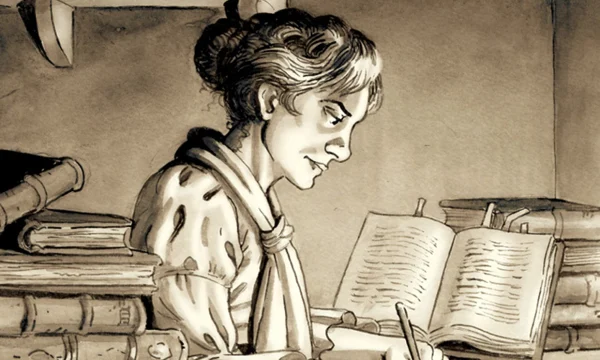
A lot happened in Mary Wollstonecraft’s 38 years. She navigated difficult family relationships, political upheaval, children born out of wedlock, and living in Paris during the Reign of Terror.
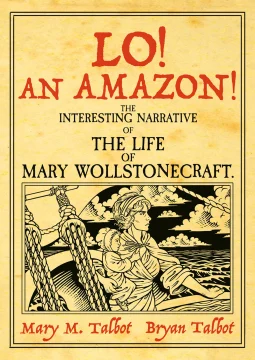
Her 1792 book A Vindication of the Rights of Woman is still widely read, while her daughter Mary Shelley’s Frankenstein is even more ingrained in popular culture. Lo! An Amazon! The Interesting Narrative of the Life of Mary Wollstonecraft, the new graphic novel from Mary M. Talbot and Bryan Talbot, focuses on Wollstonecraft’s life and ideas through the turbulent final decades of the 18th century.
Born in Spitalfields, Wollstonecraft spent much of her life challenging the limited options available to women and is regarded by many as one of the foundational feminist writers.
Published by Hackney-based graphic novel publisher SelfMadeHero, the book comes shortly after the 229th anniversary of Wollstonecraft’s death on 10 September.
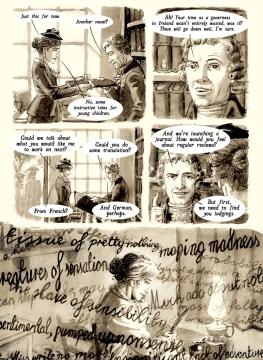
The title refers to a line from William Roscoe’s satirical poem The Life, Death and Wonderful Achievements of Edmund Burke: a new ballad, in which he writes: “And lo! An Amazon stept out, One WOLLESTONECRAFT her name.”
It’s a striking book, with a neat hardback cover – the back featuring a collage of books and images, including Germaine Greer’s The Female Eunuch, aptly placing Wollstonecraft in the longer history of feminist writing.
Mary and Bryan Talbot previously worked together on Dotter of Her Father’s Eyes, which won the Costa Biography Award, as well as Sally Heathcote: Suffragette. Here, they condense Wollstonecraft’s life into 152 pages, moving between her relationships, travels, writing and encounters with some of the radical thinkers of her time.
“Creating a graphic novel is very labour-intensive,” says Mary Talbot. “But it’s an excellent format for getting across complex material in an accessible, engaging way.”
The book is less a comprehensive biography and more an introduction to Wollstonecraft and the world she inhabited. The familiar names that pop up throughout are enjoyable – “William Blake, the engraver” as he is introduced to Wollstonecraft, and Samuel Taylor Coleridge, to name a couple.
The old-timey language is a nice touch too, and refreshing to see in this format. In the prefatory note, the authors write that they “have sought to glean her [Wollstonecraft’s] voice from her writings, and retain her spellings, unless they impede understanding for a modern reader.”
It works well, setting the scene and drawing you into her world while giving her as much of a voice as possible.
Period pictures
Bryan shares: “Where possible, the locations were based on old drawings of the areas and specific buildings where the story is set.”
He also drew the visual identity of the book from satirical cartoons by artists including James Gillray, George Cruikshank and Thomas Rowlandson. Wollstonecraft’s face is based on a 1797 portrait by John Opie, while the artwork was created using black watercolour washes which were then digitally tinted.
At first, the overall colour scheme seems a little disjointed, shifting at points between inky blue, sepia and grey, but the subtle changes do help distinguish between different periods and voices in the story, and they become easier to follow as the book goes on. A short full-colour sequence set in the present day provides a nice contrast, framing the main story and reminding us that Wollstonecraft’s ideas are still being revisited more than two centuries later.
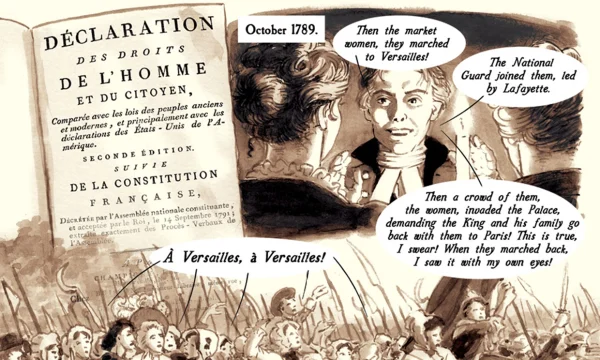
If you’re unfamiliar with Wollstonecraft or the period in which she lived, the book can be difficult to follow at times. There is a lot of historical context packed into the story, particularly around the French Revolution, and the graphic novel format leaves little room to explain who people are or what is happening politically. Having some knowledge of Wollstonecraft’s life and the period beforehand would help.
Print culture
The graphic novel format, though, feels appropriate for this story. Print was hugely important to the spread of political and revolutionary ideas in the late 18th century, and Wollstonecraft was writing in the middle of that world. With its period typography, illustrations and black watercolour artwork, Lo! An Amazon! has something of the feel of an old pamphlet, connecting it to the print culture of the time.
The book also brings home why Wollstonecraft’s ideas still resonate today. She was writing at a time when women had limited opportunities to control their own lives, access education or manage their finances, yet she sought to live independently, travelling, working and writing in ways that challenged the expectations placed on women.
“She was determined to live her life as she chose,” says Talbot. “She was extraordinary and groundbreaking.” Wollstonecraft was vilified during her lifetime and for generations afterwards, and as Talbot points out, although the position of women has improved in many parts of the world, “we are still far from equality”.
Lo! An Amazon! is at its most interesting when it places the ideas Wollstonecraft is now known for alongside her messy, complicated personal life. Rather than presenting Wollstonecraft as a distant feminist icon, it gives a sense of the friendships, arguments and ambitions that shaped her thinking.
For fans of Wollstonecraft, it offers an engaging depiction of her life and work, while its detailed recreation of 18th-century London and Paris gives plenty to look at.
Lo! An Amazon! The Interesting Narrative of the Life of Mary Wollstonecraft by Mary M. Talbot and Bryan Talbot
Hardback / 152pp / Colour / ISBN: 978-1-914224-49-2
Price: UK £17.99 / US $24.99 / CAN $34
UK publication date: 17 September 2026; US publication date: 3 November 2026