
Hackney tops London schools exclusions table as capital’s rate falls
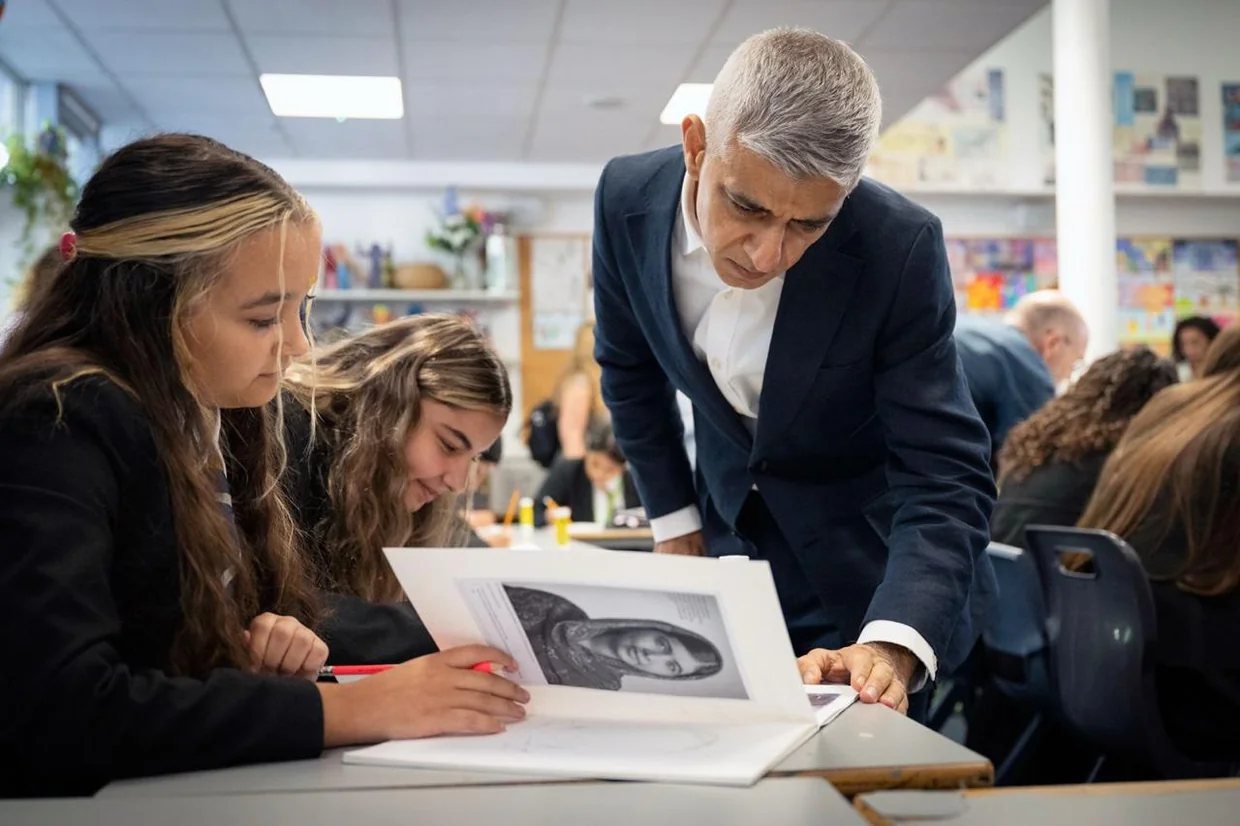
Hackney had the highest permanent exclusion rate of any London borough last year, as the mayor of London urged ministers to learn from a City Hall-backed charter credited with bringing exclusions down across the capital.
Department for Education figures show 50 permanent exclusions from schools in Hackney in 2024/25, a rate of 15.5 per 10,000 pupils. That is 2.7 times the London average of 5.7, the widest the gap has been in 19 years of records.
Hackney also topped the London table in 2023/24, at 15.8 per 10,000. Those two years are the borough’s highest readings since the series began in 2006/07.
Exclusions and suspensions by London borough
State-funded primary, secondary and special schools. Select a borough for its record back to 2006/07.
Measured from
Source: Department for Education, Suspensions and permanent exclusions in England, 2024/25, published 9 July 2026. Rates count exclusions at schools in each borough, not where pupils live. Figures for 2019/20 and 2020/21 are shaded on the chart because school closures make them unusable for comparison. Hackney Citizen
The rise runs against the trend across the city. Hackney recorded 33 permanent exclusions in 2022/23, the last full school year before London’s Inclusion Charter launched in February 2024. That climbed to 52 in 2023/24 and 50 in 2024/25, an increase of just over half, while the London-wide rate fell.
The number of pupils at Hackney schools dropped over the same two years, from 33,615 to 32,217, which on its own would push a rate up. But the number of exclusions rose far faster than the roll fell, so a shrinking pupil population does not explain the increase.
Secondary schools
All 50 of Hackney’s permanent exclusions last year came from its 16 secondary schools. None of the borough’s 54 primary schools or three special schools permanently excluded a pupil.
The secondary rate was 34.7 per 10,000. That was again the highest in London and well above the England secondary average of 22.6.
Neighbouring boroughs recorded far fewer exclusions. Islington had eight, Tower Hamlets nine and Haringey six. The next highest rate in London was Camden’s, at 13.8 per 10,000 from 28 exclusions.
Hackney and Camden are the only London boroughs with rates above the England average of 11.8. Nationally, however, Hackney ranks 45th of 153 local authorities, making it an outlier in London rather than in England.
The figures count exclusions from schools located in Hackney, not exclusions of Hackney residents.
Suspensions
Hackney’s suspension figures show a different pattern. The borough suspends a wider group of pupils, but suspends each of them fewer times.
In 2024/25, 4.89 in every 100 pupils received at least one suspension. That was the highest proportion in London and 23rd of 153 authorities in England, against a national figure of 3.89.
But each suspended pupil in Hackney was suspended 1.93 times on average, compared with 2.79 in England. The pattern can be read either as earlier intervention or as a lower threshold for suspending a pupil.
Hackney’s overall suspension rate of 9.46 per 100 pupils is the second highest in London, behind Islington, but below the England average of 10.88.
Long view
Hackney is not new to the top of the London table. It was second in the capital in 2017/18 and 2021/22, and third in 2010/11, 2011/12 and 2018/19. It has run above the London average in 14 of the past 15 years, the exception being 2020/21, when schools were closed.
What is new is reaching first place, holding it for two years running, and doing so while the rate across the city falls.
Inclusion Charter
The figures come as Sir Sadiq Khan calls on ministers to take lessons from London’s Inclusion Charter. City Hall credits the charter with reducing absenteeism, suspensions and exclusions across the capital’s schools.
The strategy was launched in 2024 and is backed by 30 London boroughs and dozens of charities. According to City Hall, London’s school suspension and permanent exclusion rates have fallen to half the national average. New data shows a 14 per cent reduction in the exclusion rate for the last academic year, a 7 per cent fall in suspensions and a 2 per cent drop in absenteeism.
However, London’s permanent exclusion rate was already roughly half of England’s in 2021/22 and 2022/23, before the Charter launched. The capital had dropped below the national rate around 2014/15. The Charter has therefore continued a decade-long divergence rather than started one.
Hackney is one of seven boroughs singled out by the mayor’s Violence Reduction Unit (VRU) for its Inclusive and Nurturing Schools work.
Boroughs that have seen a noticeable change include Sutton, where permanent exclusions have fallen by 63 per cent since 2023, and Wandsworth, where levels fell by a third. More than 730 schools, around a quarter of London’s institutions, have signed up to the Charter.
Belonging
The document sets out four “guiding principles” for helping students feel included: embedding diversity in the curriculum, giving students responsibility to shape school policy, offering a range of educational pathways to include all types of learners, and prioritising exposure to new places and points of view.
New research commissioned by the VRU and carried out by the University of Strathclyde found that pupils at ‘rights-respecting schools’ are more likely to feel that they belong and that they are safe.
Sir Sadiq said City Hall would be sharing the results with ministers in due course.
“This is a good example of a policy that’s been incredibly successful,” he told the Local Democracy Reporting Service (LDRS) during a visit to St Augustine’s CE High School in Kilburn, north-west London.
“The Inclusion Charter in London, used by nearly every borough, has led to fewer exclusions than the rest of the country, fewer suspensions than the rest of the country, and great progress made in terms of persistent absenteeism as well.
“That’s leading to schools being safer, better connected, better included, but also it’s leading to fewer young people getting sucked into criminal gangs.
“So we’ll be sharing with the Government the great results in London, because this is the way we can make sure that more and more children are kept in the safest place possible, which is school, which enables brilliant teachers to work with kids to have their potential fulfilled.”
Funding
City Hall is backing schools to put the Charter into practice with a £1.4 million investment in UNICEF UK’s Rights Respecting Schools Award. However, the funding will only remain available to state schools in London for the next two years.
VRU director Lib Peck said: “Keeping young people in school and safe is a critical part of the Violence Reduction Unit’s approach to driving down violence in London.
“The strength of London’s Inclusion Charter has always been genuine partnership and whilst we have seen reductions in exclusions, suspensions and persistent absenteeism, it’s clear there is more to do to ensure no child misses out on learning and becomes vulnerable to violence.
“The independent evaluation shows the true value of putting children’s rights front and centre. It changes how safe and connected they feel to school. Almost a quarter of London schools have now signed up and we have built incredible momentum, but we want to increase that number so that we work to ensure young people are safe and supported to thrive.”
The VRU was set up in 2019 and has carried out more than half a million targeted interventions and opportunities for young people. City Hall says this prevention-centred approach is working, pointing to ONS figures that show a 15 per cent drop in knife crime in the last 12 months.
Government guidance
The Department for Education did not respond to a request for comment. In July, officials published updated guidance on school exclusions, saying that “the Government recognises that school exclusions, managed moves and off-site direction are essential behaviour management tools for headteachers and can be used to establish high standards of behaviour in schools and maintain the safety of school communities”.
However, the guidance also encourages schools to “work to create environments where school exclusions are not necessary because pupil behaviour does not require it”.
As these secondary schools are mainly academies and not run by the local authority should this factor not be looked into? The governance of these schools also needs to be factored as again the local authority has limited influence in these schools. Ultimately it is the Dfe and the sec of state who sets the governance of these schools…. Possibly a reason why they didn’t want to comment…,.?????