
Council must keep tenants cool under new heat law
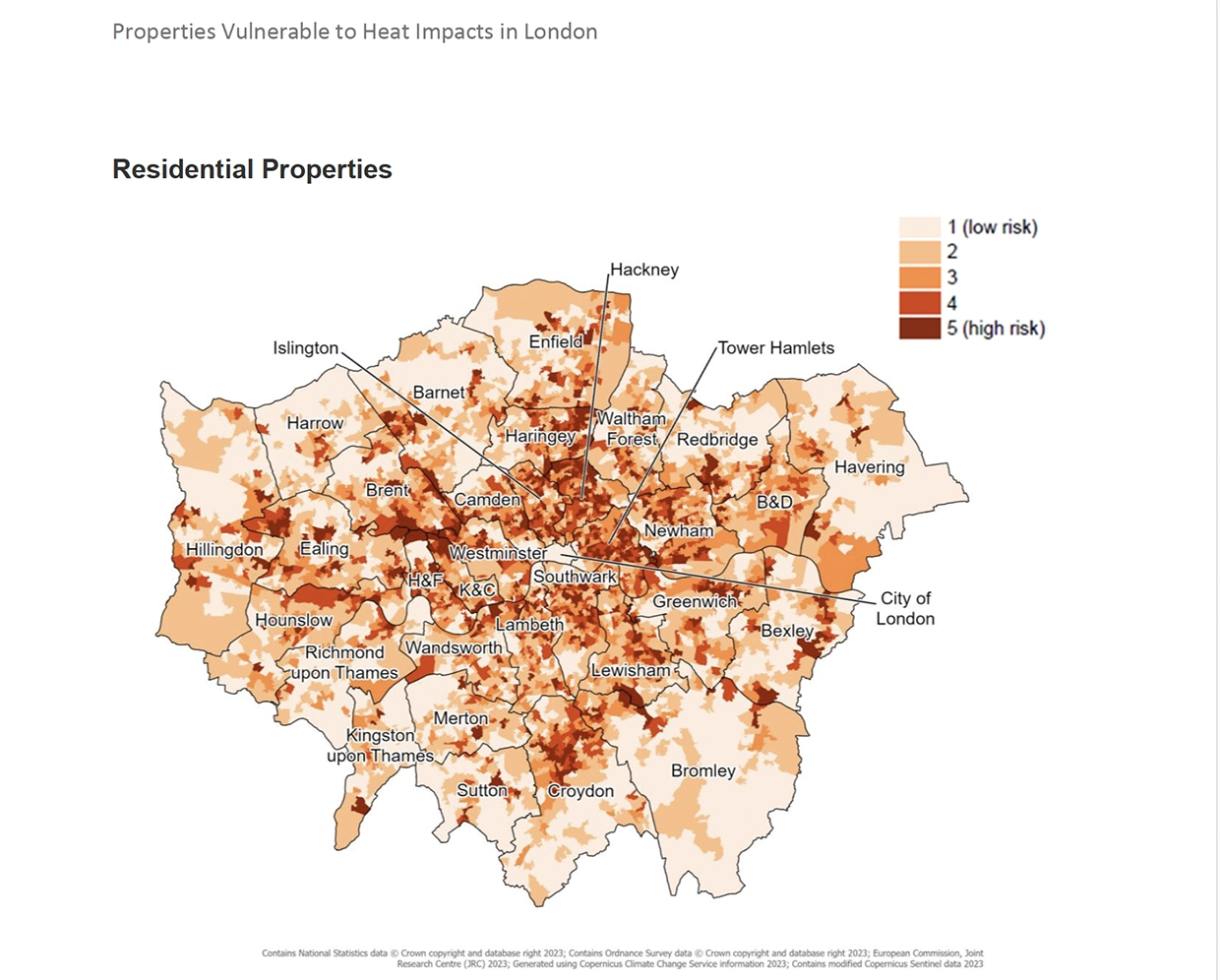
Hackney Council will be under a legal duty to keep its tenants’ homes cool by the end of this year, as City Hall publishes evidence that around a million London homes may already be at high risk of overheating.
The duty comes through Awaab’s Law, the housing legislation named after Awaab Ishak, the two-year-old who died in Rochdale in 2020 after prolonged exposure to mould in his family’s flat. Introduced in 2025, it obliges social landlords to investigate and fix damp and mould within fixed timeframes rather than at their own pace. The Heat Ready London plan confirms that later in 2026 it will be extended to cover excess heat.
Hackney is one of the larger council landlords in the country, with a stock weighted towards flats — including top-floor flats in Victorian conversions and post-war estates, the housing type most prone to overheating.
The confirmation sits inside evidence published yesterday by the mayor of London and London Councils, which warns that extreme heat and the wider effects of climate change could cause damage worth up to £36 billion a year to London’s economy by the 2050s unless the capital adapts.
Without further adaptation, the Heat Ready London technical report finds that damage could reach the equivalent of three per cent of the city’s economy — between £16 billion and £36 billion a year. City Hall stresses the figure is not a bill, and covers climate-related damage broadly rather than heat alone.
Overheating
The plan gives no detail on what the extended duty will require in practice. But it does call on the health and care system to feed learning from clinical work into “a system-wide, evidence-based approach to implementing Awaab’s Law, including individual risk factors for heat-harm” — an indication that liability may turn on who lives in a flat as much as on the flat itself.
That reflects how the report characterises heat risk in housing. The highest-risk homes are identified through a combination of exposure and vulnerability: building type, orientation and construction, but also the age, health, mobility and income of the people inside.
London also has “a high proportion of renters who have limited ability to adapt their home”.
Preliminary analysis suggests around a million London homes may currently be at high risk of overheating, alongside 1,361 schools, 60 hospitals and 351 care homes in high heat-risk areas — figures the report footnotes as needing further work to refine.
During the 2022 heatwave, 80 per cent of people reported discomfort in buildings.
Retrofitting London’s most heat-exposed homes would require upfront investment of between £9 billion and £45 billion, depending on the measures chosen. No funding stream on that scale currently exists.
Warnings
The report’s health findings undercut the assumption that heat is a red-alert problem. According to the report, most heat-related deaths occur outside periods of extreme temperature and impacts on vulnerable people can arise within 24 hours of temperatures rising.
Evidence suggests Londoners aged between 45 and 65 face a greater risk of premature death in hot weather than people of the same age nationally.
London sees an estimated 3,996 heat-related A&E attendances a year — around one and a half times the rate of other English regions.
UK-wide heat-related hospital attendances and admissions could triple by 2050.
There were more than 300 excess deaths from high temperatures in each of 2020, 2023 and 2025, and the 2022 heat contributed to an estimated 387 premature deaths in London.
In England in 2024, 38 per cent of heat-related mortality occurred in care homes, 36 per cent in hospitals and 27 per cent in people’s own homes — precentages that put council commissioning and the local NHS estate at the centre of the problem.
The conditions that raise risk are more wide-ranging than than age alone. The report names severe and common mental health conditions, neurological disorders, cardiovascular disease and diabetes, and proposes pilot care pathways for the first three.
Schools
Schools emerge as one of the plan’s greatest challenges. Of those surveyed under the Greater London Authority’s Climate Resilient Schools Programme, 78 per cent reported that overheating had significantly affected pupils’ learning, productivity or behaviour, or disrupted school activity. In 2022, one in four London schools closed during the heat.
Green space
On green space, the report makes a strong but wide-ranging economic case. London’s existing parks and green spaces are estimated to deliver more than £90 billion in benefits over 30 years against costs of £3.3 billion, and greening measures are given a benefit-cost ratio of between 5.6:1 and 27:1.
Retrofitting buildings including homes and care homes scores between 1.2:1 and 11.2: 1. Shade, water provision and cool spaces are all described as “not well evidenced, but expected to be above 1”.
Tree canopy
Hackney sits slightly below the London-wide tree canopy figure of 19.6 per cent, and analysis of GLA data published last year indicated the borough’s canopy fell by 4.6 per cent between 2016 and 2022, during a period of intensive development. The report says that access to green space “is not equal across the city”, and that trees themselves are now at risk from heat, drought and wildfire.
Implementation
The plan is being driven by a familiar figure. Mete Coban, deputy mayor of London for environment and energy, spent a decade as a councillor for Stoke Newington and ran Hackney’s climate, environment and transport portfolio, overseeing a £61 million programme and launching the borough’s Community Energy Fund before moving to City Hall in July 2024.
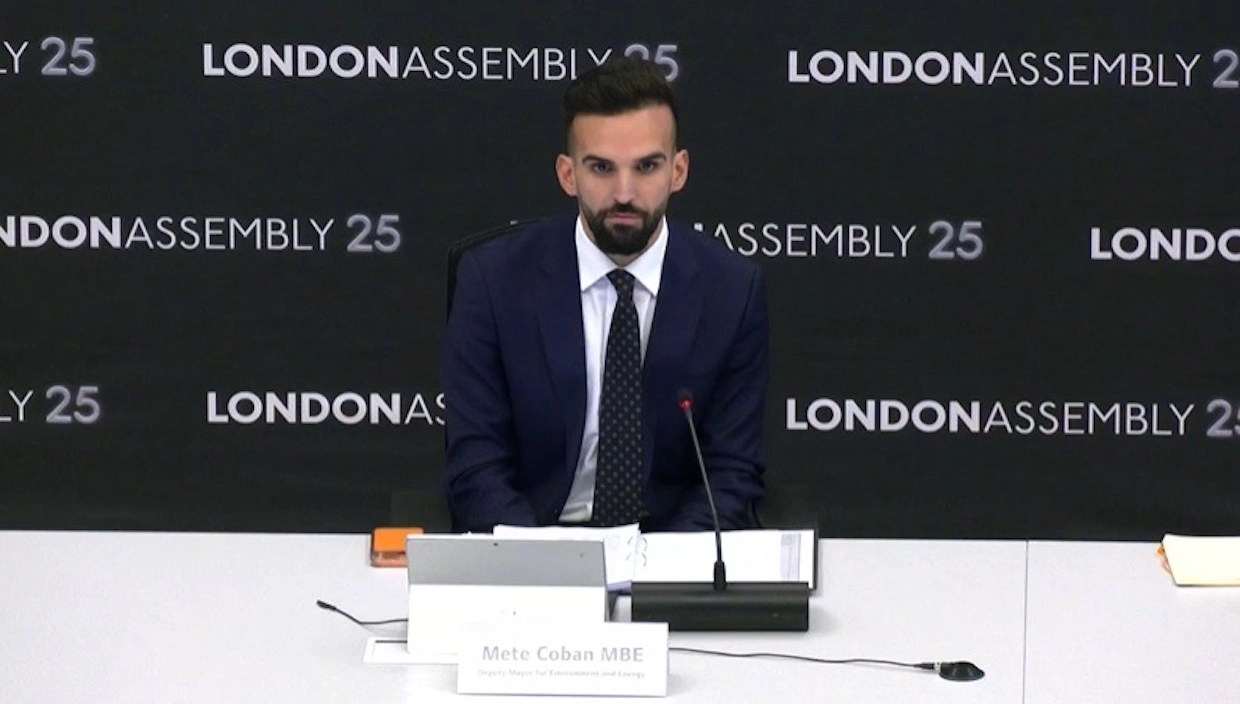
Coban said the technical report “gives us the evidence and clear priorities needed to accelerate action”, and that delivery “will require sustained investment and close collaboration across government, boroughs, businesses and communities”.
Much of the 37-point delivery list is borough work, and it lands on Mayor Zoë Garbett’s desk.
Boroughs are named as delivery partners on retrofit, non-residential retrofit, outdoor shading, drinking water points and public toilets, tree cover, cool spaces and habitat management for wildfire risk.
Each borough also runs a resilience forum within the London Resilience Partnership, which coordinates more than 170 organisations.
One route to money is already in council hands: the plan proposes guidance on using the Disabled Facilities Grant, which boroughs administer, for housing work to reduce indoor overheating.
Funding
The wider funding position is stark. According to the report, heat is an emerging hazard, “the gap between action required and finance available is large”, and adaptation is “largely a public benefit with low financial returns”, meaning public support “will remain critical”.
Professor Emma Howard Boyd, chair of the National Heat Risk Commission and former chair of the London Climate Resilience Review, said delivery at pace meant “giving mayors statutory climate-resilience duties and funding that matches their growing powers”.
She noted the £36 billion estimate is more than double the estimated £16 billion annual cost of reaching net zero across the whole UK.
The mayor of London, Sir Sadiq Khan, said: “The climate crisis is on our doorstep. It is already threatening Londoners’ lives, disrupting vital services and costing our economy hundreds of millions of pounds…
“We must create cooler homes and buildings, greener and shadier neighbourhoods, and infrastructure that can withstand a hotter climate.”
London broke temperature records in May, June and August this year and had entered its fifth official heatwave by mid-August. Last year the capital saw four official heatwaves and more than 120 wildfires, the highest rate since 2022.