
Hackney leads London on street cycle storage — but City Hall told private bike spaces in new flats sit mostly empty
Hackney has more secure on-street cycle storage than almost any other London borough, yet new research suggests the private bike spaces developers are required to build inside blocks of flats are sitting largely empty — prompting calls for City Hall to rethink the rules.
The borough is home to more than 1,000 cycle hangars — the small, lockable on-street compounds that each hold six bikes — putting it alongside Waltham Forest at the top of the capital’s league table, according to the London Cycling Campaign. Many other boroughs, the campaign says, have only a couple of dozen.
A 60,000-strong waiting list
Even so, demand for that kind of storage far outstrips supply. A study by Clean Cities found the waiting list for hangar spaces across London stood at 60,000 in 2023, with residents of flats — who rarely have anywhere to keep a bike at home — the worst affected.
That shortage sits awkwardly against new findings on the private cycle parking developers must install inside new buildings.
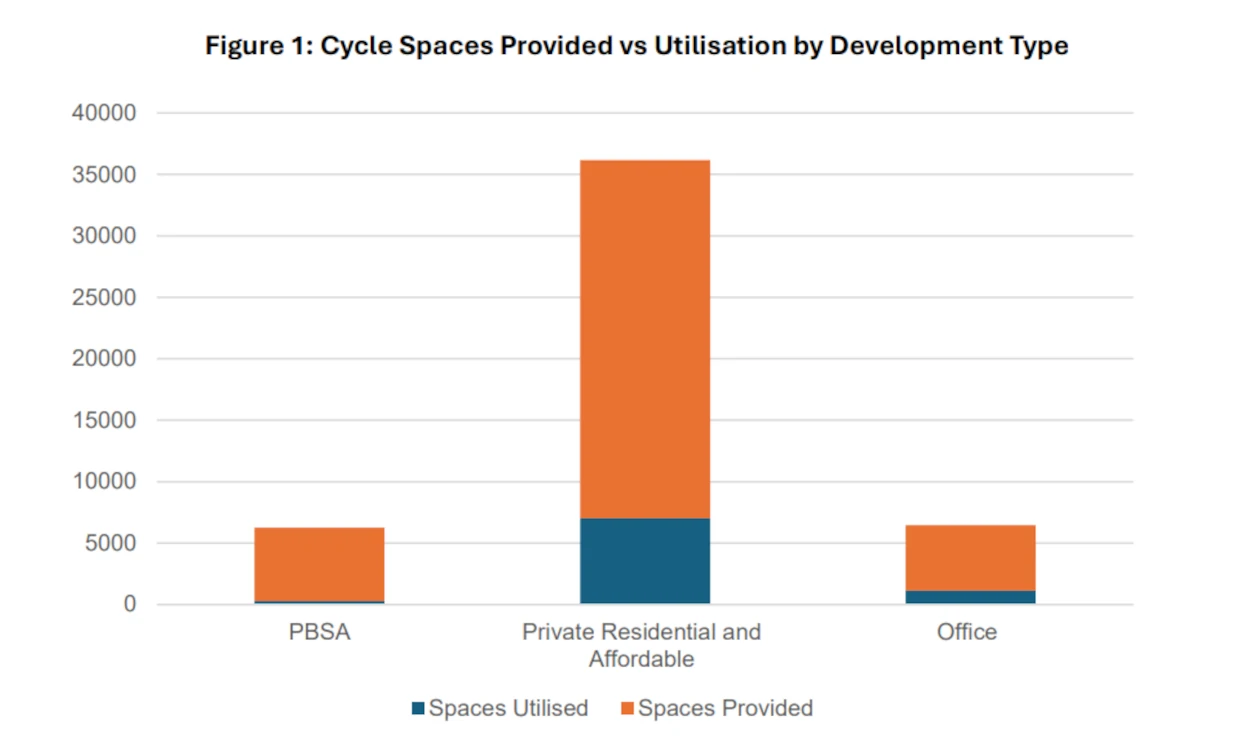
Research from BusinessLDN, seen by the Local Democracy Reporting Service, shows that just 24 per cent of almost 30,000 cycle spaces analysed across 40 developments around London were occupied.
In purpose-built student accommodation, occupancy averaged 4.6 per cent across 19 schemes; in City of London offices it was around a fifth.
‘Overprovision and underuse’
The advocacy group argues this points to systemic overprovision. “Even in high-density, car-free, or car-light schemes, demand for internal, private parking remains well below London Plan expectation,” its report concludes, adding that the pattern held “across boroughs, levels of public transport accessibility, and development types.”
Empty storage, it says, “takes up valuable space that could otherwise be used for homes, shops, or green space”, and is often built into carbon-intensive basements.
Under the current London Plan, adopted in 2021, developers must provide one cycle space per studio or one-bedroom flat, 1.5 spaces for a two-person flat and two for all larger homes.
Those requirements were loosened until 2028 under emergency housebuilding measures agreed last year between the London mayor and the government, intended both to improve scheme viability and to reflect the growth of bike hire.
Rules under review
With the first draft of the new London Plan due later this summer, BusinessLDN wants City Hall to go further, replacing the current standards with lower, evidence-based baselines and adding spaces only where demand justifies it.
City Hall appears receptive. A document released last year signalled that the GLA proposes to reduce residential cycle parking requirements, citing higher development densities and the rise of dockless hire, with “additional flexibility” in how storage is provided “to avoid costly requirements.”
Most cyclists still ride their own bikes
But cycling groups caution against reading empty basements as low demand. Transport for London figures show that in 2025 only 10 per cent of cyclists used shared bikes, meaning the overwhelming majority of the capital’s cyclists — part of some 1.5 million daily journeys — ride their own.
The London Cycling Campaign told the LDRS the lack of secure storage remains “a major barrier to cycling growth, with people who live in flats most affected”, and called for the waiting list to be cut to zero.
A spokesperson for the London mayor said the new London Plan was reviewing all policy areas “to ensure they reflect how Londoners live and travel today”, including updated cycle parking standards accounting for e-scooters, dockless hire and the expanded Santander Cycles network, alongside “the challenging issues currently facing development.”
I live in a new build (8 years old) flat in Hackney that has a cycle storage room as per London Plan. I have lived here for 6 years, and the demand for cycle storage has always vastly outstripped the allocation of storage provided. I could believe that a number of people don’t actually use their bike, but that is a different thing all together. The plans “2 (cycle spaces) for larger homes” has no consideration of children, which means there is no cycle storage for children.
Does the editor have the link to that research?