
The long road to the landslide: how Hackney turned Green
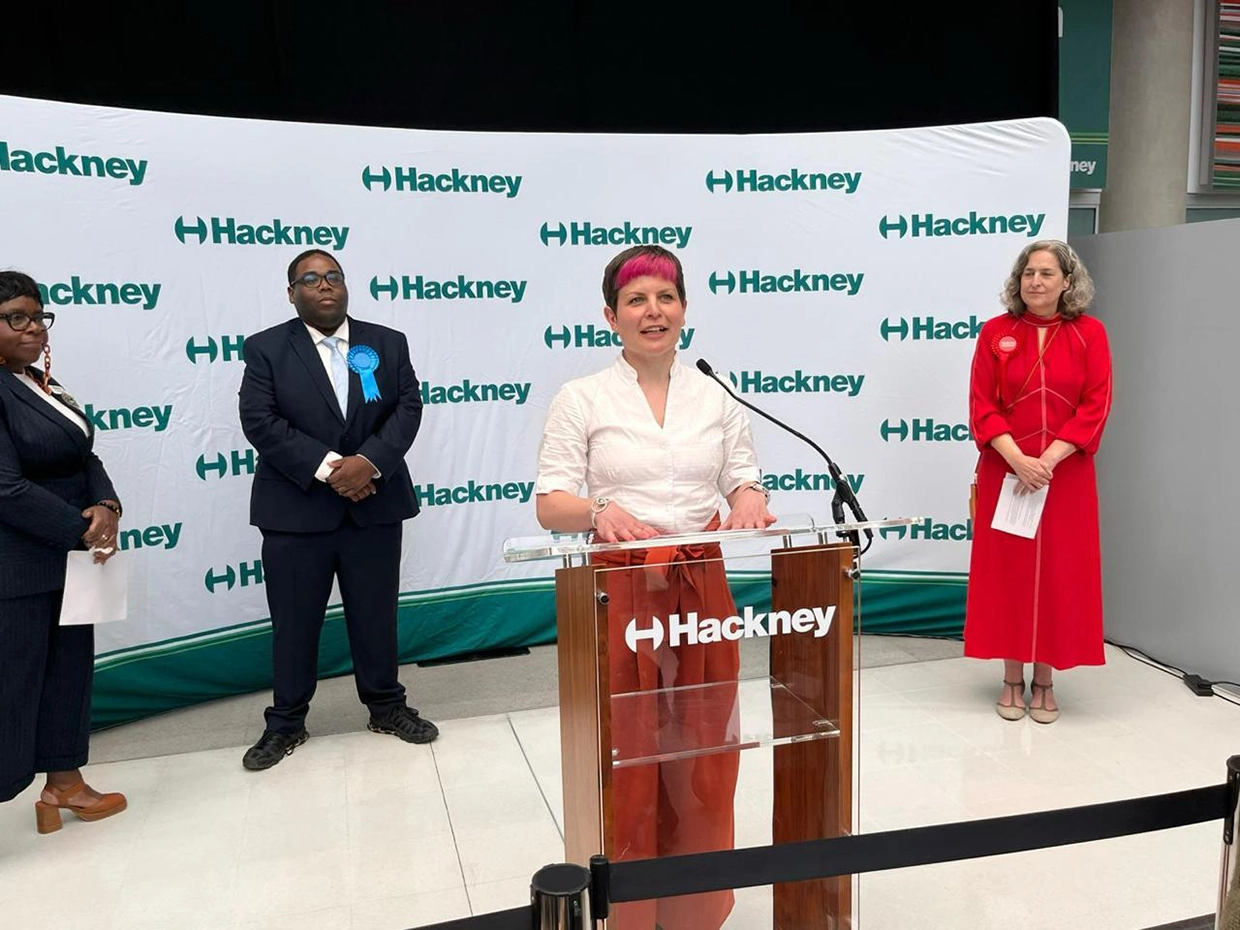
On 7 May 2026 the Green Party won 42 of the 57 seats on Hackney Council and, with Zoë Garbett’s victory in the parallel mayoral contest, took control of a borough that Labour had governed almost without interruption since its creation in 1965.
Labour, which had held 50 seats after the 2022 election, was reduced to nine. The Conservatives, insulated in the northern wards of Stamford Hill, held six. It was, by any measure, a rout. But it was not a bolt from the blue.
The landslide was the sudden crystallisation of pressures that had been building for the better part of a decade — some peculiar to Hackney, some the reverberation of a national realignment.
The baseline was never as solid as the seat count suggested
The headline arithmetic of Hackney under Labour flattered the party. Under the borough’s multi-member first-past-the-post system, a relative majority of the vote in a ward delivers all its seats, so a party can convert a narrow lead into total local dominance.
The disproportion in 2022 was stark: Labour took 50 of the 57 seats on 53.4 per cent of the vote, while the Greens won just two seats on 23 per cent — a quarter of the vote converted into a twenty-fifth of the chamber.
The ceiling on Green representation was structural, not a measure of weak support; the party had been runners-up across a swathe of central wards for years, narrowly beaten in the very seats it would later dominate, and winning almost nothing despite a substantial borough-wide share.
Seats won at each all-out election, 2006 to 2026 · 57 seats · 29 for a majority
When the underlying vote finally tipped past the plurality threshold in enough wards, the same electoral system that had entrenched Labour handed the Greens an even larger majority in one move.
The 2026 result looks like a discontinuity in seats; in votes it was closer to the continuation of a trend – a trend amplified out of all proportion by the voting system.
Dalston and Hackney Downs: the foothold
The two Green councillors elected in 2022 mattered out of proportion to their number.
The Greens had first won seats in Hackney back in 1998, and had again gained a foothold on the council in 2006 — but 2022 was the first time in a generation the party returned councillors with the makings of a durable base in the borough’s central wards.
Zoë Garbett in Dalston and Alastair Binnie-Lubbock in Hackney Downs gave the party something it had lacked — incumbents, a record of casework, and a visible presence in the council chamber from which to hold the Labour administration to account.
Both wards were exactly the sort of central, younger, renter-heavy, graduate-inflected territory where Green support was concentrated, and both became anchors from which the party could expand outward.
Binnie-Lubbock held Hackney Downs in 2026 with a thumping personal vote; Garbett’s Dalston base became the platform for a mayoral campaign.
Hackney Council · 7 May 2026
A borough turns Green
The Green Party swept 42 of Hackney’s 57 council seats, ending Labour’s control of the town hall. Eleven wards returned a full slate of Green councillors; the Conservatives held their two northern strongholds.
Eight wards returned councillors from more than one party, shown here in diagonal stripes in each party’s colours, with the wider band marking the party that took more seats. Seven pair Labour with the Greens; Cazenove pairs Green with the Conservatives — see the striped keys below. Hover over any ward for its full result.
Source: London Borough of Hackney official ward results (hackney.gov.uk). Boundaries: London ward boundaries 2014 (GLA/ONS), © Crown copyright and database right. Solid fill = all seats to one party; stripes = seats split between parties, each band in that party’s colour and sized to its share of the ward’s seats.
The by-election effect, 2024–2025
Between the two borough-wide elections, Hackney Labour suffered a slow haemorrhage that told the story in miniature.
In September 2024 the Greens gained Stoke Newington in a by-election on a swing of more than 19 points away from Labour — a striking result in a ward where Labour had taken all three seats two years earlier — taking their group to three, the party’s best standing in Hackney since 1998.
Around the same time, three Labour councillors broke away to form an independent socialist grouping, and further defections followed.
These contests were also notable for an emerging tactical understanding between the Greens and the ex-Labour left, both mobilising against the party they had left or opposed.
The cumulative effect was to normalise the idea, ward by ward, that Labour could be beaten in Hackney — and to give the Greens the organisational muscle and local credibility to do it at scale.
Labour’s local baggage
Incumbency in Hackney came with baggage. The mayoralty had been destabilised in 2023 when Philip Glanville resigned. Discontent over low-traffic neighbourhoods had already produced independent challenges in 2022.
A long-governing party accumulates the resentments of everyone it has ever said no to and after decades of one-party control those resentments had nowhere to go but to a credible alternative. The Greens, unencumbered by a record in office, could absorb all of it.
How much of this actually moved Hackney voters, though, is a question the available evidence cannot determine.
The national pattern was that Labour’s defectors broke overwhelmingly to the Greens and did so largely on grounds of values and national politics — but a national aggregate cannot be read down to a single borough.
It cannot be assumed that what drove the average Labour-to-Green switcher across Britain is what drove the switch in Dalston or Hackney Central.
Whilst several defeated Labour councillors were, by local accounts, diligent members, they were swept out in a wider reckoning as the national tide turned in the Greens’ favour at the same moment.
The national mood turned against Labour
None of the local dynamics would have produced a landslide without the collapse of Labour’s national standing.
The 2026 locals were the first serious test of Keir Starmer’s government, and the verdict was brutal: Labour lost control of dozens of councils and shed close to 1,500 seats nationally.
The distinctive feature in urban Britain was the direction of the leakage. Where Reform UK took Labour’s flank in the suburbs and post-industrial towns, in inner London it was the Greens who benefited.
Nationally, the pattern was that Labour’s departing voters broke far more heavily to the Greens than to Reform — the party leaked to its left, not its right, and did so most where Labour fell back hardest.
Under Zack Polanski’s leadership the Greens had broadened their pitch well beyond the environment, positioning themselves as the home for progressive voters who felt Starmer’s Labour had drifted rightward and equivocated on issues — Gaza prominent among them — that carry particular charge in a borough like Hackney.
Labour defectors had, in effect, stopped regarding a Green vote as wasted.
That backdrop is national, and explains the direction of Labour’s decline rather than the mechanics of any one ward; but it set the terms on which Hackney’s local contest was fought.
Across the country the Greens’ strong showing in votes translated into comparatively modest gains in seats, and Labour’s losses, though heavy, left it bruised rather than destroyed while the Conservatives even recovered a little ground.
The BBC’s Projected National Share captured the picture: Reform on 26 per cent, then the Greens, Labour and the Conservatives bunched at 18, 17 and 17, with the Liberal Democrats on 16 — five parties packed into ten points, and no one commanding much more than a quarter of the vote.
(Sky’s rival National Equivalent Vote, built on a different baseline, was less flattering to the Greens, placing them fifth on 14 per cent — a reminder that even the “national picture” depends on which projection one trusts.)
John Curtice read it less as an embrace of any party than as confirmation of fragmentation — an anti-incumbent scattering in which no party held the backing of a substantial section of the public.
Hackney, in other words, was the high-water mark of a tide that ran far more weakly elsewhere. It was not a template but an outlier, the place where every favourable condition happened to coincide.
Hackney as archetype
Hackney was not alone, but its company was strikingly specific.
The Greens’ outright council takeovers on the night came in just three London boroughs — Hackney, Lewisham and Waltham Forest, where the party gained 32 seats and Labour shed the same number.
All three are London boroughs of a particular type: young, densely rented, rapidly gentrifying, ethnically mixed and heavily graduate — the demographic terrain on which the Greens’ pitch lands hardest.
Elsewhere in the capital, even where Labour bled badly, the losses more often scattered into no overall control or were held off, as in neighbouring Islington.
The pattern suggests the Green surge did not wash uniformly across London so much as break through where a specific social composition had already primed the ground.
Hackney was the fullest expression of that: the borough where the favourable electoral system, the established Green foothold, the rehearsal of the by-elections, Labour’s local troubles and the national tide all pulled the same way at once.
The 2026 landslide was the moment they converged.
The word “landslide” nonetheless describes the seats more precisely than the votes. Garbett won the mayoralty with about 35,000 first-preference votes — some 47 per cent of those cast — with Labour still polling around 35 per cent.
Three-quarters of the council chamber rests on a plurality of under half the votes: not a criticism of the Greens, who played the system on offer and won it decisively, but a reminder that the multi-member method which flattered Labour for a generation has now flattered its successor. What the result cannot be dismissed as, however, is a product of apathy.
Turnout rose markedly against Hackney’s own recent baseline — most wards came in well above the 34 per cent borough figure of 2022, clustering in the low-to-mid 40s and reaching 48 per cent in Stoke Newington.
The vote had been moving in the ~Greens’ favour for the better part of ten years; in 2026 it crossed the threshold in enough wards, and the voting system did the rest.
The task now inverts. The Greens inherit the housing repairs backlog, the parks, the parking disputes and the union negotiations that eroded Labour — and the same electoral mathematics that delivered them 42 seats will, in time, measure whether governing suits them as well as opposition did.
A majority this large is a mandate and a hostage at once: it leaves nowhere to hide, and the next swing of the same amplifying system could prove every bit as unforgiving as the last.
The analysis puts the issue in terms of parties competing against each other while practically ignoring the real political issues. Gaza is mentioned once. So many people are disgusted with the Labour Party support for the genocide and refusal to countenance divestment and detwinning.
Perhaps the local idiot Dave Owen should visit Europe where 90% of Jews were killed during the Nazi Holicaust.
in Gaza the population has INCREASED since the 7th October Genocide of JEWS.
SORRY Jew hating John but killing terrorists is no genocide it is called making the world a safer place.
Woke lefties like you could not care less abiut the Gazans who are rules by terrorists who would have no qualms in throwing him off a roof top after raping his daughter.
If dozy John really cared he would support the elimination of Hamas and support the Israeli Government
The Greens made a lot of promises they won’t deliver. From divestment of £30m from “companies directly involved in Israel’s genocide”, to 50% social housing on the TESCOs site…..And it is now they, by their logic, who support genocide..
The Greens won in Hackney locally in 2026 in much the same way that the Labour together party won in 2024 nationally. A collapse of the incumbents due to long term misguided governance.
For many years Hackney was looked at as a safe place for career politicians to do a short stint as a councillor and go onto the gift of another safe seat in another constituency that they hadn’t come from. The borough has two MPs which doesn’t leave any room for new ones.
How many of any of the current or potential council candidates grew up in the borough and have lived experience of the changes? I’ll give the Greens the benefit of doubt but they better get on with the job rather than playing opposition. Priority for me is sorting the traffic and getting public transport moving like it used too alongside actually building decent housing and public realm. Not some pony parklets and rain gardens.
The Green party was elected for two reasons, because of their condemnation of Israeli war crimes and because they promised to be truly accountable to the people who elected them. The first was easy because the whole world condemns the mass murder of defenceless women and children the second they have already started to row back from. I urge the people of Hackney to punish them at the next election if they refuse to answer questions about their policies in the same way they punished the previous administration for its bad faith.
Absolute rubbish.
Greens won because Keir Starmer is a very poor communicator and has poor advisors.
That is why reform and the Greens won because they are a protest vote.
Perhaps mixed up Anthony John should read up the history of Gaza and learn who actually kills after raping women and children. Or is he also on the Iranian payroll?
Gaza had full autonomy prior to Hamas taking over.
The average person in Hackney will care more about where they can get a roof over their and where their next meal is coming from rather than meddling into Middle East issues championed by champagne drinking, caviar gorging socialites.
if Labour is to regain power they need to be in touch with the electorate,this is what Tony Blair did before his disastrous foray in Iraq
God forbid Labour ever gets back in with a champion like you.