
City Hall urged to back Vienna-style Repair Voucher Schemes
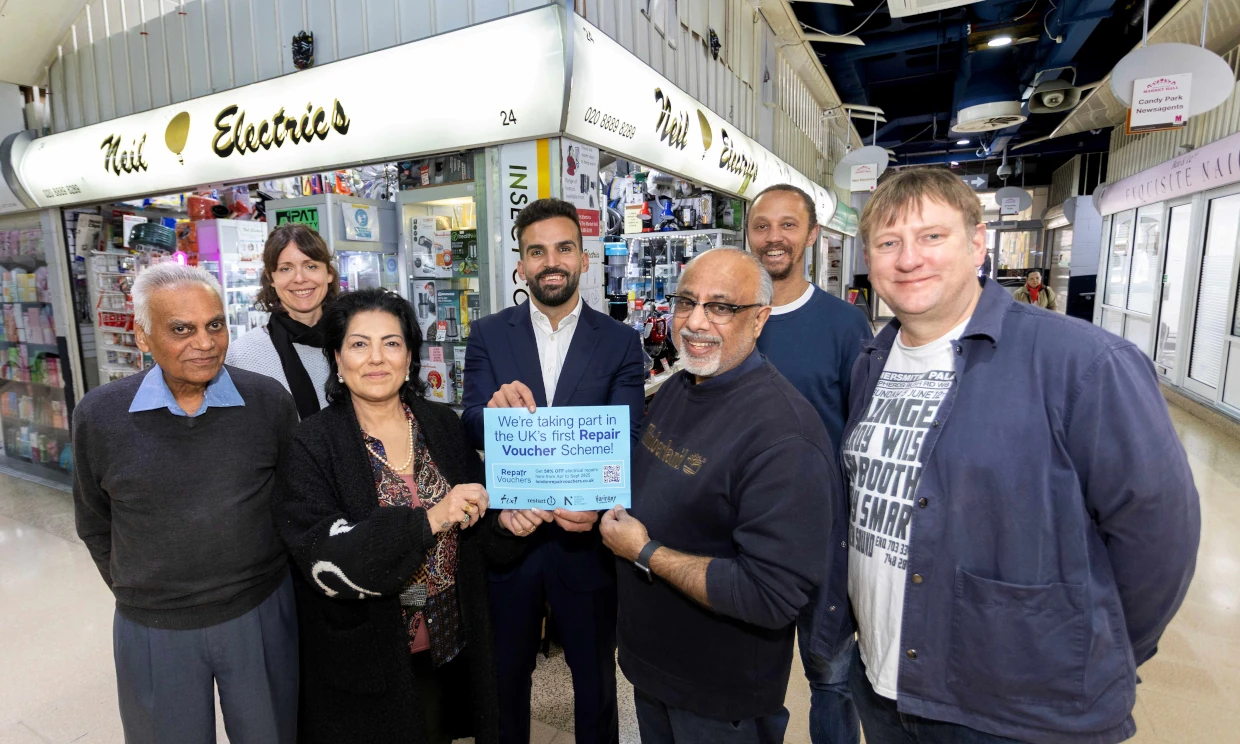
Repair Voucher Launch at Neil Electrics, Wood Green. Photograph: NLWA
Campaigners are calling on City Hall to launch a London-wide Repair Voucher Scheme to help residents fix broken electronics instead of binning them.
The Mayor of London should be the face of a city-wide rollout of a scheme to encourage people to use repair shops to cut electrical waste, a campaigner has said.
Fiona Dear, co-director of The Restart Project, said a City Hall-backed Repair Voucher Scheme across the whole of London should be started following successful borough-wide trials across North London.
Residents across Haringey, Hackney, Islington, Barnet, Camden, Enfield, and Waltham Forest were given 50 per cent off the cost of an electrical repair at the point of sale, with repair businesses reclaiming the difference from the authoriser of the scheme.
Across the year-long experiment, 1,200 vouchers were issued, with funding from the North London Waste Authority’s Community Fund allowing The Restart Project and ReLondon – which is chaired by deputy mayor for the environment Mete Coban – to administer the scheme.
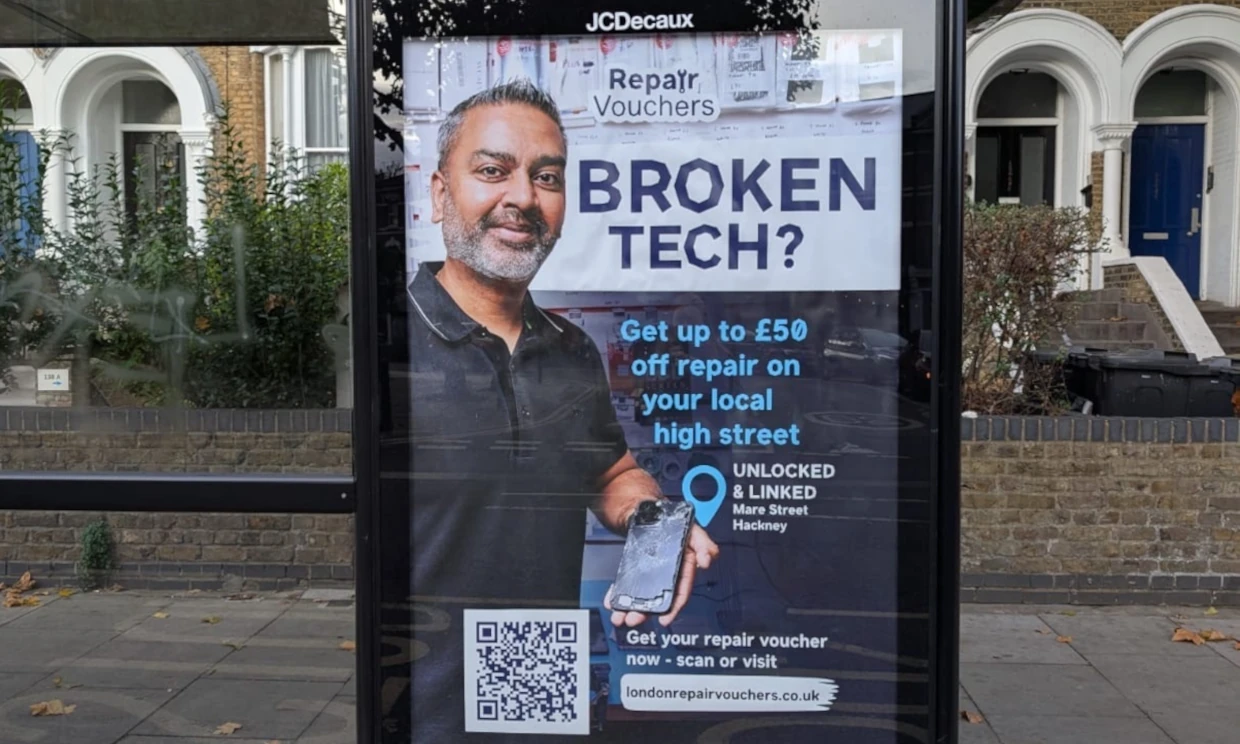
Repair Vouchers posters have been featured on bus shelters across North London
Dear is now calling on the Greater London Authority (GLA) to build on the momentum from the trial and back a Repair Voucher Scheme across all parts of the capital.
She pointed to Vienna, in Austria, as a recent success story. There, city authorities subsidise repair costs by up to 50 per cent, up to a maximum of €100.
“What we found was that the North London [project] was very popular with good public pickup but it did require ongoing promotion,” she told the Local Democracy Reporting Service (LDRS).
“If you look at Vienna, Austria, where it was led and administered by the city of Vienna itself, they did huge promotion and publication – it shows the potential that if it is owned by a central authority, you can really get the word out there.
“We’re working on a North London Repair Voucher Scheme but we want the GLA to be at the centre of a London-wide scheme. We need them to get behind it, promote it. We haven’t had any official follow up from the GLA following the meeting.
“It’s an open invitation – this is a great scheme, tested for the first time in the UK in North London, so we want the GLA to work with us to make this a London-wide scheme.”
The GLA has said it supports a circular economy – where products and materials are kept in use through repair, reuse, refurbishment, and recycling.
Deputy mayor for the environment Mete Coban chairs ReLondon, a partnership of the Mayor of London and London’s boroughs to improve waste and resource management in the capital.
The former Hackney councillor has previously backed Repair Week, where Brits are given the chance to pick up new repair skills, saying it “highlights an important message around sustainability and shows how much money we can save if we take a little time to fix a repairable item instead of just binning it”.
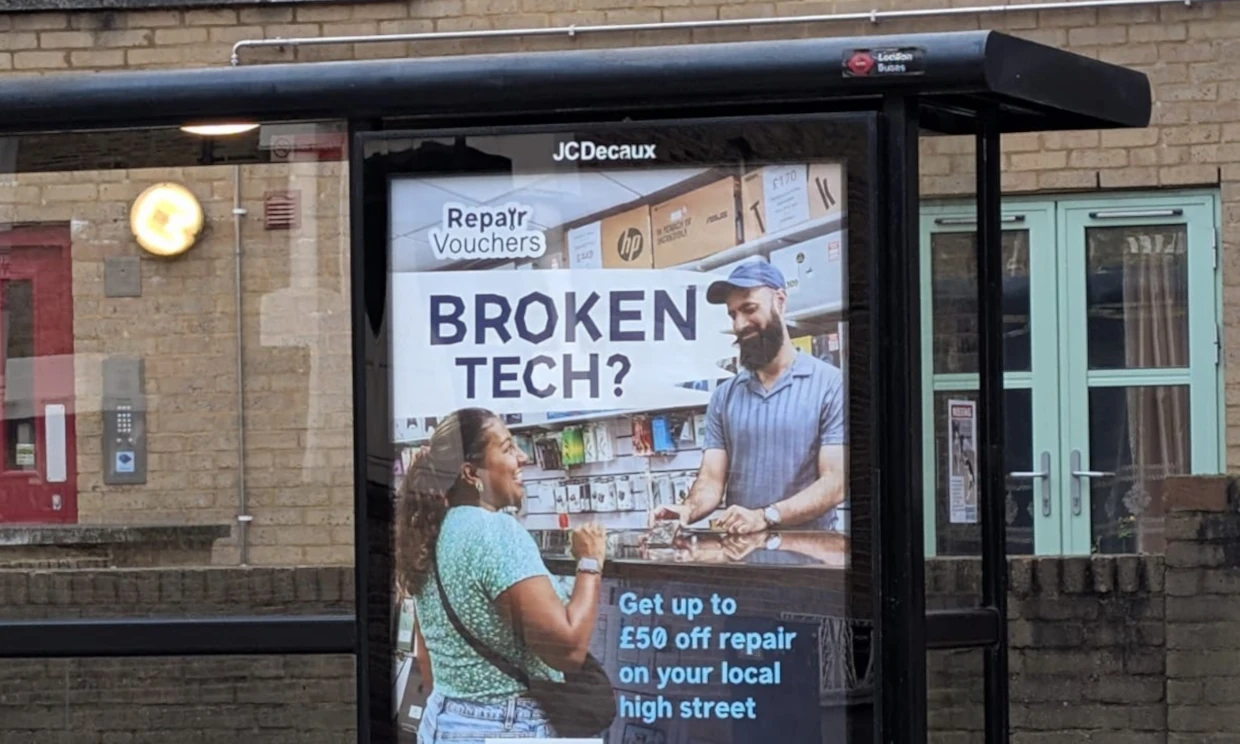
Fiona Dear is calling for the posters to be featured across the whole of London
However, the Mayor’s office say they will not comment on supporting future repair schemes during the current pre-election period. Campaigners say the scheme is a no-brainer which should be implemented as soon as possible, however, especially with Londoners and high street businesses struggling.
Dear said: “The main barrier to people getting things repaired is the cost – people usually won’t spend more than 25 per cent of the cost of buying new on a repair, which rules out a lot of products.
“There’s a lot of interest in fixing things like lamps and hoovers, and high value products. This makes a difference between people getting things repaired and buying things new. This will also stop them buying cheaper items which don’t last very long.
“It supports local repair businesses that have often been in boroughs for decades, it helps make people aware of them.
“For every product kept in use through repair, that’s one that’s not being thrown away and a new one not being purchased. We found a third of all products being thrown away weren’t broken, another 10 per cent very easily repaired. We need to do all we can to make it easier for people to repair.”
However, she admitted funding could prove the ultimate barrier. Vienna’s scheme is partly funded by federal funds coming from the European Union’s Recovery and Resilience Facility (RRF), of which the UK is no longer part.
But Dear suggested that the GLA looks to the French model instead, where the scheme is funded by contributions from manufacturers based on their market share.
“At the moment, all of that goes towards recycling, which is very inefficient for electrical items,” she said. “That fund should go towards initiatives like Repair Voucher Schemes.
“We worry that if the GLA and local authorities don’t invest in local repair businesses, we just won’t have any in 10 years, apart from for phones and laptops. There’s not many new firms coming online. Beyond Repair Voucher Schemes, there needs to be a strategy to support these businesses so they continue to exist.”