
Police ‘fail to protect’ women and girls from ‘unacceptable’ hate crime levels on TfL
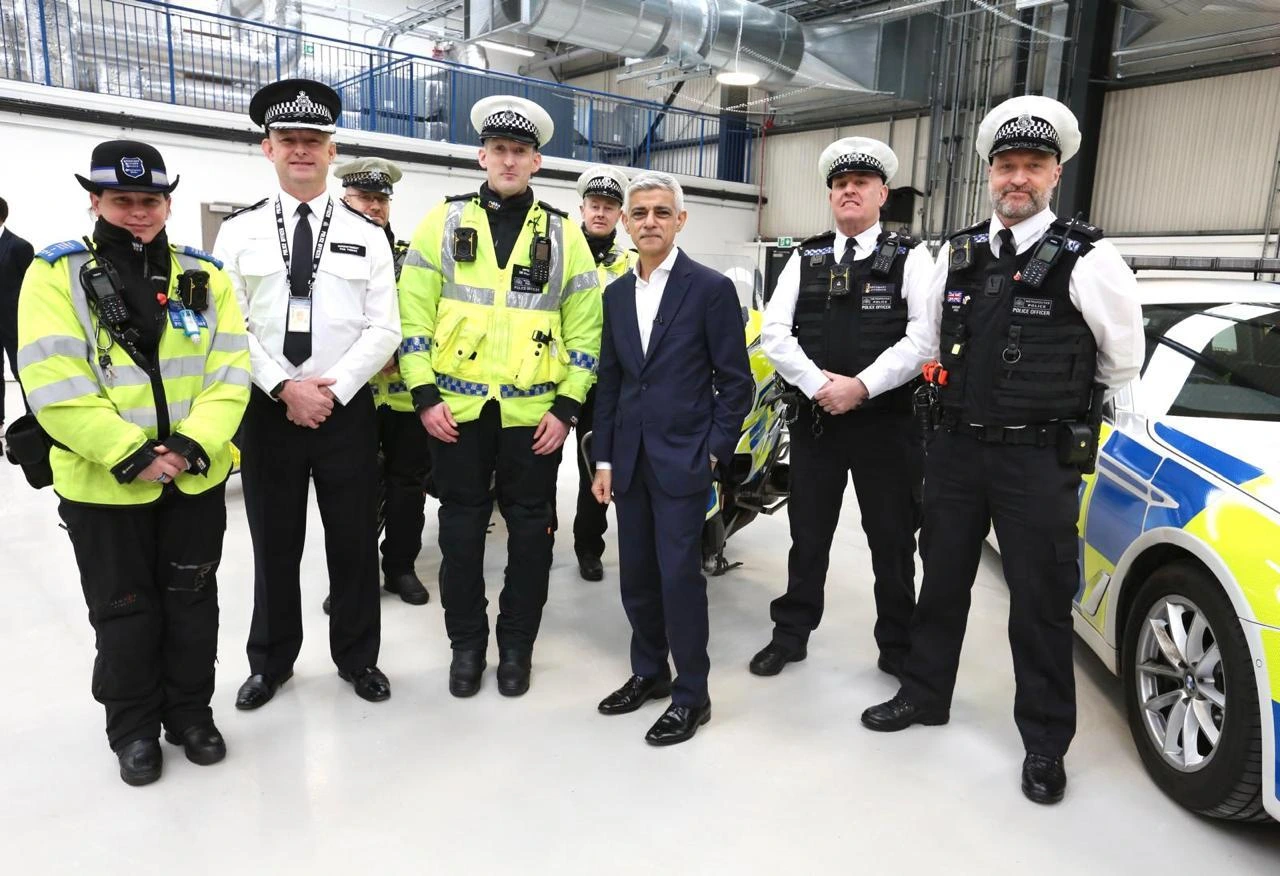
Sadiq Khan poses with Met Police officers. Photograph: James O’Jenkins/City Hall
Police are failing to effectively deal with “unacceptable” levels of hate crimes and violence against women and girls (VAWG) on public transport in London, a new report has claimed.
In 2025, there were 24,192 offences of all types recorded across TfL services compared with a pre-pandemic average of 16,544 offences – a 46 per cent increase, according to the British Transport Police (BTP). Among these were 4,593 VAWG offences yet only around 3 per cent resulted in a charge or summons, while around 58 per cent of cases identified no suspect.
In the same year, 1,724 hate crime offences were recorded, but only around 2 per cent resulted in a charge or summons with 66 per cent identifying no suspect.
With many offenders failing to be dealt with, there’s a heightening the sense of risk for many Londoners – especially women and girls, ethnic minorities, disabled people and those from the LGBTQ+ community.
In a new report, the London Assembly Police and Crime Committee argue that the BTP and Met Police have failed to understand the “true scale and nature of hate crime and VAWG on public transport”, while victims no longer have the confidence to report incidents nor receive adequate support after doing so.
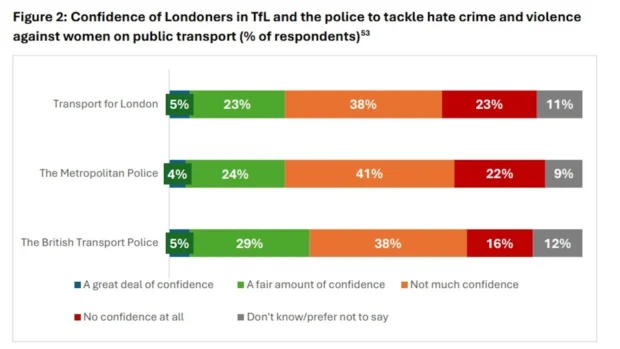
Image: London Assembly
This has led to a situation where, despite hate crimes and VAWG incidents trending upwards, there is still a fear that such occurrences on public transport are being “unreported”.
TfL data shows 1,667 hate crime offences were recorded between July and December 2025, a 9.8 per cent increase on the same period the previous year, while over 1,800 sexual offences were recorded in 2025.
Marina Ahmad AM, chair of the London Assembly Police and Crime Committee, said: “Millions of people use London’s transport network every day, and what should be a straightforward journey, can turn into a traumatic experience for so many.
“Many Londoners, in particular women and girls, disabled people, members of faith communities, and LGBTQ+ Londoners, face unacceptable levels of hate crime and harassment on the network.
“We heard throughout our investigation that many crimes like this will go unreported, for various reasons, including a lack of trust in any outcome, the trauma of the incident taking place, and slow response times”.
The report reads: “This rise [in incidents] is contributing to a growing sense of concern about how safe people feel when travelling across the network.
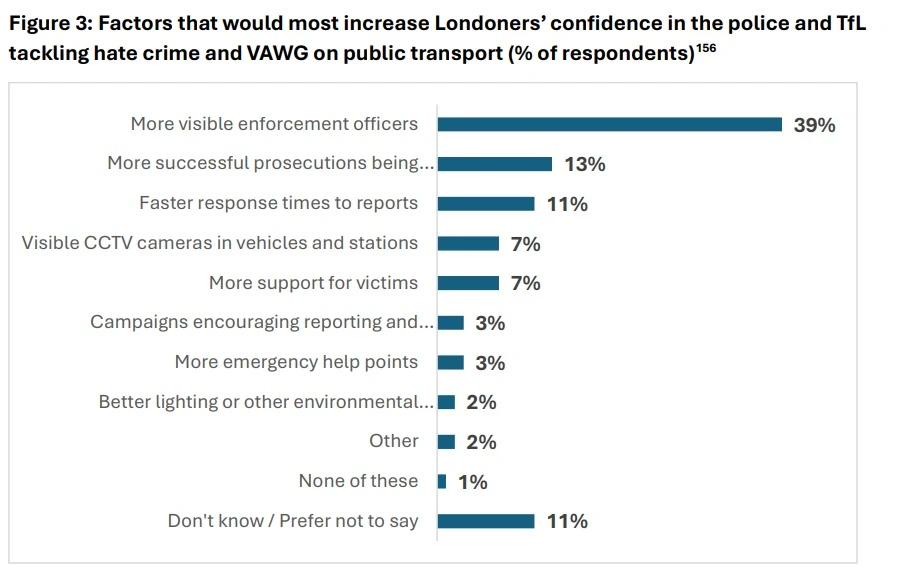
Image: London Assembly
“Within this broader picture of crime on public transport, the committee identified hate crime and VAWG offences as areas of particular concern. These figures are likely to understate the true scale of harm, as many incidents go unreported”.
Fear of such incidents has prompted a reduction in certain groups choosing to travel on public transport, instead having to spend up to £900 annually on taxis. Tricia Hayes from London TravelWatch told the committee that its research found “70 per cent of people were choosing not to travel, or not to travel at particular times of day, because they were worried about their personal security”.
There is an acknowledgement of TfL’s efforts to crack down on the issue, including the ‘Act Like a Friend’ bystander campaign and a “revamped online reporting tool”, but the report suggests a nationwide increase in hate crime means a more effective system is needed.
There was also optimism about the Mayor’s Transport Hate Crime and VAWG Taskforce, launched last October – though the report stressed the importance that it “brings together prevention, reporting, data, design and enforcement within a coherent and accountable framework”, including monitoring progress through target figures.
To tackle the issue, the cross-party committee recommended the creation of a “dedicated rapid response taskforce” comprising of Transport for London (TfL), British Transport Police and the Met, so that any reports of hate crime and VAWG are responded to “within a reasonable, published timeframe”.
Assembly Members also called for more comprehensive data collection and analysis, including commissioning and publishing an annual, London-wide survey capturing the “lived experiences of passengers”, as well as specialist training for frontline TfL staff and bus drivers to combat hate crimes and VAWG while incidents are ongoing.
A spokesperson for the Mayor of London told the Local Democracy Reporting Service (LDRS): “Nothing is more important to the Mayor than keeping Londoners safe, and he is clear that no one should have to feel scared or vulnerable on public transport or anywhere in the capital.
“Sadiq has invested over £277million to tackle the epidemic of violence against women and girls in all its forms, and dedicated a record £16million – more than any other Mayor – to tackle hate crime and intolerance in all its guises.
“But there is more work to do and the Mayor will be stepping up collective action with TfL, Met Police and other partners to ensure our transport network is inclusive, safe and welcoming as we continue building a safer, fairer, better London for everyone”.
Siwan Hayward, TfL’s director of security, policing and enforcement, added: “The safety of everyone using the transport network is an absolute priority for us, and we are committed to tackling all forms of hate crime and violence against women and girls.
“We have a strong police and enforcement presence on our services and in our stations to prevent crime and are determined to continue working together to make the transport network a hostile place for offenders.
“This includes targeted police and enforcement operations, our work to help customers feel more empowered to report offences, as well as our powerful campaigns to encourage people to be active bystanders. We welcome the committee’s report and will be responding to the recommendations in due course”.
Commander Clair Kelland, public protection lead for the Met, said: “We are already delivering major improvements across several of the areas identified in this report – from rolling out bespoke VAWG training to more than 23,000 officers and staff, to strengthening victim support through specialist services.
“Alongside this, our publicly accessible online VAWG Dashboard consolidates a decade of crime data at borough-level, driving greater transparency and scrutiny.
“As this report highlights there is more to be done to make women feel safer on transport in London, which is why we will continue to work closely with TfL, BTP and local partners, recognising that lasting safety on the capital’s transport network requires a coordinated, city-wide response”.
A spokesperson for the BTP said: “No one should feel unsafe on the transport network, and tackling hate crime and violence against women and girls (VAWG) remains our top priority at BTP. We are absolutely committed to working closely and dynamically with our partners at TfL and the Metropolitan Police to ensure we are responding as effectively as possible to keep the public safe.
“We know that reporting crime needs to be easy and discreet, and we’re proud of our text 61016 service which allows passengers to report crime to us discreetly and for free. Last year we received a 20% increase in reports, showing us that more passengers know how to report crime to us and have the confidence to do so, knowing they will be believed and taken seriously.
“Messages go straight into our control room, where trained staff assess them and take action. For many people, sending a text feels safer and more manageable than making a call, especially in busy or confined spaces.
“We will consider the committee’s findings carefully as part of our ongoing commitment to keeping people safe and doing everything we can to identify offenders and support victims.”
Note: this article was amended at 1.01pm on Thursday, 26 March, to include a comment from the BTP.