
Hackney’s safeguarding boss takes DfE advisor to task over ‘embarrassing’ criticism of Mossbourne review
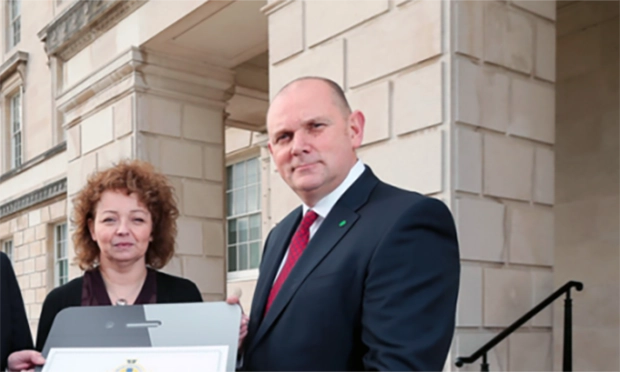
Independent Chair Jim Gamble
Hackney’s safeguarding chief has hit back at criticism of a hard-hitting review into Mossbourne Victoria Park Academy (MVPA) – calling it an “embarrassing misstep”.
A long-awaited report by Sir Alan Wood CBE was published earlier this week and found that the school had “caused harm to some of its most vulnerable pupils”.
Parents’ concerns about shouting and public humiliation of pupils were backed up by Sir Alan’s findings.
But in a blogpost, Tom Bennett OBE, a behaviour ambassador for the Department for Education (DfE), called the review “staggeringly weak, biased, and reliant on a methodology that would shame a fortune-teller”.
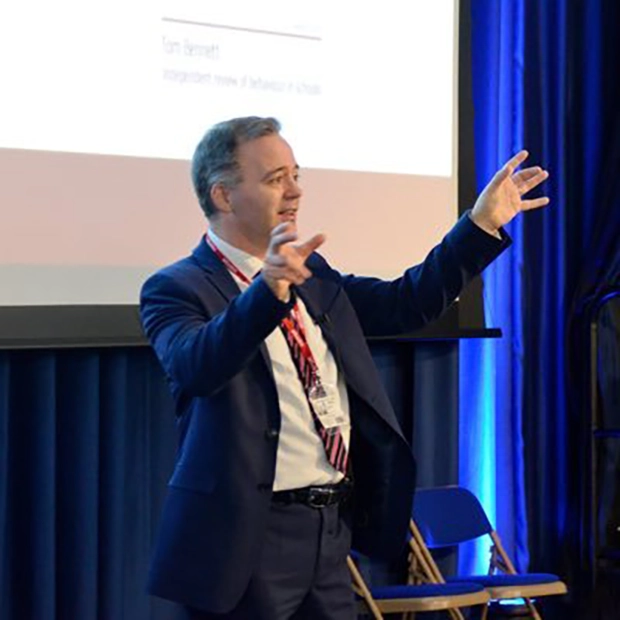
Tom Bennett OBE
He characterises it as a “hit-job”, with echoes of Arthur Miller’s The Crucible: “If there are witches here, we’ll find them. And if there aren’t… we’ll find them anyway.”
Bennett wrote: “MVPA gets fantastic results for its children, in an area where results like that don’t happen often. Its Ofsted rating is Outstanding. It is, by many accounts, a brilliant place to be.
“So of course, it attracts a perpetual mugging from people who campaign against any form of school discipline, rules, consequence or boundaries.”
The opinion piece has prompted a strong rebuttal from Jim Gamble, City and Hackney’s independent safeguarding children commissioner.
In a statement titled ‘The Cost of ‘No Excuses’: Why Safeguarding Must Trump Ideology’, published today, Gamble accuses Bennett of failing to engage with the review’s “serious safeguarding findings”.
He says the behaviour advisor “seems unable to distinguish between an ideological attack and a necessary safeguarding intervention”.
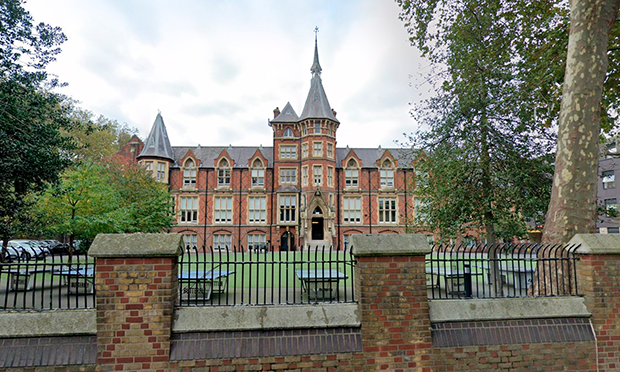
Mossbourne Victoria Park Academy. Image: Google
Gamble is particularly scathing over Bennett’s attack on Sir Alan, who has had a long career in children’s services.
“To sweep this expertise aside and describe the methodology as akin to a fortune-teller is not just disrespectful; it is an embarrassing misstep.
“Is this a serious reflection by one of the DfE’s Behaviour Ambassadors? Or is it the type of emotional outburst that, under the strict rules of a ‘no excuses’ culture, would result in an immediate sanction?”
The commissioner questions Bennett’s grasp of what a Local Safeguarding Children Partnership (LSCP) review entails.
“Such reviews are not driven by partisan political groupings, but are overseen by serious professionals from health, children’s social care, the criminal justice system, and the education sector,” he explains.
“By dismissing this rigour, Bennett suggests he [himself] may need to do some extra homework on how statutory safeguarding actually works.”
Gamble goes on to outline the review process: “For over a year, the DfE, Ofsted, Hackney Council, and others attempted to work with the school to clarify issues and prevent escalation.”
He also counters Bennett’s claim that the review’s evidence amounted to “73 complaints generated over a five-year period, collected by an activist group, Educating Hackney, which campaigns against any form of school discipline”.
Gamble retorts: “There were not merely a handful of complaints; there were 342 individual concerns raised across the Federation, with a significant number appearing in the weeks immediately prior to the review being triggered.
“Of this total, 268 were submitted by individuals providing their names and contact details – these were not anonymous snipers.
“Specifically, 103 people put their names to their concerns about MVPA.
“The ‘73 accounts’ that Bennett disparages formed the core analysis for the review… to reduce this substantial body of evidence to ‘anecdote after anecdote’ is a disservice to the families involved.
“It included testimony from current and former teachers at MVPA, surveys from pupils and parents, concerns from external agencies, and critical documentation provided by the Federation itself.
“Sir Alan also undertook 42 separate interviews.”

The report’s author, Sir Alan Wood CBE
Educating Hackney, set up in November 2024, describes on its website its ambition to “draw attention to links between the way behaviour policies are implemented in some schools, and potential consequences for children’s wellbeing, including their mental health and school attendance”.
Gamble also takes Bennett to task for selectively quoting Ofsted, accusing him of ignoring survey data from the watchdog in which “41 per cent of students stated they would not recommend the school, and 29 per cent reflected that they did not consistently feel safe”.
“These are not new concerns; they are historical, systemic issues,” Gamble adds. “There is a consistent pattern across Ofsted reports. In 2016, they noted that strict discipline limited pupil expression and in 2021 and 2023 their findings highlighted weaknesses in welfare and communication.”
In his blogpost, Bennett asserts that “the whole report is unsubstantiated claim after unsubstantiated claim. It alleges racial bias, but provides no data sources, no numbers, no comparisons to check this”.
Gamble explains: “The source of the data is made explicitly clear: it was MVPA’s own data, which took the school 10 months to provide to Sir Alan.
“The figures are included in the report, and the methodology adheres to government standards.
“Furthermore, Sir Alan is identifying the statistically significant and notable disproportionality that exists within that data.
“It shows that Black Caribbean children are 2.6 times more likely to be sanctioned compared to White pupils and 5.1 times more likely to end up in the Behaviour Support Unit (BSU) or Alternative Provision Centre (APC).
“Black African pupils are 2.3 times more likely to receive a sanction and 4.4 times more likely to be in the BSU or APC.”
The commissioner then refutes Bennett’s “egregious” claim that there is no evidence of mental health damage, stating: “The data paints a starkly different picture. The review highlights that the school identified more than double the number of mental health concerns, 708 in total, compared to its much larger sister school in the same year – a figure that had risen by 17.4 per cent from the previous year.
“External agencies corroborated this; Hackney’s Multi-Agency Safeguarding Hub (MASH) noted a disproportionately high number of referrals from the school, and Child And Adolescent Mental Health Services clinicians reported that staff usage of shouting and angry communication exacerbated psychological harm.
“Former pupils have directly linked the culture to self-harm and suicidal ideation. ”
Bennett misses a fundamental point, according to Gamble, that “the review does not deny academic excellence; it shines a light on potential the human cost of that success”.
The report, says Gamble, “provides overwhelming evidence that a culture prioritising compliance and control led to harmful, humiliating practices that went unchecked due to a defensive leadership culture and a failure of governance”.
He concludes: “Bennett’s insistence on defending a model of strictness, despite compelling evidence that this model is a source of trauma for a significant minority of vulnerable pupils, suggests his critique is centred less on objective truth and safeguarding, and more on protecting his own ideology.
“If the safeguarding principles of professional curiosity and challenge are lost to the white noise of such a zealot-like approach, we have truly lost our way.”