
Hackney Council more than doubles its debt in one year – but what is the Town Hall spending on?
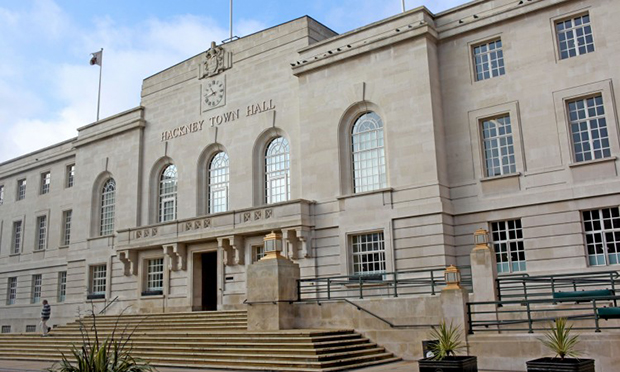
Hackney Council’ says its financial planning is “robust”
Hackney Council has seen the fastest rise in borrowing out of all London boroughs as it more than doubled its total debt in the space of a year.
Analysis of local government finances taken from April this year revealed that Hackney grew its debt pile by 150 per cent (2.5x) since April 2024 as it took out more long-term loans, mostly tied to housing and regeneration projects.
With its recent history of relatively modest borrowing, the council’s debt burden still falls below the London average.
It is also significantly less than boroughs like Croydon, Barking and Dagenham and Newham, who each owe at least £1.4 billion.
But according to the council’s own forecasts published earlier this year, by 2028 Hackney’s debt will have grown more than five-fold to £785 million.
Having owed roughly £63 million in April 2024, in 12 months the local authority’s borrowing rose to £153 million at a rate outstripping not just all other London boroughs but nearly all UK local authorities besides North Devon, King’s Lynn & West Norfolk, and Swale District Council in Kent.
A BBC investigation has found that in the same period local authority borrowing has risen nationwide, with UK councils adding roughly £8 billion to their collective debt burdens – equivalent to £1,791 per resident – since last year.
Barking and Dagenham amassed a further £200 million in debt and now owes £1.5 billion, 13 times the national average.
A Hackney Council spokesperson said: “In Hackney we have secure, stable finances, and we have balanced our budget at a time where other councils have been forced to seek extra funds from the government and our borrowing levels remain significantly below the London average.”
Why are councils in so much debt?
The increase in borrowing has been partly driven by the near-tripling of short-term lending from the government, which in some cases is being used to paper over cracks in some councils’ revenue budgets. Many council leaders said they had no choice but to invest in order to fill the gap in income they used to receive from the government under the revenue support grant.

Jonathan Carr-West. photograph: LGIU
Council finance experts say this reflects an “extremely worrying” national trend. Jonathan Carr-West of the Local Government Information Unit (LGIU) said the spiralling levels of debt were “not sustainable” and essentially amounted to “payday loans” for local authorities. “I don’t think the government would say it’s a long-term ambition,” he told the BBC.
How much council spending is paid for by borrowing?
It depends on the kind of ‘spending’. Local authorities have different pots they use to pay for services, and these are financed in various ways. Revenue budgets cover day-to-day spending, such as on education, social care and housing, alongside council wages, salaries, supplier payments and other operations costs.
This is funded mostly by grants from central government and revenue from council tax and business rates. Crucially, councils are not allowed to borrow money to pay for day-to-day expenditure.
Capital budgets, however, are used for investment in building, and expensive pieces of equipment. Traditionally, capital programmes have been paid for through grant funding and contributions, borrowing, or revenue funding, alongside some money gained from selling council assets (capital receipts).
Local authorities often borrow from the Public Works Loan Board (PWLB), an arm of HM Treasury which lends money to councils at low interest rates specifically for housing projects and other public services. But the interest on these loans must be paid from councils’ revenue budgets.
What is Hackney borrowing the money for?
While bodies like the LGIU have warned against councils using debt to cover the costs of day-to-day spending, Hackney Council says its financial management is prudent and borrowing will be used for investing in housing, tackling poverty and decarbonisation.
The vast majority (94.5 per cent) of debt-funded capital projects are from PWLB loans.
In a statement, the council’s spokesperson said these were “planned, considered investments, ringfenced from day-to-day spending, and fully accounted for in [its] robust long-term financial planning”.
Between now and 2035, the council expects to spend an additional £900 million on capital projects, including for the long-term regeneration of Woodberry Down estate and the revamp of Victorian-era Kings Hall Leisure Centre.
According to Town Hall documents, the council expects its sharp rise in borrowing will ease off after 2028, once it starts to recoup its investments in housing through rental income and selling off more assets.
But the local authority acknowledges the risk that inflation and higher interest rates could play havoc with this, namely by hurting the potential returns from capital receipts. The council also anticipates the cost of servicing its borrowing for capital is set to rise from £4m to £44m per year over the next decade.
When the council was asked how its outstanding liabilities could impact the council’s reserves, and whether servicing more debt would lead to future spending cuts, its response did not address this question.
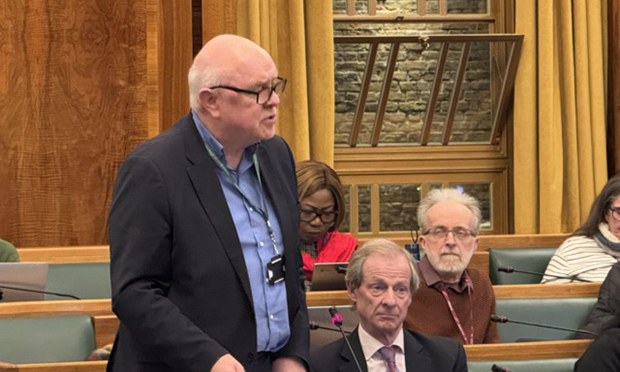
Cabinet member for finance, Cllr Robert Chapman. Photograph: Josef Steen. Free for use by LDRS partners
In November last year, Hackney Council’s finance chief Cllr Robert Chapman said the borough had to find £67 million by 2028 to plug its “unprecedented” day-to-day overspend, mainly driven by the skyrocketing costs of social care, homelessness and children’s services.
This was followed by a series of “difficult” budget cuts made this year, alongside capital investments for libraries, leisure centres, council homes and other areas.
In July, Cllr Chapman stated the shortfall had shrunk to £50 million but warned that “tougher choices” around spending lay ahead as the council continued its work to balance the books.
INSTEAD OF BUILDING NEW PROPERTYS MANTAIN THE ONES YOU HAVE LEAVING THEM IN A STATE OF DISREPAIR THE ELDERY ARE SUFFERING IM GOING TO TAKE MY CONCERNS FUTHER .LOOK CLOSER TO HOME WHY HACKNEY COUNCIL IS IN DEBT WHY IS ESTATE MANAGERS REFUSING TO ACKNOLEDGE A REPAIR IS URGENT THERE NOT ALLOWED BUT A RECEPTION CAN DOSENT MAKE SENSE A PENSIONER DISABLED EXPECT ME TO WAIT W WEEK WITHOUT WATER BECAUSE HE WOULDNT GIVE GO AHEAD ITS URGENT .THREATENING PEOLE THEYLL LOSE TENANCY IF YOU MENTION GOING TO PRESS WELL I AM