
Morning Lane campaigners accuse council of consultation ‘con job’ in scathing report
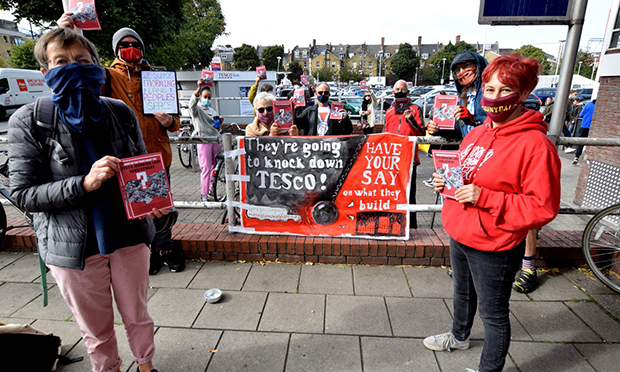
Morning Lane People’s Space has been campaigning for six years. Photograph: MOPS
Campaigners have claimed that Hackney Council’s consultation for a major town centre redevelopment has been a “time-consuming attempt to manufacture consent”.
In a blistering report published over the weekend, Morning Lane People’s Space (MOPS) sets out a long list of complaints about the Town Hall’s engagement process, which they call a “con job, not co-design”.
MOPS was founded in 2019 by residents who were concerned about plans to revamp 55 Morning Lane, a huge site in central Hackney that is currently home to a large Tesco supermarket and car park.
The group has spent years leafleting and gathering community feedback, resulting in two main demands: that there is social housing on the new site, and to “keep a big Tesco there”.
When the council announced a consultation on the Morning Lane plans in September last year, MOPS was hoping to be invited to contribute.
According to the group, no such invitation was forthcoming, so it decided to produce a report that “assesses the council’s consultation against its promise to not just consult local residents but to design the site with us”.
The resulting 35-page document, titled Con Job Not Co-design: Why the community won’t accept Hackney Council’s Consultation on 55 Morning Lane, is sharp in its criticisms.
A key issue for MOPS is the council’s handling of co-design, which the group describes as a “collaborative process of mutual learning and creating something, that starts before any decisions are made, and in which (at least some) decision-making is shared between stakeholders”.
The campaign’s analysis of workshops put on by the council shows “a stark contrast between what emerges from our documentation of all the feedback and the council’s selective sharing of this online, notably the lack of any mention of social housing in the latter”.
The report details an instance where questions from residents and a councillor were shut down by a workshop facilitator, in what MOPS said appeared to be a response to the “discomfort” of those answering the questions.
MOPS wrote: “It would have been challenging to build bridges between the council’s position and the community’s. But that is the work of co-design, not to avoid antagonisms but to create spaces in which they can be worked through.”
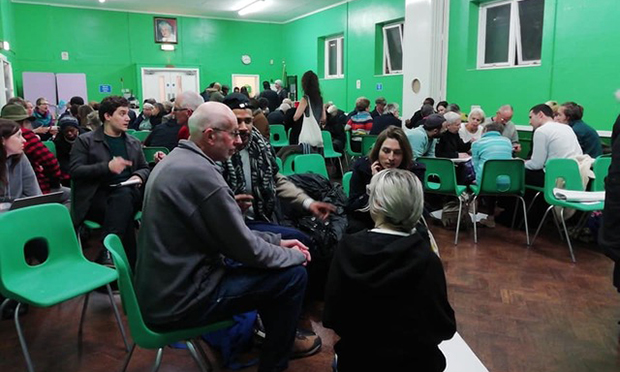
A MOPS meeting in 2022. Photograph: MOPS
In a section titled Transparency, MOPS accuses the Town Hall of using “four rhetorical strategies that frustrate residents who want them to be open and honest: dodging, wordiness, hiding and omitting”.
“When faced with questions, they may dodge them, or give wordy replies that do not provide an answer,” the report states. “When they do provide information, they may hide or omit key facts.
“Whether intentional or not, the impact is to compound the existing mistrust that Hackney residents feel towards our council, and to make co-design impossible.”
One example was an online survey published by the council that did not inform respondents about plans for a smaller Tesco and private housing on the site.
According to MOPS, the council’s response when asked why this information had been omitted was: “The online survey was designed as a light-touch way to gather broad input on values and priorities for the site.
“We deliberately kept it high-level so that it would be accessible to a wide range of people, including those without detailed knowledge of the site or planning process.
“In contrast, more detailed conversations about things like the future of Tesco and the scale and layout of housing have been taking place through workshops and meetings.”
MOPS wrote: “This is a wordy way of saying that the council does not believe it can give residents the homes and shops we need so it did not ask us about them in the survey.
“Instead, officers created a series of design workshops to convince us that what we need is impossible, because of ‘legal and financial realities’.”
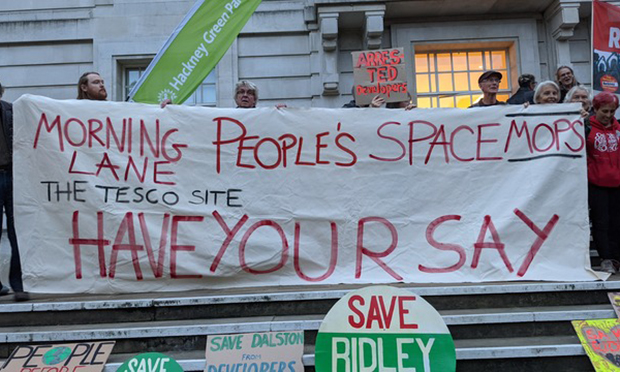
MOPS’s report says the group can no longer ‘in good faith’ encourage people to take part in the council’s consultation process.
The report is also critical of the power the council and its consultants held over the process.
“They decided what happened at every point of the consultation process, from when and where the workshops were held to who represented the community in the appointment of the architect,” it states.
“They were the only individuals to be allocated time to speak at the meetings. In this way, they were positioned as the experts, the ones who stand at the front sharing their knowledge.”
The way the architect was appointed was one of the reasons MOPS quit the council-run Hackney Central community panel last year.
Three designs were on show at the council’s final workshop, and MOPS argues that all three reflected the Town Hall’s vision.
“They all have a Tesco that is the minimum size that the council is contractually obliged to build (about 36 per cent of the floor space of the existing superstore),” the report states.
“They all have a more-or-less identical housing mix, with 25.8-26.8 per cent social rent homes, 17.3- 17.8 per cent shared ownership properties, and 55.3-56.8 per cent market rate housing.”
MOPS believes “all of these designs could have been created without the months of ‘consultation’”.
“Therefore, it was not a consultation but a con: an elaborate, infuriating and failed attempt to convert us to the council’s point of view,” they add.
“If the council was not willing to learn from us, they should have been honest and imposed their vision from the start, rather than wasting our time.”
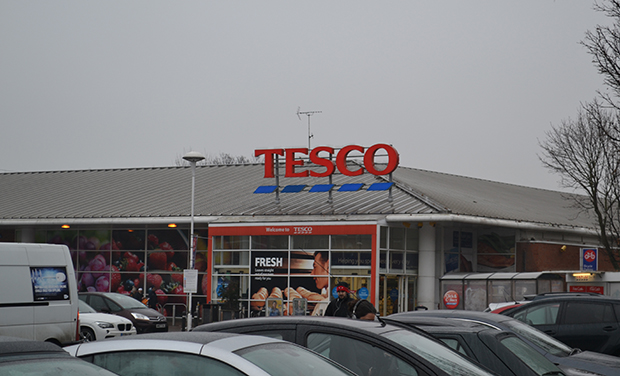
The large Tesco at 55 Morning Lane
MOPS also calls out the “disappointing” lack of engagement from Hackney Central’s three ward councillors.
Its report concludes that the Town Hall’s “consultation process has been a time-consuming attempt to manufacture consent for their plans”.
“For nearly six years we have called on our council to engage meaningfully with the community.
“When leafleting, we have tried to convince residents that this could happen. We can no longer argue that.
“Nor can we, in good faith, continue to encourage people to give of themselves when it is clear that the council is not prepared to listen.
“Hackney Council can change this; they can reach out to the community; they can do better.
“We have written this report in the hope that it encourages and assists them to do that.
“The future of Hackney’s town centre is at stake.”
Mayor of Hackney Caroline Woodley said: “After Tesco put 55 Morning Lane up for sale, the council bought it to ensure we could directly influence what would be built in this key town centre location.
“We’re committed to putting the community in Hackney Central at the heart of these plans, which will help create a new part of the town centre and deliver new homes, including for social rent, better public spaces and a new Tesco store.
“The views of thousands of people have already helped define the priorities for the site and the wider Hackney Central area, and over the last six months alone we have worked with hundreds of residents to explore potential ideas and high level design options for the future of 55 Morning Lane. This work is at a very early stage of the design and development process.
“MOPS continue to bring a huge amount of energy and drive to the engagement process. We would like to thank all residents for their participation during these early stages and look forward to continuing to work together constructively on this important site in Hackney.”
You can read MOPS’s report in full here.
Update: this article was amended at 2.22pm on 15 September 2025 to include a comment from Hackney mayor Caroline Woodley.
I’d like to thank the Morning Lane People’s Space for the time and effort they have spent on genuine community consultation for the use of this key site in Hackney. Sadly, after a series of miscalculations at the start of the project, the Council did not embrace the opportunity to work with the campaigners on genuine community co-production. I have attended some of the MOPS workshops and one of those run by the Council. The difference between the two was marked, with a ‘we know best’ attitude prevailing from the Council. There is still time for a change of heart, but that will entail the Council swallowing its pride, admitting its consultations too often fall short, and making a concerted effort to get people back on board, working with MOPS. Hackney Independent Socialists raised a debate in July’s Full Council about the Council’s repeated shortcomings on consultation. Instead of listening and engaging, the Labour administration’s response was to mock us. That is not how community trust is won.
Howon earth does the Council think that 70% market housing on this site is any use to the local population. Why have the so-called socialists running the Council treated the local community in such a contemptuous fashion?
Instead tbey could have joined with them to pressure the government to provide a 60 year loan from the Public Works Loan Board to provide 100% Council housing and a full sized Tesco.
It’s not too late to scrap their plan and start again. The horrible environment they permitted at Dalston Junction, still shrouded in scaffolding, should persuade them to reconsiider. Or do we have to wait for the Green Party to win next year’s election to get the right thing done?
Hackney as a whole needs to stand up against the council, it is not a democracy, it is totalitarian.
While we’re at it, LTNs also need to be reversed, why are motorists constantly penalised, why is Chatsworth Road, which only needs to be closed for one day a week on Sundays for the market, and even before that it functioned just fine, being turned into a bus-gate after numerous people objected to it?
Why are so many major roads inaccessible, such as Richmond Road?
Why is Homerton High Street constantly a traffic jam that my children have to walk past on their way to school?
Why do we pay road tax and yet are not allowed to access 75% of the roads in Hackney?
Who implements these LTNs, do they live in Hackney, do they own a car, do they cycle, in other words, does it serve them?
How many of these people these LTNs serve are only here for the short-term (until they decide to relocate to the countryside for more space) whilst the rest of us, who are actually stuck with these decisions, are real residents with families?
People need to stand up and campaign against the unlawfulness the council demonstrates constantly. Enough is enough. The LTNs are one issue of many.