
Concerns raised over progress of controversial Edmonton incinerator
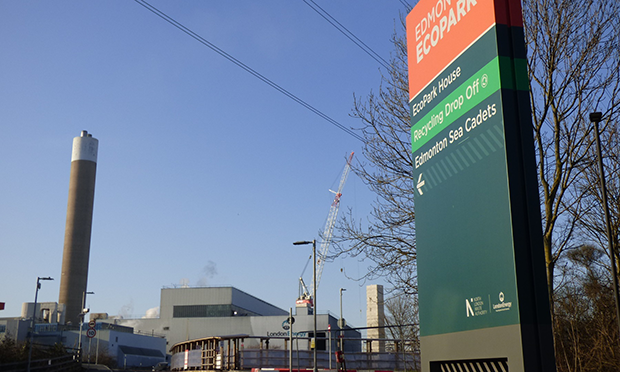
Edmonton Eco Park. Photograph: LDRS
Progress on the construction of the new Edmonton incinerator is continuing to drag amid a series of local and international challenges.
The redevelopment at Edmonton Eco Park, which will replace the existing, ageing waste-burning facility has been delayed, overseers say.
They have pointed to Brexit, the war in Ukraine, and high interest rates impacting the cost of raw construction materials.
The incinerator was originally intended to be up and running by 2027.
No fresh timeline has been made publicly available, but the North London Waste Authority (NLWA), which is guiding the project, says “construction progress continues to be made”.
The NLWA is controlled by councillors from Hackney, Barnet, Camden, Enfield, Haringey, Islington and Waltham Forest, and is responsible for disposing of waste from the seven boroughs.
Construction firm Acciona was still facing “challenges”, NLWA chair Cllr Clyde Loakes said.
Last year, it was reported the firm had faced “continued” delays in bringing in subcontractors for the next stage of development.
Cllr Loakes, who also serves as the deputy leader of Waltham Forest Council, said: “The delivery of the energy recovery facility has not stopped – construction progress continues to be made, with over 200 workers on site.
“The subcontractors engaged by Acciona have consistently demonstrated excellent competency throughout the project. The civil works are largely complete and work to install the first two boilers and the steelwork for the turbines and flue gas treatment continues.
“However, as we have consistently reported publicly, there are challenges being faced by Acciona and the programme is delayed.
“Factors such as energy and raw material price shocks following the outbreak of the Ukraine war, high interest rates, and Brexit have impacted the construction industry.”
Despite the reassurances, campaigners opposed to the scheme fear it is in “serious disarray”.
Carina Millstone, with the Stop Edmonton Incinerator Now coalition, said: “The NLWA’s stubborn refusal to release information about the delays in the building of the new incinerator suggests to us that the relationship with Acciona has irretrievably broken down, no doubt at a hefty cost to the councils.
“We now believe the new incinerator will never be built.”
A total of £66.5million has been allocated to the project from the Heat Networks Investment Project, a government-funded scheme aimed at increasing the number of networks in England and Wales.
The budget has already risen from £1.2billion to £1.5bn, with the NLWA citing similar supply issues.
At a cabinet meeting in June, top councillors in Haringey agreed they would shelve their plans to pipe heat from the incinerator, citing “economic turbulence” and the need for “prudent” management.
Concerns have also been raised about the potential impact of the incinerator on air quality in north London.
Waltham Forest Conservatives leader, Cllr Emma Best, said Highams Park would be “covered in plumes”.
The Tories claimed Chingford “will continue to be exposed to highly toxic ultrafine particulates (PM0.1) from the burning of waste, which ‘constitute a significant health hazard”.
They also attacked the Labour-run council for supporting the project despite costs having “spiralled out of control”.
The North Middlesex University Hospital, which serves Enfield and Haringey, saw 14,587 children with breathing difficulties admitted in 2024. That is 220 per cent higher than the London average.
Cllr Loakes said the NLWA was following the “well-established scientific evidence that modern and well-run facilities do not pose a significant risk to public health”.
He said: “By far the biggest source of air pollution is road traffic – even at its absolute peak level, the new facility would be responsible for just 0.52 per cent of local particulates and 2.93 per cent of nitrogen oxide, compared to 30 per cent from road traffic.
“More than 35 facilities have been given consent since we submitted our application, and only three of them will have emissions-cleaning technology as good as ours.”
He said the incinerator would lead to the “best environmental outcomes” and the “best value for our council taxpayers”.
He added: “Councils must dispose of all the rubbish our residents throw away, so we need to focus on solutions to put an end to unnecessary waste, in particular plastic.”
The chair said the NLWA was “starting to see some progress, with commitments to making producers pay for the waste they create and a deposit return scheme both showing steps in the right direction”.
The NLWA previously said that while it expected “people will recycle more and produce less waste in the future”, there would also be “more people producing waste, which means we need to plan for increasing volumes of waste”.
Councillor Noakes should look at the Inside Croydon article of 15 October 2024: “Health agencies ignored public’s concerns on incinerator” to see how two doctors independently chose to brush aside the link between incinerator emissions and infant mortality in 2008 – just as the London Assembly had done on 9 November 2006 (Document Reference: MGLA061106-0335).
The above article also contains two tables of data for infant death rates in London’s electoral wards (2002-2013 ONS data). Each table lists four electoral wards that form a single group. The four wards clustered around the Edmonton incinerator, which had the highest average rate of infant deaths of any other four London wards forming a single group, had an average infant death rate of 9.2 per 1,000 live births (12,109 live births, 111 infant deaths. That rate was fifteen times higher than the four Bromley wards forming the lowest infant death rate, which had an average rate of 0.6 per 1,000 (5,119 live births, three infant deaths).
Counillor Loakes and the NLWA should take no comfort from following the “well-established scientific evidence that modern and well-run facilities do not pose a significant risk to public health” because neither the NLWA, nor the former Health Protection Agency (or their successors), nor the Environment Agency have bothered to check ONS data to see whether or not there’s a clear pattern of elevated rates of infant mortality in electoral wards exposed to incinerator emissions.
Neither have the above bodies examined ONS data to see whether or not infant death rates rise in Councils exposed to incinerator emissions after incinerators start operating or fall after such plants shut down.
The Waltham Forest Guardian article “Concerns over infant death rates in Chingford Green” (2 August 2007) reported ONS data showing that Chingford Green had a very high infant death rate of 17.2 per 1,000 live births (2003-2005 ONS data).
The article, which started: “CONCERNS have been raised that an abnormally high rate of infant mortality in an affluent area of Waltham Forest could be caused by toxic incinerator fumes.” should have persuaded NLWA to force their expert advisers to examine ONS data at electoral ward level around Edmonton and other incinerators in 2007, but they apparently did not.
I suggest that Councillor Loakes reads my letter about Dr William Brend in the current issue of Private Eye as he demonstrated beyond any reasonable doubt in his “Heath and The State” (Constable,1917) that poverty couldn’t be blamed for high infant mortality and that air pollution must be the dominant causal factor.
It’s what passes through the ineffective incinerator filters and into our lungs that matters.
Here’s an extract from the decision letter dated 16 July 2015 sent to Veolia regarding their proposal for an incinerator at New Barnfield, Hatfield (Application Ref: 6/2570-11)
“702. Andrew Bousfield is a reporter concentrating on health related stories. He referred to a large amount of information he received from ‘whistleblowers’ from within the energy recovery industry. He submitted a redacted letter from a worker in the industry concerning the measurement of particulate emissions, and particularly fine particulates which are not filtered by the lungs (PM2.5) The evidence of health effects of PM2.5 – including increased stroke and heart attack risk, cardiovascular disease, cancer risk and respiratory illness is beyond any serious doubt. Particulate emissions from stacks are not monitored continuously, but tested on two or three days a year by a certified company. If a test is failed there is no obligation to inform the EA, but a further test could be done later, with only the later test result reported to the EA. It is suggested that the operator might simply reduce the load under incineration to pass for that year. There appears to be no available dataset which measures the effect of PM2.5 particles form incinerators on local air quality. The use of bag filters is only 65 – 70% effective for PM2.5, and only 5 – 30% below that level. The only way to be sure that the population will be protected from PM2.5 emissions would be to carry http://www.planningportal.gov.uk/planninginspectorate Page 163 out a proper base line measurement at affected sites and then carrying out regular monitoring measurements after commissioning.”