
Number of people registered to vote has fallen, new figures reveal
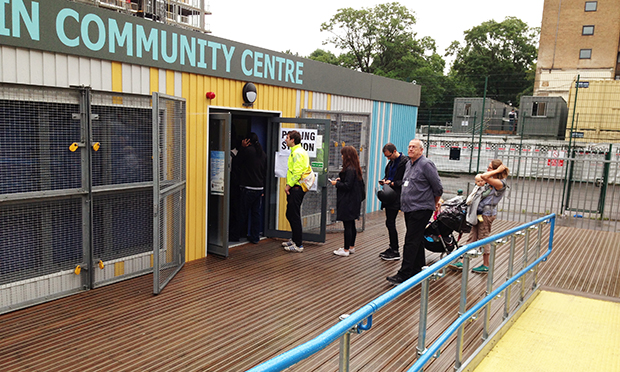
Dwindling: voters queue up at a polling station in Hackney last year.
The number of people registered to vote in Hackney has tumbled by 4.2 per cent since the 2015 General Election.
Newly-released figures from 22 May, the closing date for registration, show the total electorate in Hackney North and Stoke Newington is down from 88,153 two years ago to 83,905 in 2017 – a drop of 4.8 per cent.
The Hackney South and Shoreditch seat has seen a decline of 3.6 per cent, with 81,905 people registered for the upcoming election, compared to 84,971 in 2015.
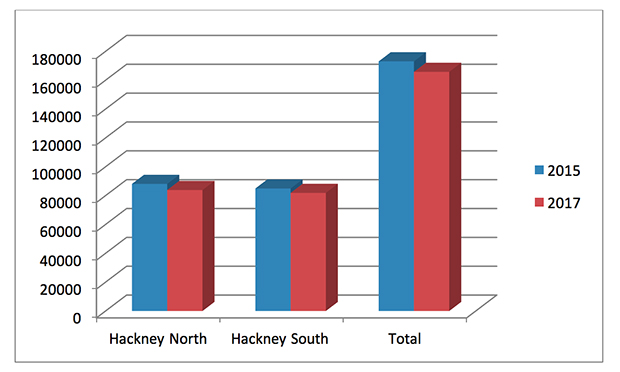
The lack of up-to-date population data makes it impossible to ascertain whether waning voter numbers are due to a fall in the overall population or a failure by the council to compile a complete electoral roll. The evidence points towards the latter.
Between 2011 and 2015, the borough’s population grew at a rate of over 5,000 per year, suggesting that even a minor post-Brexit exodus would have done little to dent a steady rise in the number of residents eligible to vote at General Elections – especially as this figure does not include European Union nationals.
A more likely reason is that Hackney Council officials have not managed to produce an accurate list of eligible electors.
Voter registration has long been a challenge in Hackney. A 2015 Electoral Commission report singled out the borough as the local authority with the most inaccurate voter roll in Great Britain. Part of the problem appears to be the large number of historic duplicate entries on the register, which were removed when the new system of individual voter registration was introduced three years ago.
A report published last year by London First and Democracy Club suggests that the problem is deeper, with the Town Hall’s elections department struggling to engage the local citizenry despite the fact that enrolment is compulsory and non-registrants can be fined £80.
But Hackney Council blamed the new registration system, introduced in 2014, for the dwindling electorate. Previously, one person was in charge of registering everyone in their household, but the new rules mean each resident must now sign up separately to be eligible to vote.
Returning Officer Tim Shields said: “The new individual electoral registration system meant that a number of electors who had not individually registered were removed from the electoral register in December 2015, this was in accordance with the legislation.
“The electors who were removed were those who we had not heard from for two years, despite repeated attempts to contact them. It is our view that, given the high turnover rate of electors in the borough, the vast majority of those that were deleted in December 2015 were no longer eligible to vote in Hackney.
“We’ve gone to great lengths since 2015 to encourage people to register, from advertising campaigns to letters to residents who had not yet registered. Between the General Election being called on 18 April 2017 and the registration deadline on 22 May, we received over 35,000 applications to register to vote.”
This is a worrying trend. Part of the problem has got to be disengagement with politics caused by a recognition that we have a broken First Past The Post (FPTP) voting system that means that our votes in Hackney are much less likely to make a difference on the national stage. It is a system that entrenches power for the two main political parties and at the moment heavily favours the Tories.
In the last major election in Hackney, for the Hackney Mayor, (where the Greens came second to the Labour Party) turn out was a shockingly low 18.6%.
According to the website Voter Power Index, http://www.voterpower.org.uk, a vote in Hackney North (where I am standing a the Green Party candidate) has 5 times less power than the national average. It’s even worse in Hackney south with votes having 6 times less power, with Labour’s Meg Hiller refusing to support a proportional system.
The Labour Hackney Council must also make sure it takes measures to learn from its past mistakes. In the Mayoral election postal voting forms were misprinted meaning that they were delivered later than they should have been. In the past voters have been turned away at the end of the day due to excessive queues. This complacency comes with knowing that Hackney is an ultra-safe seat. With Proportional Representation (PR) we would do away with the out-of-date system of safe and marginal seats and all votes would be worth the same.
Without Proportional Representation voting in Hackney is something of a pantomime with the only way to effect change in parliament being to go out to a marginal constituency to campaign there. To put pressure on Labour to make all votes count equally your best bet is to push the Tories into 3rd by voting Green on Thursday. Increasing Labour’s majority here changes nothing on the national picture and is another vote for the status quo.
I’m voting Labour on Thursday and I’m hoping that many more young people will be coming out to vote for Labour too – this fall in numbers registered to vote does not bode well for our chances of getting the Tories out.
As I understand it, the change in the registration system was pushed for by the Electoral Commission due to the high potential for fraud in the old system, where the “head of the household” could put any number of names down on the form and there was no way to verify whether any of them actually lived at the property or were even alive at all. This was backed up by research showing that large numbers of fraudulent registrations did exist, particularly in places such as Tower Hamlets and Birmingham where electoral fraud is endemic.
It seems to me entirely logical that overall registration figures would come down under the new system as all these false registrations are eliminated. This is a sign that the change is working, and this can only be a good thing. I can’t see any reason why any genuine resident who is eligible to vote is now prevented from registering, and nobody who moans about the new system has satisfactorily explained why they believe this to be the case. Just another opportunity to take a vague swipe at the Tories.
The UK voting system is still incredibly lax and open to fraud. I cannot think of any other advanced country where voters do not have to show ID at the polling station. Even in places such as Bangladesh they are implementing a high-tech biometric identification system to eliminate fraud.
Both Hackney constituencies are already held by Labour, and both Labour MPs look certain to be re-elected. If you want a change of government it will have to come from elsewhere, not from Hackney.
Nick- thanks for the mansplain but I meant new voters elsewhere – outside Hackney !
The new registration system, as operated in Hackney, has in my personal experience been an unmitigated disaster. I’ve been a single householder at the same Hackney address for over 23 years (and been a Hackney resident for over 30) but had more inaccurate entries put in my name in the last 3 years than in all the previous time here. At the last general election, I even had a duplicate entry (in yet another wrong version of my name, which I’d already had to correct repeatedly) as well as the one that I’d had to work so hard to get correct.
If the Council makes this much mess of re-registering a single UK adult after all this time as a Hackney resident, I’m not surprised that its overall registration figures aren’t what they once seemed.
It troubles me hugely that all this slovenly mismanagement of the Electoral Roll is being done at public expense – out of the voters’ own pockets!