

The Hackney Green party’s pledge to divest the council’s pension fund from companies allegedly supporting genocide has been challenged, as council officers red-flagged the risk that the Green-led pensions committee will put the party’s manifesto before its legal duties.
After taking control of the council for the first time in May, the Green administration has begun changing how the council’s pension pot is invested, following campaign promises to start “full ethical divestment” from companies “complicit in territorial human rights violations”.
Before her election victory, Hackney’s mayor, Zoë Garbett, told the Local Democracy Reporting Service (LDRS): “People don’t want their money invested in firms like Elbit and Palantir – pension funds could be used to invest in housing, to help people locally instead.”
Both firms have been accused by Amnesty International of complicity in Israeli war crimes against Palestinians in Gaza, including genocide. At a pensions committee meeting on Tuesday 22 September, members were quizzed by former Labour councillor Vincent Stops about whether the council’s actions matched the Greens’ campaign rhetoric.
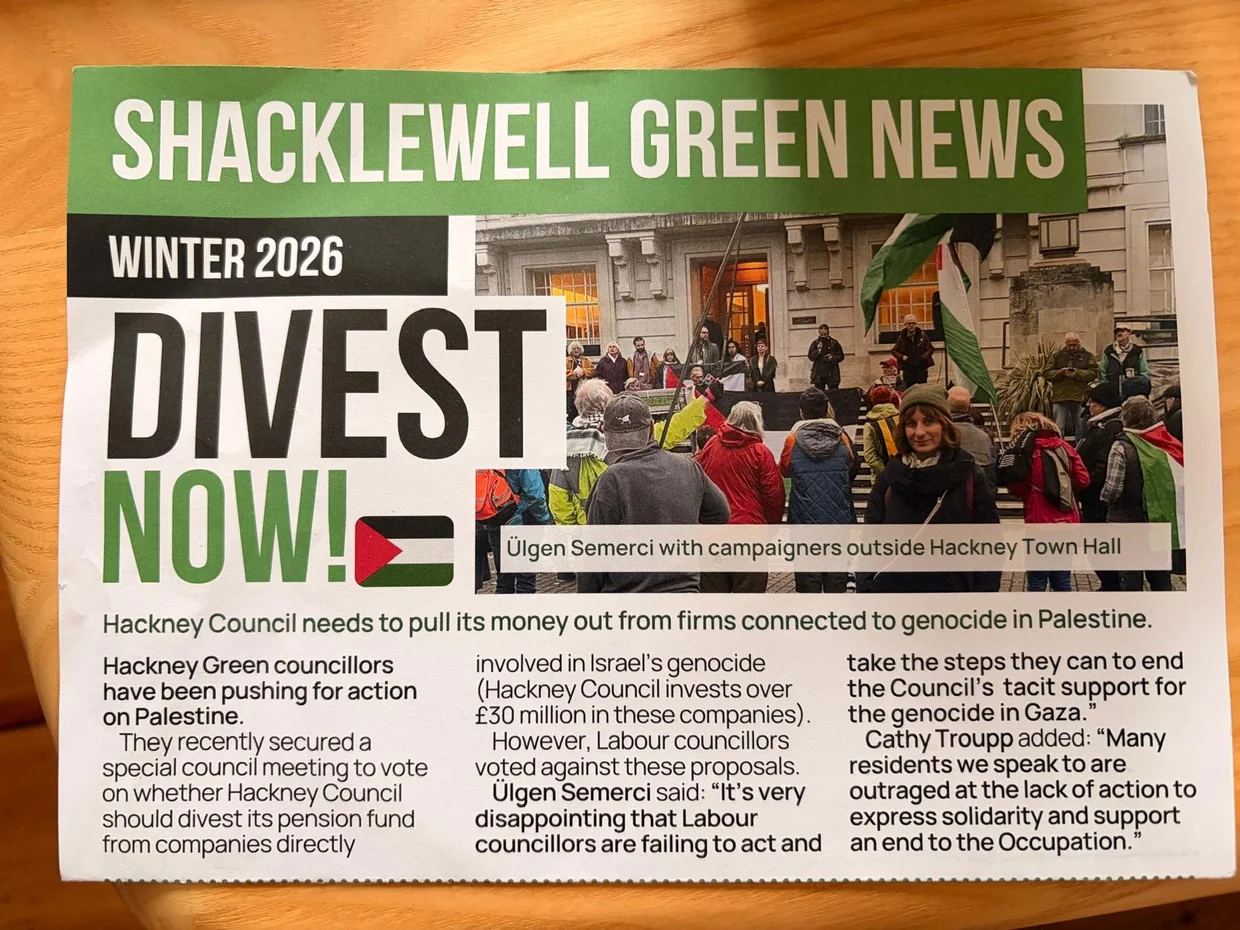
Brandishing a Green party campaign leaflet, Stops said: “Hackney Green party told residents, Labour councillors and Hackney councils supported genocide in Gaza, investing in companies like Elbit. You, the Greens, demanded divest now. 30 million pounds was demanded from its pension fund to be divested from companies directly involved in Israel’s genocide.
“Please list those companies and the investment value you have or will divest from each.”
Holdings
The committee’s chair, Izzy Castello-Cortes, said the council would provide details of the specific holdings in writing at a later date.
An actions log published the day before the meeting shows that the information needed to answer him had already arrived. In July the committee asked officers to obtain from the London Collective Investment Vehicle (LCIV), which manages the fund’s assets, the securities it holds on Hackney’s behalf. The log’s update, dated 21 September, says information on the pool’s fund holdings “has been provided and will be passed to the chair”.
Pressed by Stops – “So, as of today, you haven’t divested anything from any companies involved in Israel’s genocide” – Cllr Castello-Cortes replied: “As of today, we have taken some big steps in terms of looking into this. I cannot preempt the findings of the Responsible Investment Working Group, but those are the steps that have been taken so far.”
Speaking to the LDRS after the meeting, Stops said the Greens were “backtracking from their demands for immediate divestment now”. He has previously called on the mayor to “apologise to Labour councillors accused of supporting genocide in their squalid campaign”.
Figures
The amount of money Hackney has invested in firms linked to alleged human rights abuses, war crimes and genocide is disputed.
In 2024 the council stated that the pension fund was worth £1.994bn – it now stands at about £2.4bn – and that roughly 0.2 per cent was “indirectly” exposed, “mainly through its equity portfolios”, to firms listed on the database of the Office of the High Commissioner for Human Rights (OHCHR) of companies conducting business in the occupied Palestinian territories. The council has offered various figures at different times, the smallest £1.9m and the largest £3.5m.
The Palestine Solidarity Campaign (PSC) has put forward a much larger figure, claiming roughly £106m of Hackney’s pension was invested in “companies complicit in Israel’s grave violations of Palestinian human rights”, based on an analysis of 81 Local Government Pension Scheme (LGPS) funds.

The PSC previously put the number at £30m. The Green party’s campaign leaflet, headed “Divest Now”, stated that Hackney Council invests “over £30m” in companies “directly involved in Israel’s genocide”, but did not cite the PSC.
The £30m figure was not included in the Green party’s manifesto. Instead the manifesto pledged to “initiate a full ethical divestment process from companies complicit in genocide, apartheid or ethnic cleansing in Gaza, the West Bank, and other occupied Palestinian territories, as well as in Sudan, the Democratic Republic of the Congo, Haiti and other regions facing genocide, conflict and exploitation”.
In June the LDRS asked the mayor’s office whether she stood by the “over £30m” figure used in her party’s campaign literature. The mayor did not answer.
History
In 2024 Kam Adams, the Labour councillor who then chaired the committee, said the fund did not invest in individual companies and that its holdings sat in “pooled” funds managed externally.
The then Labour-run council also said it had been advised that pulling these indirect investments by leaving its pooled fund for a “highly customised” alternative would cost more than £2.1m in the first year alone and more than £10m over five years, which “would risk financial detriment to the Fund and would therefore breach Law Commission guidance”.
In September 2025, however, the council said it would “engage with” the London Collective Investment Vehicle to “create a framework that will enable future exclusions of investments linked to conflict, military occupation or genocide”. The then mayor, Caroline Woodley, also committed to building the UN Genocide Convention into Hackney’s investment framework.
The London Collective Investment Vehicle manages London councils’ pooled pension investments, while each council still sets its own fund’s strategy. The body says it “must remain neutral except where led by the UK government, for example in the case of sanctions”, and that under recent reforms it needs a “critical mass” of member funds before putting ethical exclusions in place.
Guidance
Hackney’s pensions committee agreed on 24 June to review its responsible investment strategy and develop future exclusion criteria for its own fund. Cllr Castello-Cortes told the meeting that the government’s statutory guidance, published on 29 June, ruled that out: “As you might know, that the June 2026 statutory guidance stipulates that we cannot exclude specific named companies. Instead, we are looking into a policy that uses a series of lists and highlights proposed core beliefs that we believe is in the interest of pension scheme members.”
Committee papers go further. Under the guidance, officers write, pension funds “should not set exclusions relating to individual companies, countries or investment styles, as decisions to buy, hold or sell individual investments now rest with the Pool”.
A draft stewardship statement put to the committee for approval lists among the fund’s investment beliefs that “engagement is generally a more effective mechanism for influencing corporate behaviour and delivering real-world outcomes than exclusion or divestment alone”. It adds that implementing the fund’s human rights priorities “is now the responsibility of the investment Pool”.
The actions log also shows how the Greens’ first demands collided with the timetable for pooling. On 24 June Cllr Castello-Cortes asked officers to redraft the fund’s investment strategy statement before a 30 September deadline, and to bring a revised responsible investment plan to the July meeting “with consideration of systematic exclusion clauses for corporate entities in conflict zones”.
Officers replied that the strategy statement was already on schedule for submission to LCIV by 1 July, “following the prior administration’s approval” of it and of the agreement handing the pool responsibility for the fund’s assets. There was, they said, “insufficient time to engage in a full consultation with scheme members” before the deadline.
Risk
Council officers have now rated as “likely” the risk of the “Pensions Committee making decisions based on party manifesto, disregarding existing legislation, legal advice, financial impact and fiduciary duty”.
The entry, headed “political influence” in the fund’s investment risk register, is rated “major” in impact and “likely” to happen, giving it a score of 16, shaded red. Officers set the same rating as the target for 31 March 2027, so they do not expect the risk to reduce before then. The mitigations listed are training on LGPS regulations, including members’ fiduciary responsibilities, and obtaining legal advice.
A second entry, in the fund’s governance risk register, warns of “material breaches” arising from a party manifesto “taking precedence over fiduciary duty and LGPS regulations”. Officers rate that risk major but only “possible”.
Addressing the warning at the meeting, Miriam Adams, the council’s assistant director of pension investments and administration, said new statutory guidance made “very clear” that unlike other council panels, the pensions committee was “not political”, and that acting politically could result in the secretary of state for housing, communities and local government intervening and “taking over a fund”. She added that she hoped “that’s not going to be the case”.
Cllr Charlie Lawrie, a Green member of the committee, said the committee was a “political body” with a duty to observe risks to the fund and its members, such as “environment and investment governance”.
Review
The responsible investment working group reviewing the policy has seven members: Cllr Castello-Cortes, five other Green councillors and scheme member representative Jonathan Malins-Smith. Neither of the committee’s two Labour councillors sits on it.
Its update to the meeting shows it met on 13 August and 9 September and sent suggested policy changes to the fund’s investment adviser, Gallagher, to test what LGPS regulations and statutory guidance allowed, and whether proceeding “could create legal or governance risks later down the line”. The report says only that “a way forward was agreed”, and does not say what Gallagher advised.
In July the chair said the review was targeting completion by 30 September. The group’s work plan now shows it continuing at meetings on 24 September, 21 October and 18 November.
A question put to LCIV’s chief investment officer in July – whether the pool’s proposed 5 per cent revenue threshold for excluding weapons companies would cover dual-use technology – remains unanswered in the actions log.
Sanctions
Local resident Sussan Rassoulie asked what the committee was doing in response to the government’s planned sanctions on businesses supporting Israeli settlements, naming Airbnb, Expedia Group, Bank Hapoalim, Mizrahi Tefahot and Motorola Solutions among companies on the UN’s list of firms linked to settlement activity.
Cllr Castello-Cortes said: “So on divestment as a result of new sanctions and trade restrictions related to Israeli settlements in the occupied Palestinian territories, under the Pensions Act 2026 [Pension Schemes Act 2026], the responsibility to divest in line with these sanctions lies with LCIV. LCIV have advised us that they will now review the details of the measures and assess any potential implications for our portfolios, as well as working with investment managers and service providers to do so.”
She said LCIV had confirmed the changes would be implemented “over the next six to nine months”, adding that “there are many companies on those lists that are unaffected” by the sanctions.
Funding
A third questioner, Nadine Nassar, noted that the fund's actuary estimates it was 140 per cent funded at the end of June, needing an annual return of 3.9 per cent, which the actuary rates as more than 95 per cent likely – "so in a pretty good place". She asked whether officers and the actuary would test whether screening out "companies with a record of human rights abuses" would actually affect the fund's ability to meet its obligations.
Fiduciary duty, she said, is "often a shutdown that's used when people advocate for divestment", and the question was whether "those calculations will be properly made, rather than just saying that the fund will not be able to meet its fiduciary obligations".
Cllr Castello-Cortes said: “If the Responsible Investment Working Group decides to recommend changes to the committee, and the committee then votes to incorporate those recommendations, we will have to model the financial implications of any changes to made to our investment universe.” She added: “So far, we like have not like found that to be an issue.” Written answers will follow.
With additional reporting by Hackney Citizen.
Find out more on these topics


