

Campaigners have railed against Hackney Council’s move to bring in controversial bus stops they say are “frightening” and dangerous for disabled people — and which did not appear in the scheme that residents were consulted on last year.
John Thornton, a visually impaired wheelchair user and Dalston resident, says the design will put residents like him in potentially mortal danger.
Speaking to the Local Democracy Reporting Service (LDRS), he said: “I can’t see either side as I go down the [bus] ramp. Two and a half metres from the bus is a fast-moving cycle lane, with speeding e-bikes and scooters. They don’t stop, so I’m wheeling straight down into fast-moving traffic.”
Thornton came to the town hall to protest against the updated scheme on Wednesday 16 September and told the council he was going on hunger strike until it changed course. Two days later the council opened a 21-day statutory consultation on the plans.
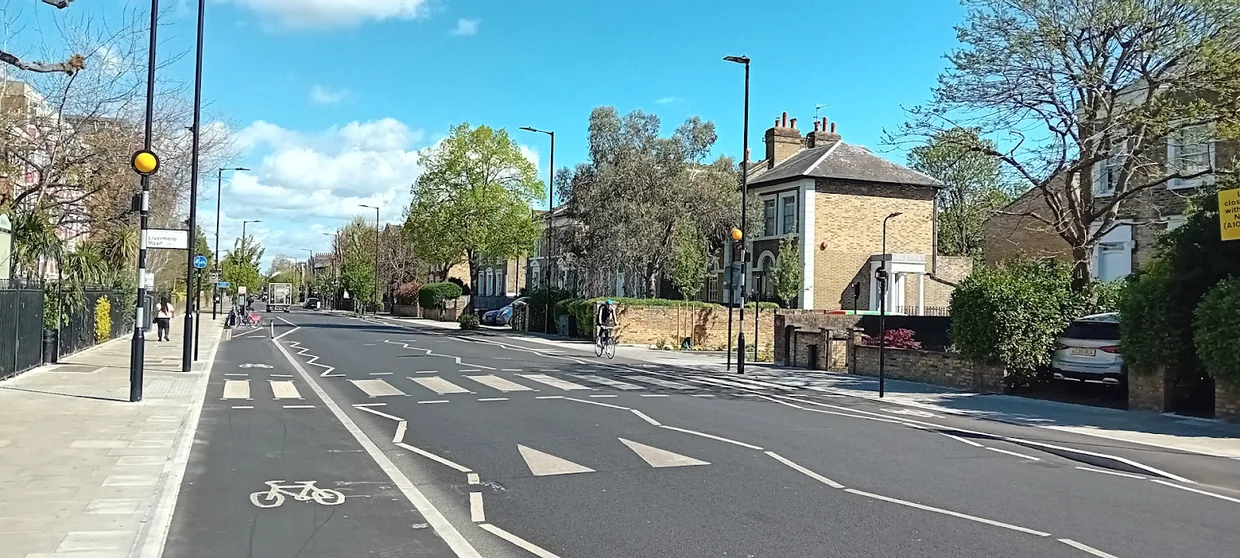
He added that, unlike previous projects, the council did not hold an accessible consultation event with disabled residents, “in particular with blind and visually-impaired residents” — despite 70 per cent of disabled respondents to last year’s consultation opposing the Queensbridge Road proposals, against 24 per cent who supported them.
The council says Thornton is one of its named consultees for the scheme, alongside Living Streets in Hackney, the London Cycling Campaign in Hackney, the Metropolitan Police, the ambulance service, the London Fire Brigade and the RNIB, and that the proposals were shared with him ahead of the statutory consultation.
No question about floating bus stops
He was joined by Sarah Leadbetter, who is also visually impaired. She said pedestrians like her cannot see or hear the bikes as they ride through bus stops. “There’s just no way to know when it’s safe to cross. And we know the vast majority of people will not stop,” she told the LDRS.
The scheme that residents were asked about between 27 October and 30 November last year contained no bus stop bypasses. The consultation document listed raised cycle tracks, resurfaced pavements, raised junction tables at Middleton Road and Richmond Road, blended pedestrian crossings on five side roads, exit-only traffic lanes, rain gardens and the closure of Scriven Street to motorised traffic. The questionnaire asked no question about floating bus stops.
Of 634 people who answered, 60 per cent disagreed with the proposals and 35 per cent agreed. Opposition ran highest among car users inside the scheme area at 78 per cent, carers at 76 per cent and disabled respondents at 70 per cent, on a base of 86.
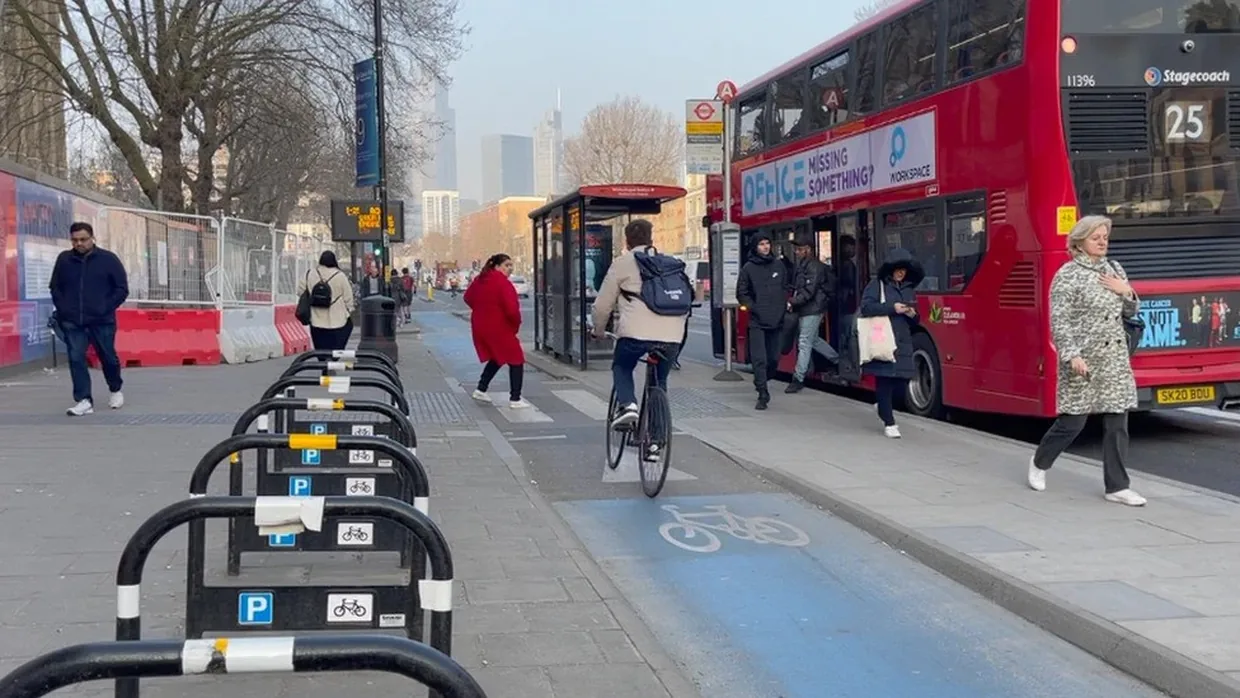
Floating bus stops were raised twice in the consultation. Cyclists asked for them. Living Streets in Hackney, meanwhile, told the council it supported the scheme partly because it contained “no bus stop cycling bypasses for disabled people to have to negotiate”.
Bypasses were added afterwards
The council’s own consultation report, prepared by Field Sauce Ltd, also recorded that floating bus stops “are viewed as discriminatory because the visually impaired cannot see or hear silent, fast-moving cycles”. One respondent told the council that blind people cannot see or hear cycles at floating bus stops and that the crossings are not equivalent to conventional zebra crossings.
The bypasses were added afterwards. A delegated powers decision signed on 31 July 2026 by the assistant director for streetscene, and copied to Cllr Jacob Cable, agreed to take the scheme to statutory consultation including two floating bus stops with 21-metre bus cages, outside 292 and 365 Queensbridge Road at the Lenthall Road junction.
The layout plans attached to the decision show both stops set in “distinct paving material” next to the raised cycle tracks, with the existing stops relocated — one slightly north, the other further south — “for added visibility”. They give no dimensions for the islands or the crossings.
Below the threshold
The decision justifies the stops by setting the council’s traffic figures against Department for Transport (DfT) recommendations. Its table gives Queensbridge Road fewer than 100 pedestrians a day, 68 cyclists an hour, 12 bus movements an hour and a “low” place context, against DfT values of “medium” for the first three.
Those DfT figures are the applicable contexts the department sets out for a bus stop bypass. Under the same guidance, fewer than 500 pedestrians a day and fewer than 200 cyclists an hour both count as low flow — so on the two measures the DfT quantifies, the council’s own numbers fall below the context for the design it has chosen.
The guidance describes a different design, a cycle track with a separate boarding island, as suited to low and medium flows, and says stops may be left untreated where cyclist flows and traffic speeds are low.
The same decision confirms that the Scriven Street closure, the most objected-to element of the scheme, will not now go ahead, to give officers more time for further consultation.
Met Police warning
The Metropolitan Police had separately warned the council that raising the carriageway to footway level at the Middleton Road and Richmond Road junctions “leaves no detectable kerb for the visually impaired except at designated crossing points”, and could allow a visually impaired pedestrian to walk into the carriageway. The council’s answer was a 6mm kerb upstand at crossing points and pedestrian-cycle delineators “where applicable”.
The decision’s equality impact assessment rates the scheme’s overall effect on disabled people as positive. The two negative impacts it identifies are the effect of a narrower road on traffic speeds and the risk of motorcycles using cycle lanes. Floating bus stops do not appear in the negative column.
Joining the demonstrators was Sarah Gayton from the National Federation of the Blind of the UK (NFBUK), who warned that the “Russian roulette” bus stop bypasses meant disabled people were being “designed out” of London.
“I’ve had blind people in tears to me on the phone. There are blind people who have to take taxis or who don’t bother going out to pubs and social activities. They’re becoming much more isolated,” she said.
Paused rollout
In November last year, ministers asked councils in England to pause installing floating bus stops where passengers board or alight directly from or into a cycle track — a design known as a shared use bus boarder (SUBB).
Bus stop bypasses, where the cycle track runs behind the stop onto an island, were not covered. Statutory guidance covering both designs followed in January, issued under the Bus Services Act 2025, and it is that guidance Hackney Council cites.
That guidance sets accessibility and safety as the primary considerations for designers, and says no bus passenger should be expected to board or alight directly into a cycle track.
It also tells councils to seek input from groups representing disabled people at an early stage of scheme development.
Gayton pointed to Transport for London’s decision earlier this year to withdraw a report defending floating bus stops as safe amid questions over the quality of its data. The LDRS reported in August that the two designs together make up around 1.5 per cent of the capital’s 19,000 bus stops.
Thornton has accused the mayor of Hackney, Zoë Garbett, of breaking two of her manifesto promises: to prioritise disabled access and improve the quality of the council’s consultations. The Hackney Greens’ manifesto does not refer specifically to floating bus stops but acknowledges the “access barriers” that disabled residents face on London’s public transport system.
Cllr Cable, cabinet member for climate, clean air, energy and transport, told the LDRS he was committed to arranging a meeting between Mr Thornton and council officers during the consultation.
“I met with John [...] and I’m writing to him to follow up on our discussions. I appreciated our frank conversation about the impact floating bus stops are having on him and others with access needs,” he said.
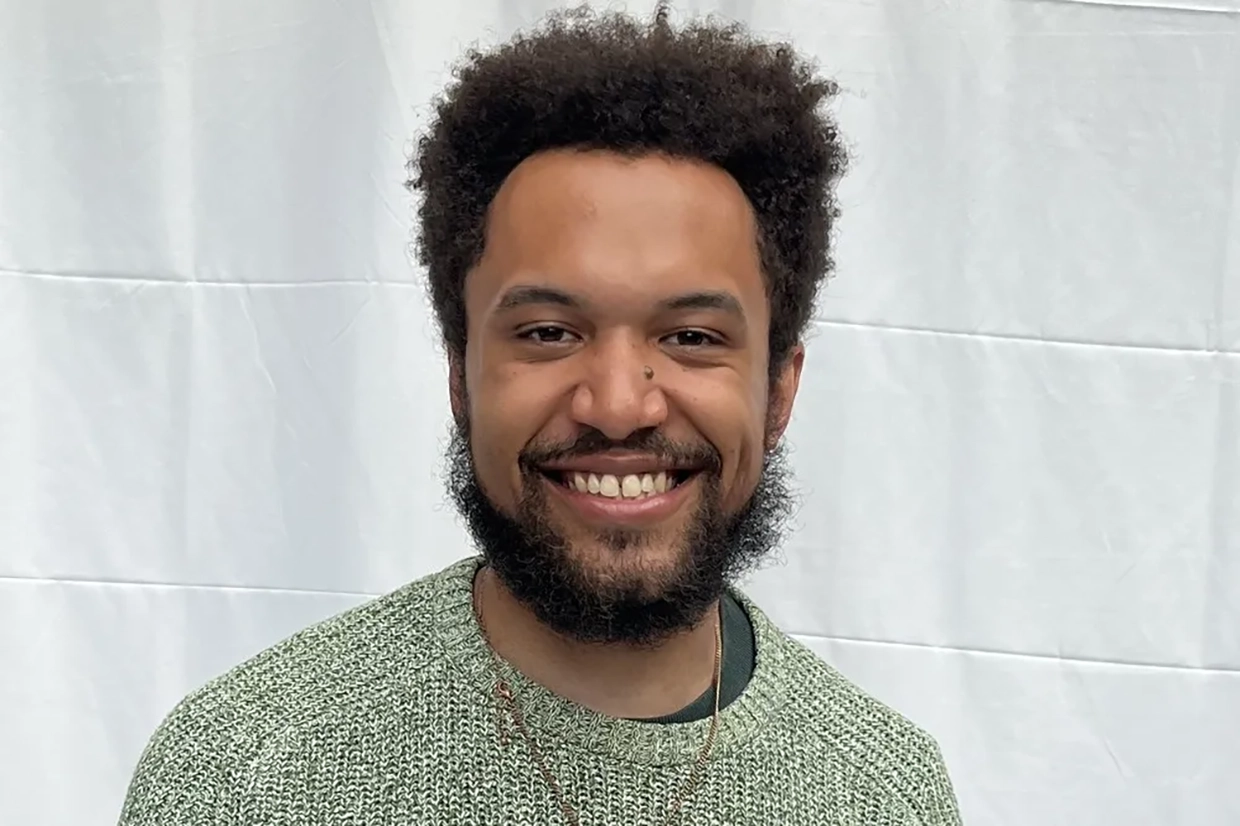
“These changes are still at the proposal stage and no decision has been made. We [opened] a 21-day statutory public consultation this Friday (18 September), giving everyone the opportunity to review the plans and raise formal objections. We are legally bound to consider and respond to any objections we receive.
“We want to make sure feedback is properly considered and work together to make Hackney safer and more accessible. As part of this, I want to bring together advocates for continuous cycle routes, accessibility advocates and transport engineers to explore what is a really challenging transport design question.”
Hunger strike
Thornton has since paused his hunger strike but told the LDRS this would resume if floating bus stops came “back on the agenda”.
The 21-day statutory consultation began on Friday 18 September. Hackney Council says statutory consultations of this kind are not listed on its consultations website, and that it is notifying residents by letter and leaflet, with notices on local lamp columns and in the Hackney Citizen, Hackney Gazette and London Gazette.
Note: this story was amended at 1:25pm on Tuesday 22 September 2026 to add that the council says Thornton is one of its named consultees for the scheme and also to clarify how the consultation is being carried out.
Note: this story was amended at 3:21pm on Tuesday 22 September 2026 to add the council's clarification that it advertises its notices in the Hackney Citizen.


