Plans submitted for 23-storey ‘co-living’ high rise in Homerton

Designs submitted by Re:shape for a mixed-use residential scheme on Homerton High Street include a 23-storey co-living tower containing 385 en suite rooms. These are aimed at single-person households who would share communal facilities like kitchens and lounges, and are touted as one solution to the critical lack of affordable housing in the capital.
Beside it would stand an eight-storey block, which is proposed to house 66 self-contained flats, all at social rent.
If approved, the scheme would redevelop a cluster of decaying low-rise industrial blocks and warehouses, including workshop garage and a disused place of worship which have “failed to contribute positively to the local street scene”, the developer claims.
Hackney Council first resolved to grant planning permission to a different residential scheme at the site in 2020, but it was never implemented – and was followed by major changes to building safety regulations in 2022.
Workaround
In 2025, Re:shape stepped in with the current co-living scheme as a workaround for the steep cost of conventional residential-led developments. The company has already spearheaded several projects across London, including the Woolwich Electric Works regeneration project and another co-living scheme in Tower Hamlets.
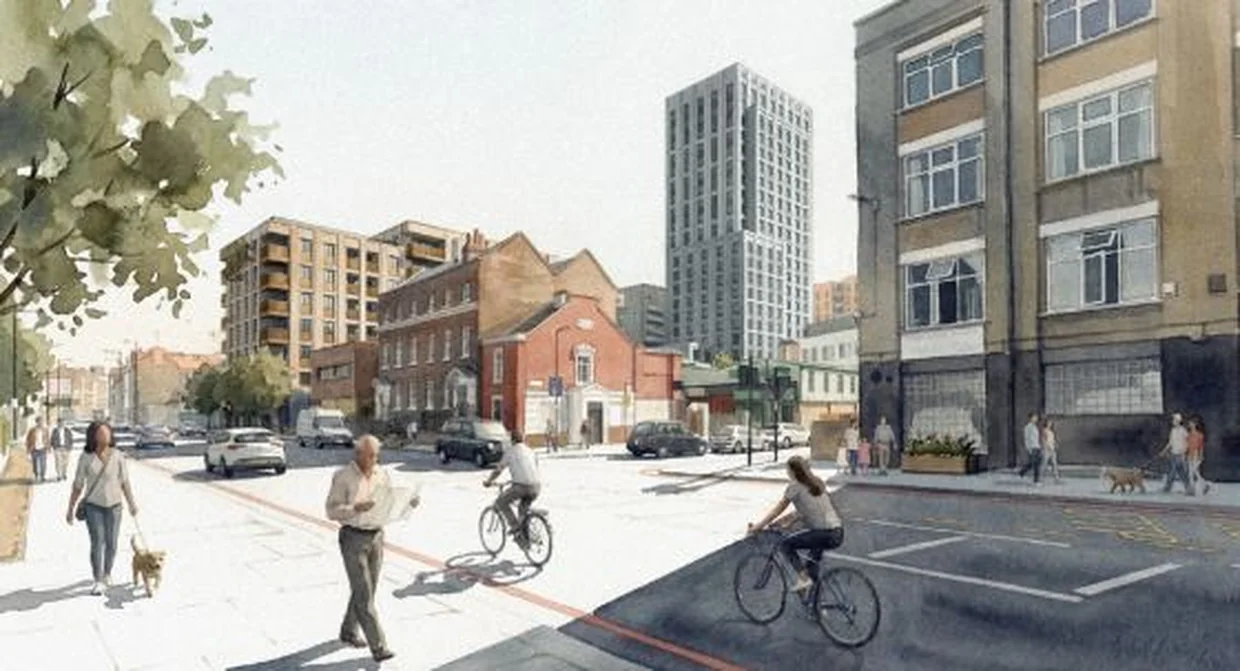
The Homerton High Street project also proposes to create 650 sqm of commercial workspace which will be split into 10 individual units. These would be discounted at least 50 per cent below open-market rates to make them accessible for local, small to medium-sized businesses.
Earlier designs for the project received a backlash from hundreds of people who feared the “disproportionately tall” tower would overshadow their homes on Sedgwick Street, Digby Road and others. Since March, nearly 400 people have signed a petition urging the council to scale back the development to no more than 14 storeys, and to give evidence that the influx of new residents would not spike car congestion on the already “gridlocked” Homerton High Street.
“We support new homes and investment in Homerton, but this proposal, as currently envisaged, is too tall, too dense and too skewed towards private-rental co-living, with no clear commitment to more family-sized or affordable homes or to protecting the safety and flow of Homerton High Street,” the petition stated.
Skyline
Town hall planners, meanwhile, have shared concerns over the project, including the need to demolish a community space and the building’s scale. Heritage officers claim the tower will compete for skyline with the nearby Grade II-listed St Barnabas Church.
The plans are expected to come before Hackney’s planning committee at a later date.
UPDATE: this article was corrected on 28 August at 2.25pm. The former version erroneously referred to a Masjid being redeveloped, but this was confused with a separate place of worship which is in fact disused. This was due to a Google Maps error which states the address as 150 Homerton High Street, but this is understood to be wrong.

This kind of co-living simply isn’t practicable, certainly not on this huge scale.
Sharing kitchens is a disaster, as anyone who’s ever shared a flat, house, an office kitchen or student accommodation will recall with horror.
Food kept in communal kitchens is invariably lost to shameless theft, so every resident would need to have adequate private food storage (including fridge space) in their own tiny flat. Keeping cooking equipment communally results not only in theft but unacknowledged damage and breakages caused by others, but having to cart both that equipment and one’s ingredients around the building is wholly impracticable.
So every flatlet would at least need to have space for a fridge, storage for other food and culinary equipment and a microwave or air fryer.
Sharing lounge space mostly isn’t practicable either, except to the limited extent already familiar in retirement homes. Everyone would want to watch and listen to their own choice of TV or music at all times, which isn’t feasible in a shared space. Those residents with the loudest voices and/or the nastiest behaviour would simply bully other would-be users out of the supposedly shared space. So peaceful residents would end up unable to relax except in their own tiny flatlet.
About the only shared indoor amenities that might be practicable would be communal laundry facilities, although even those don’t keep people’s clothes etc safe from damage and/or theft.
Calling this “co-living” misleadingly evokes the idea of sharing living space with a group friends, which is nothing like having to share basic living facilities with 65 other households, let alone their visitors.
The project is disgracefully ill thought out, not only because of its horrendously selfish scale.
I totally agree with Diana W. Where is the money going to come from, and who actually has an interest in pushing these ideas?
It sounds like a modern version of the Victorian workhouse. Human beings need their own space, privacy, peace and quiet. Who are these people coming up with these ideas, and what are they basing them on? Sometimes I wonder if these ideas are even being generated by AI!
Community spaces are far more important than people seem to realise. Any psychologist or mental health professional would tell you how important social interaction, community and having a safe space are for people’s wellbeing.
We need to be creating communities that support people’s mental health and dignity — not designing environments that take away people’s privacy and independence.
These are going to age terribly. They’re going to turn into dystopian hellscapes, creating a halo effect of anti-social behaviour around them. Examine the trajectories of all of the previous high rise blocks in Hackney, that Hackney was ultimately forced to step in and knock down.
Gloss up all the hipster wnk you like to sell the idea, and sell them to the first wave of renters, but they’re going to go bad faster than a junkie’s lesions as they wear out & are filled with social housing problem cases.
These developments are not about ‘need’. They are about ‘greed’. The extraction of profit from Hackney, taken offshore or up to the Shires, while dumping the social problems & externalities on back onto Hackney residents.
And they are destroying what are essential services for Hackney residents; i.e. the “dirty” trades & workshops they eradicate.
These projects will not work in the UK as we do not have a homogenous society of polite, civilised people, like Japan; nor a cowed population of worker drones, like China (at least not yet …).
Such Modernist dreams would only work if they were to be populated by monastic aesthetes, as imagined back in the days of Bauhaus & Corbusier, & we neither have that, nor even the laws to allow such control over housing in the UK.
LBH needs to put on it’s long sighted glasses on this one and ask, not how it looks in the glossy, expensive brochures; but how it will look after 10, 20 years of neglect … and, more importantly, what it will COST society in the latter part of its designed life.
And, again, this is not new research required. We’ve already seen what happens in all the other tower blocks & estates around them that had to be torn down. Decades of hell before they were …
And they were better built, and with more individual space, than these profit extraction devices will be.
They’re pump, dump, and run schemes with the millionaires and equity managers behind them will be long gone before the full costs start to kick in.