

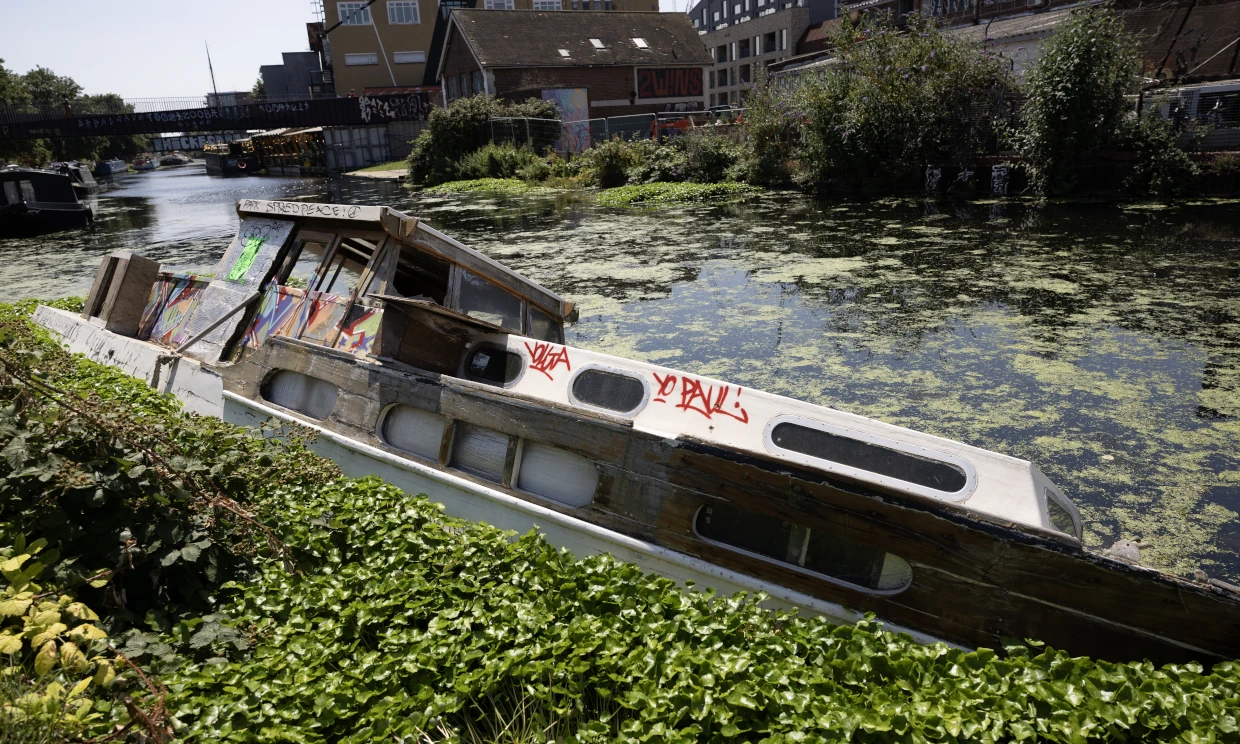
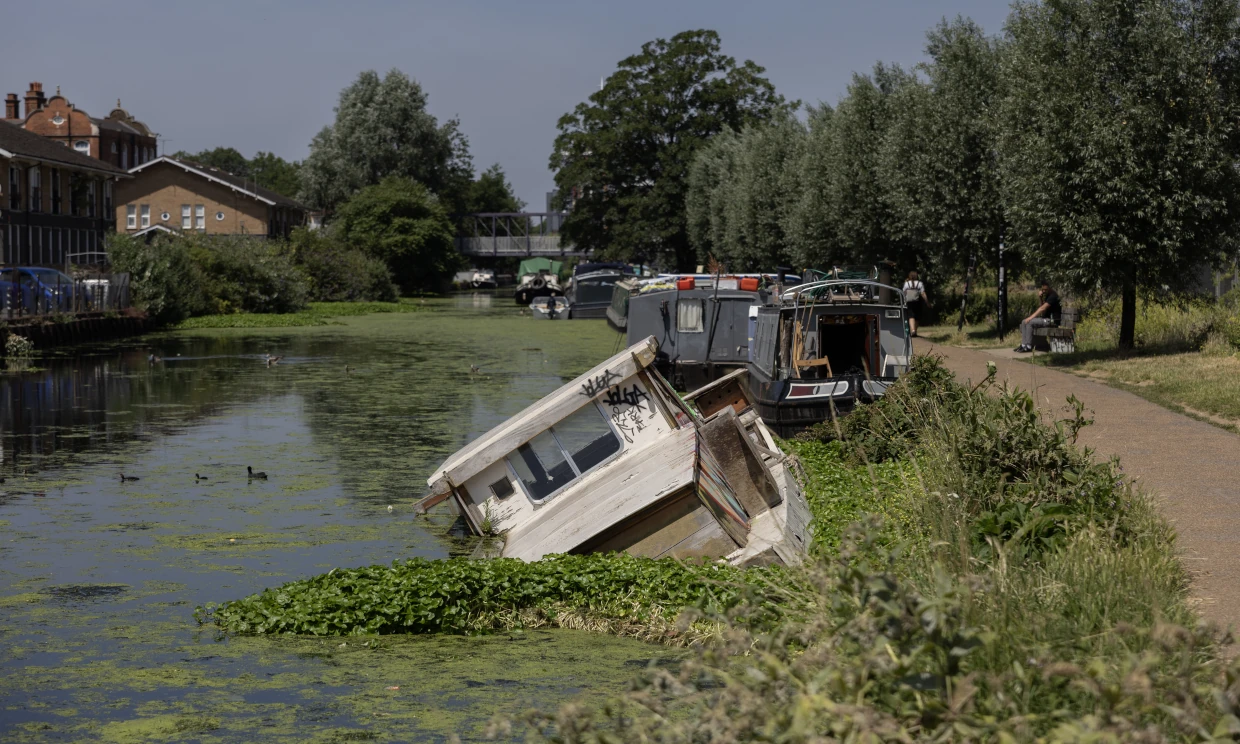
Passers-by walking along the canalside at Hackney Wick, where the Hertford Union Canal meets the River Lee Navigation, can spy at least two sunken boats within touching distance of each other. One is lopsided and strewn with graffiti, slowly being encroached upon by plant life. The other is completely submerged.
They are the visible edge of a problem creeping across London's waterways — and one that Hackney Council has no power to fix.
In a city where exorbitant rents and house prices have become the norm, a rising number of cash-strapped Londoners have felt the call of the water.
An estimated 15,000 people live on narrow boats dotted across London's 100 miles of canals as the lifestyle has seen a surge in popularity. Among the busiest stretches are the Hertford Union, which splits Hackney and Bow along the edge of Victoria Park, and the Regent's Canal running through Haggerston and De Beauvoir. But there's a darker side to this boom – the environmental impact of less responsible owners.
According to the Canal & River Trust (CRT), between 2010 and 2018 the number of boats on London's waterways roughly doubled and it has continued to steadily increase. Up to 2,500 of those boat-dwellers are "continuous cruisers" without a permanent mooring, who are required to move between temporary moorings every 14 days – a category well represented on Hackney's crowded stretches.
As the capital's canals have become more crowded, a rising number of wrecks or abandoned vessels left to rot are polluting the water and blocking the canals.
In April, the CRT confirmed it had a backlog of 126 sunken boats scattered across London's waterways.
Charlie, 29, bought his narrow boat in 2025 with a plan to move to London and is currently moored up on the Hertford Union Canal bordering Victoria Park splitting Hackney and Bow. He speculates that the main driver is owners who fail to properly look after the vessels, either due to negligence or because maintenance costs are high. "They're expensive to get rid of," Charlie said, citing the £500 cost of removing a perfectly functional boat from the water and into a dry dock.
In 2024, the Trust announced that boating licences would see an above-inflation rise, steadily increasing to 25% extra by 2028. The National Bargee Travellers Association (NBTA) estimates the true cost is much higher and warns that boaters' futures look "increasingly unpredictable and financially insecure". It's these rising costs many suspect are resulting in the idealistic lifestyle being abandoned, and with it the deteriorating boats.
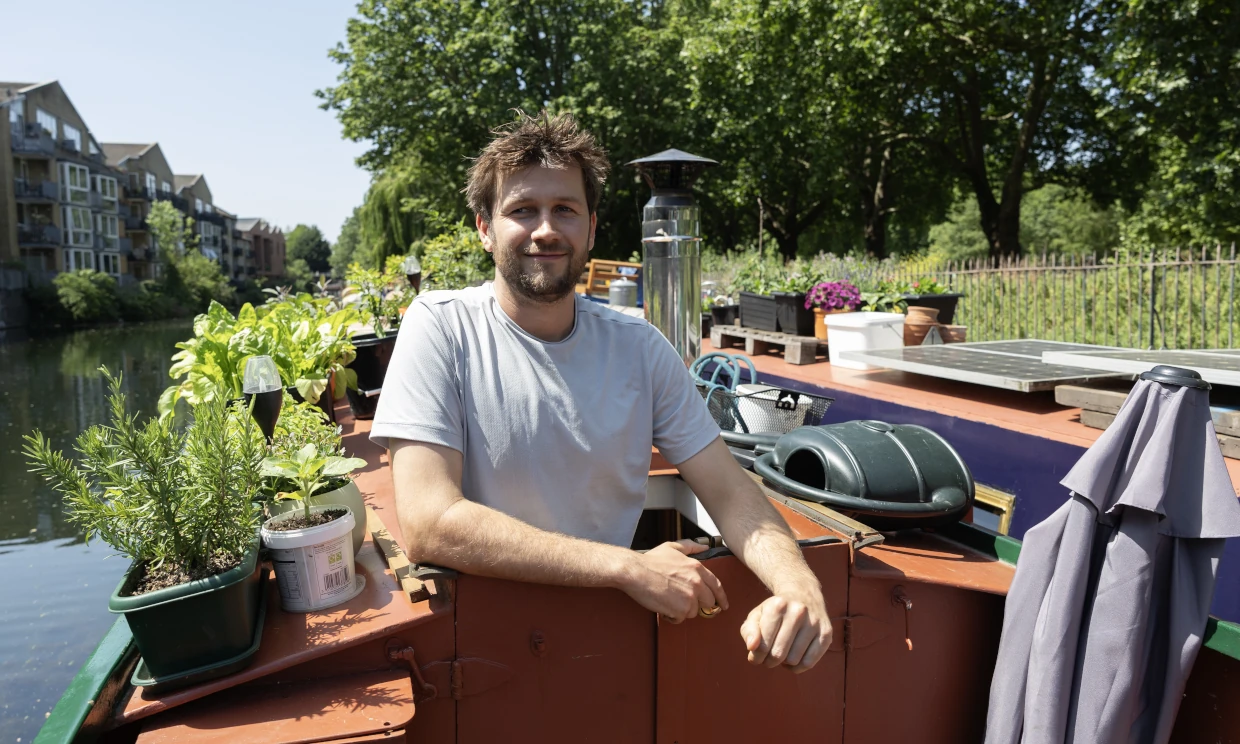
Scott MacDonald, a 62-year-old lifelong canal dweller, despairs at the waste. "You see some really nice boats go under," he says.
Scott is presently tethered at Hackney Wick, where the Hertford Union Canal meets the River Lee Navigation.
As soon as these vessels sink, their engines release oil and other pollutants into water already contaminated by sewage, industrial debris and petrol, plus an increasing number of Lime Bikes.
Scott blames the problem on unlicensed boaters who don't share the same respect for and stewardship over the canal. "We hate it because it gives us a bad name. If you dispose of it correctly, you've got a licence, you know how to get it removed. But it's the unlicensed who don't give a sh*t. It's unacceptable," he said.
However, Scott adds that the protocol around the issue can be vague. After phoning the CRT's emergency helpline to report a sunken boat, he claims he was told by an employee there was nothing the Trust could do and they instructed him to call the London Fire Brigade (LFB).
The LFB has no formal role in the Trust's removal of the boat, but a derelict vessel that sits abandoned or unmaintained for a long stretch can present a risk due to unattended gas, frayed wiring and neglect.
Herein lies the frustration for anyone looking to the town hall for answers. Though London's canal networks snake through several boroughs, council initiatives to reduce pollution tend to focus on air quality. This is because local authorities like Hackney have no jurisdiction over the waterways and do not interfere with derelict vessels – that is the job of the CRT, as well as the Port of London Authority and Thames Water.
For example, Hackney Council issues Smoke Control Orders aimed at limiting solid-fuel boat emissions from wood-burning stoves. Most narrow boat engines, meanwhile, are diesel-powered – and beyond the town hall's reach.
The buck ultimately stops with the boat owners, whose responsibility it is to remove a submerged boat, typically through insurance. But when people simply decide to leave their boats behind, this creates an enforcement loophole if the boat cannot be traced back to its owner.
In May 2026, the Trust said the phenomenon of abandoned boats "can reflect the challenges some boaters face and the Trust's welfare team is there to help those who are struggling". If unclaimed, salvage workers use heavy-duty pumps to re-float the vessel and either tow it away or lift it out of the water with a crane for disposal.
Under the British Waterways Act 1983, the CRT has the power to remove a sunken, stranded, abandoned or unlawfully moored craft once it has exhausted communications with the owners and waited out a statutory removal notice period. Whether abandoned or sunken, the entire process takes an average of 257 days, according to the Trust.
The CRT also states that it paid contractors more than £700,000 to remove boats in 2024/5, equivalent to 2.6 per cent of boat licence fees.
A spokesperson for the Trust said: "The responsibility for removal lies primarily with the boat owner. But the Trust can also take action, which we're most likely to do where a boat is blocking navigation."
They added that as a charity with limited resources, the CRT has the primary goal of keeping the canal and river network open and navigable, which is "a constant balancing act of competing priorities".
Nevertheless, the Trust has committed to tackling the problem over the next three years as it develops a "dedicated and transparent" work programme to salvage these remaining wrecks.


Comments