

The Mossbourne Federation declined three times to apologise to children whose treatment was found harmful by a safeguarding review, as councillors and the safeguarding commissioner who commissioned that review questioned whether anything had changed at a scrutiny meeting yesterday (Wednesday 8 July 2026).
The trust that runs Mossbourne Victoria Park Academy refused to apologise to pupils allegedly harmed under its disciplinary regime when its leaders appeared before Hackney councillors, seven months after an independent safeguarding review substantiated concerns about a “climate of fear” at the school.
Asked directly by Cllr Laura-Louise Fairley, deputy cabinet member for SEND support, whether the federation would publicly acknowledge the experiences reported by children and apologise, the chair of its central board, Toby Campbell-Gray, told the children and young people scrutiny commission: “the answer’s no.”
Pressed again later, he said the federation is “not going to get into apology politics,” and, asked a third time whether he would at least acknowledge what pupils had described, replied: “we won’t respond to the experiences. We will respond to the recommendations as is normal in any public review.”
The refusal drew a pointed response from Jim Gamble, the City and Hackney Safeguarding Children Partnership’s independent commissioner, who had triggered the review.
In closing remarks he said he was “really disappointed that Mossbourne … are not taking the opportunity to apologise to those children that Sir Alan Wood has evidenced suffered,” adding that candour “differentiates those who can reflect and learn from those who simply will defend and continue to defend.”
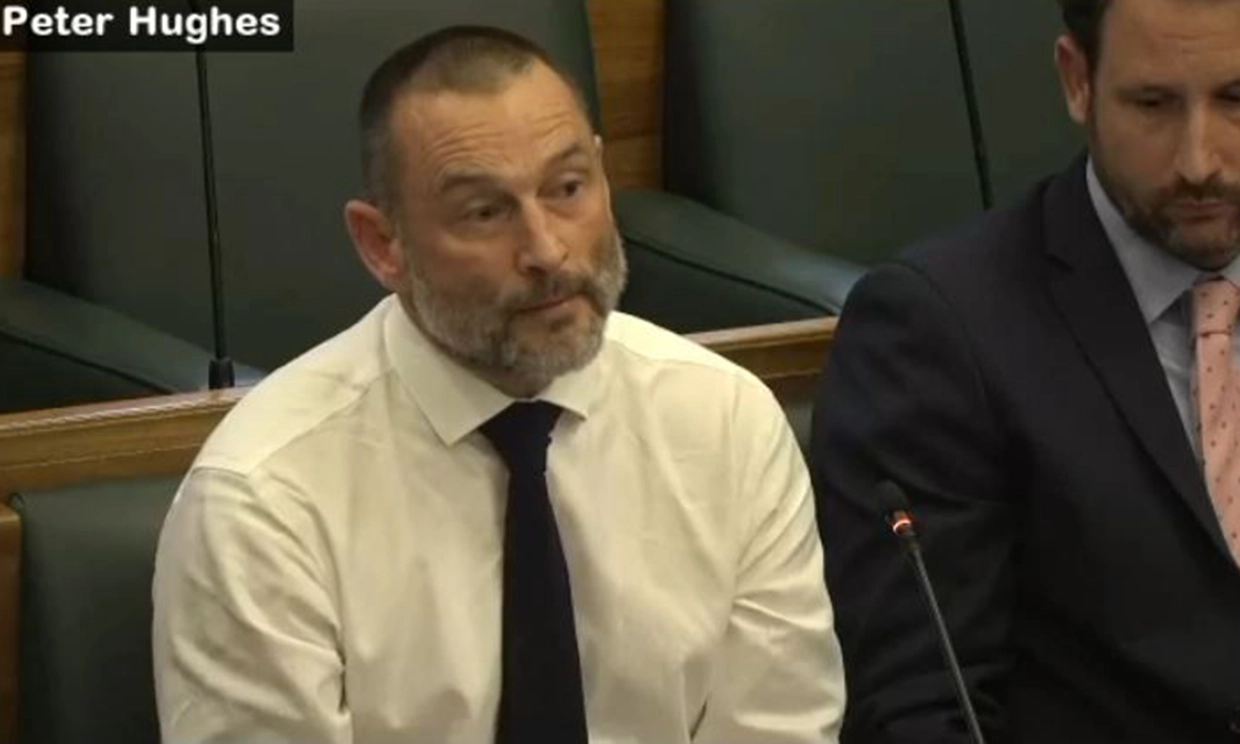
The federation rejected the premise that its methods were the problem. Campbell-Gray said there was “absolutely nothing wrong” with the behaviour policy, and the chief executive, Peter Hughes, said the school made “no apology” for being strict, arguing that classroom time was for learning.
Tyrone Silcott, a long-serving member of the federation, told councillors that if he were choosing a school for a young Black boy, “Mossbourne would be my first choice … and it would still be my first choice today.”
The trust said it had begun a programme of changes in response to the review.
‘Enormous progress’ or no evidence of change
The 8 July meeting was called to test the federation’s implementation of the 17 recommendations made by Sir Alan Wood, the former Learning Trust chief executive whose review was published in December.
That review found that shouting was used routinely to humiliate pupils, that the practice of “desking” — placing children at desks in corridors — was isolating and unmonitored, and that Black Caribbean and Black African boys and children with special educational needs were sanctioned disproportionately.
Campbell-Gray told councillors the federation had made “enormous progress” and had “ultimate confidence in the executive team” to deliver the recommendations.
Gamble’s assessment was starkly different. Reviewing the federation’s update, he said it was “very hard to identify any impact, any evidence of actual change,” and that the trust had never explicitly accepted either the need for the review or its recommendations. What he had seen, he said, “does not give me a level of reassurance that actual real change is being delivered.”
£400,000 in legal fees
Councillor Daniel Rea asked whether the federation still considered its legal spending during the review — reported at more than £400,000, including the appointment of a King’s Counsel to conduct a parallel review — an appropriate use of public money.
Campbell-Gray conceded the trust “would have preferred to have spent less,” and that the decision was “a position that we took, which on reflection may not have been the correct position. However, we took it … It is what it is.”
Desking defended as ‘restorative’
The sharpest exchange came over desking. Councillor Janet Lee put it to the federation that the practice existed to humiliate children, and asked why it continued.
Campbell-Gray replied that “what you call desking is restorative,” and that children often asked to be removed themselves.
Told that this was not what Sir Alan had found, he said that if there was a difference between what the reviewer saw and what he saw, “then we’ll have to register that as a gap,” and questioned whether Sir Alan had examined the behaviour support unit at all — a claim at odds with the review, which devotes several pages to it.
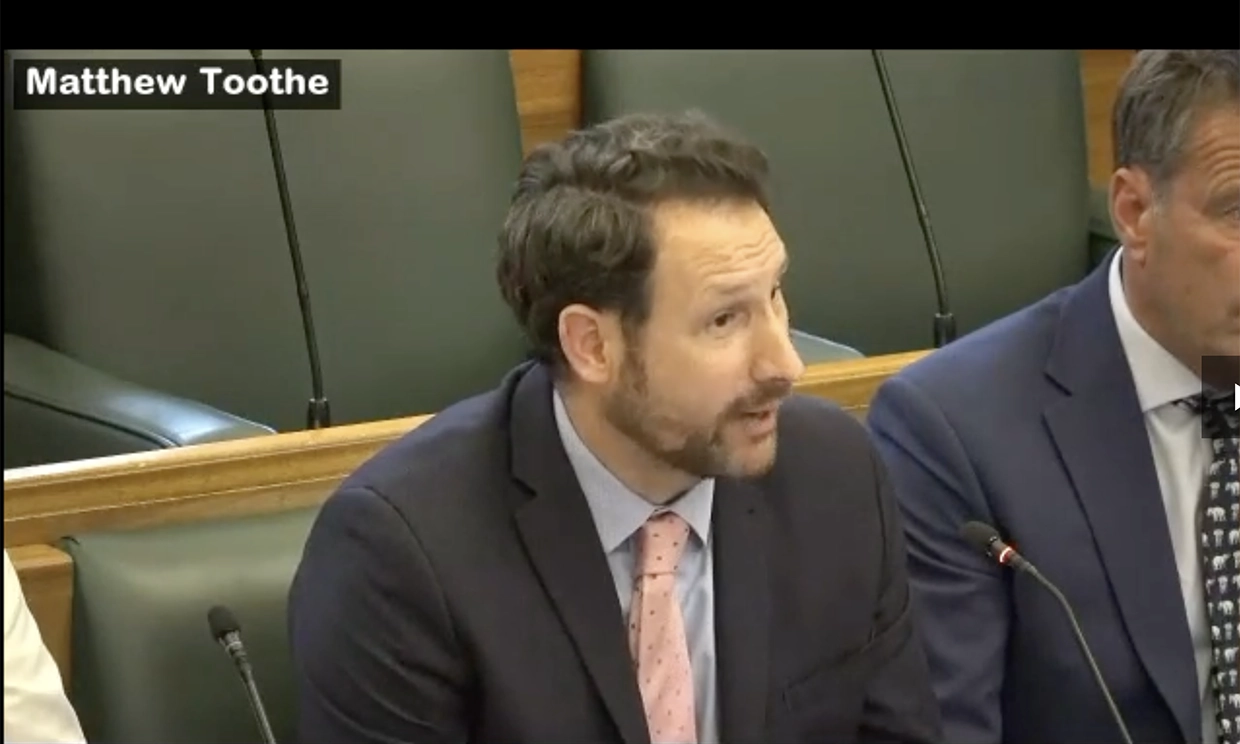
On the school’s toilet policy — which the review linked to accounts of a girl left bleeding through her skirt and a boy who wet himself — the principal, Matthew Toothe, said there had “never been and there still isn’t a policy of not allowing students to use the toilet.”
Asked repeatedly whether pupils had to make up missed time, he eventually confirmed: “yes, we do ask students to catch up on any missed learning time.”
Cllr Soraya Adejare described the arrangement as discriminatory practice against girls.
The regulator that did not appear
Much of the meeting’s frustration was directed not at the federation but at the Department for Education, which had been asked to answer 11 written questions and, on 30 June — the publication deadline — notified the commission that it would not respond.
The chair, Cllr Pascale Frazer-Carroll, said the session had highlighted “the accountability gap for academies,” and secured the commission’s support to write directly to the education secretary about it.
That gap was thrown into relief by a sequence the commission had set out in its questions to the department. Mossbourne Victoria Park was rated outstanding by Ofsted in January 2023. Sir Alan Wood’s review was published in December 2025.
On 23 January 2026 — six weeks later — the secretary of state wrote to the academy praising its achievements and encouraging it to become a systems leader for disadvantaged pupils.
Thirteen days after that, a Hackney area SEND inspection found that secondary exclusions of children with SEND were, in its words, high “and [had] been for too long.”
Mossbourne Victoria Park Academy
Outstanding, then condemned, then praised — in six weeks
How the same academy was rated exemplary, found to be harming vulnerable pupils, and commended by the education secretary — inside a single regulatory system.
<ol class="mvpa-list">
<li class="mvpa-event">
<span class="mvpa-date">24 January 2023</span>
<p class="mvpa-h2">Rated ‘outstanding’</p>
<p>Ofsted judges Mossbourne Victoria Park Academy outstanding in every category, with no safeguarding concerns identified.</p>
<span class="mvpa-src">Ofsted section 5 inspection</span>
</li>
<li class="mvpa-event">
<span class="mvpa-date">9 December 2025</span>
<p class="mvpa-h2">Safeguarding review substantiates harm</p>
<p>The City & Hackney Safeguarding Children Partnership publishes Sir Alan Wood’s review, finding harmful disciplinary practices and a disproportionate impact on children with SEND, and Black and Global Majority pupils.</p>
<blockquote>“MVPA’s success has been achieved at too high a cost for some pupils.”</blockquote>
<span class="mvpa-src">Local Child Safeguarding Practice Review</span>
</li>
<li class="mvpa-event mvpa-praise">
<span class="mvpa-date">23 January 2026</span>
<p class="mvpa-h2">The education secretary writes to praise the school</p>
<p>Six weeks after the review, the Secretary of State for Education writes to the academy praising its achievements and encouraging it to take up a role as a systems leader for disadvantaged pupils.</p>
<span class="mvpa-src">Letter cited in the Commission’s questions to the DfE</span>
</li>
<li class="mvpa-event">
<span class="mvpa-date">5 February 2026</span>
<p class="mvpa-h2">SEND inspection finds the opposite</p>
<p>Thirteen days later, a Hackney area SEND inspection by Ofsted and the CQC reports that secondary exclusions of children with SEND are too high.</p>
<blockquote>“The rate of permanent exclusions of children and young people with SEND in secondary schools is high and has been for too long.”</blockquote>
<span class="mvpa-src">Hackney Area SEND inspection</span>
</li>
</ol>
<div class="mvpa-panel">
<p>The education secretary commended the academy as a model for disadvantaged pupils <strong>six weeks after</strong> a statutory safeguarding review found it was harming them — and <strong>thirteen days before</strong> the local inspectorate said the opposite.</p>
</div>
<p class="mvpa-footer">
Sources: City & Hackney Safeguarding Children Partnership; Ofsted; and the Children and Young People Scrutiny Commission’s questions to the Department for Education, 8 July 2026. Dates and quotations as recorded in the published documents.
</p>
Gamble reserved his bluntest words for the department. It “obfuscate[s],” he said: “the left hand doesn’t know what the right hand’s doing.”
The federation has offered to provide written responses to the commission’s questions — though, Campbell-Gray noted, any such update “will have to go past the Department for Education first.”
The changes the federation says it has made
The federation told the commission it had begun a series of changes in response to the review.
Complaints are now tracked digitally across the trust, and an email address monitored independently of the executive has been introduced.
An anonymous pupil-experience survey has been run across years 7 to 10 at two of its schools, and an external governance review is due to report by the end of December.
On shouting, Campbell-Gray acknowledged the school had “in the past been, dare I say, shouty,” and said the code of conduct was being revised so that “no child is belittled or [made] to feel less than,” with an ambition to reduce shouting “to zero.”
Note: this article was amended at 8.27 am on Friday 10 July 2026 to name Tyrone Silcott as a member of the board.


