
Council consults on Tyssen Street greening as campaigners cry foul over play area
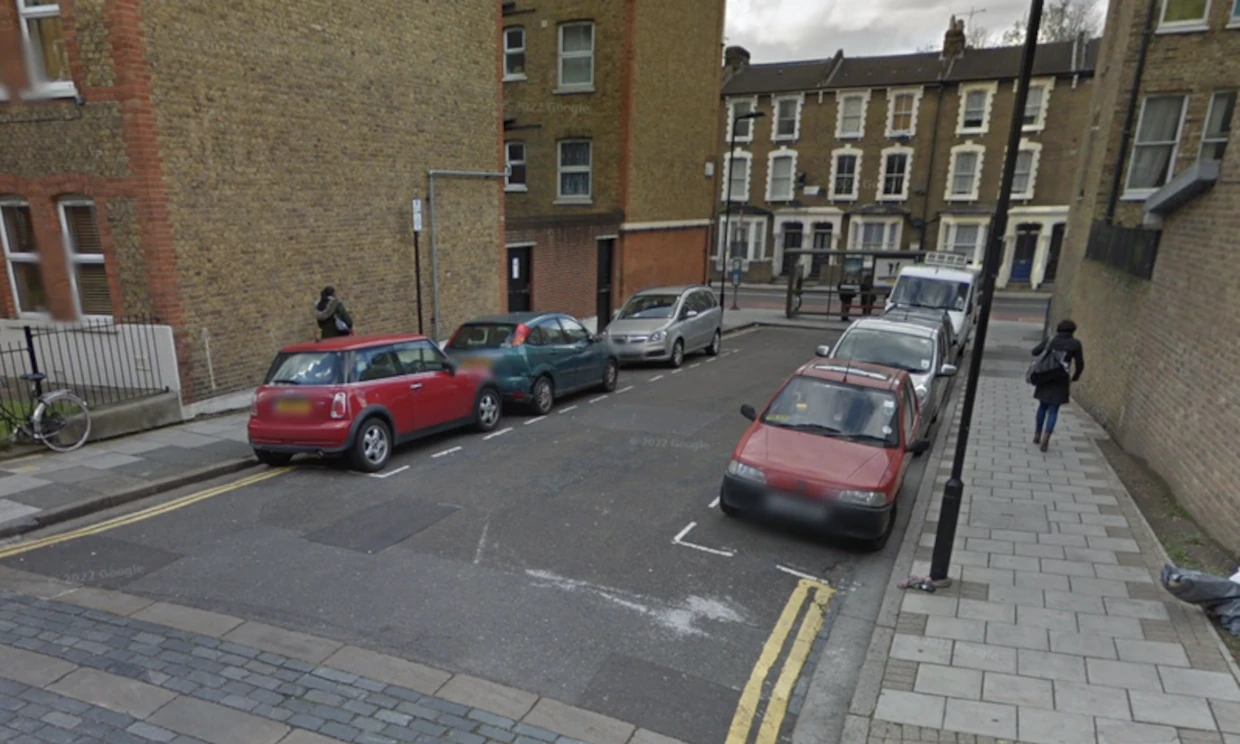
Hackney Council has opened a consultation on plans to redesign the courtyard behind Hoxton Trust Community Garden on Tyssen Street, as part of the wider Connecting Hoxton project.
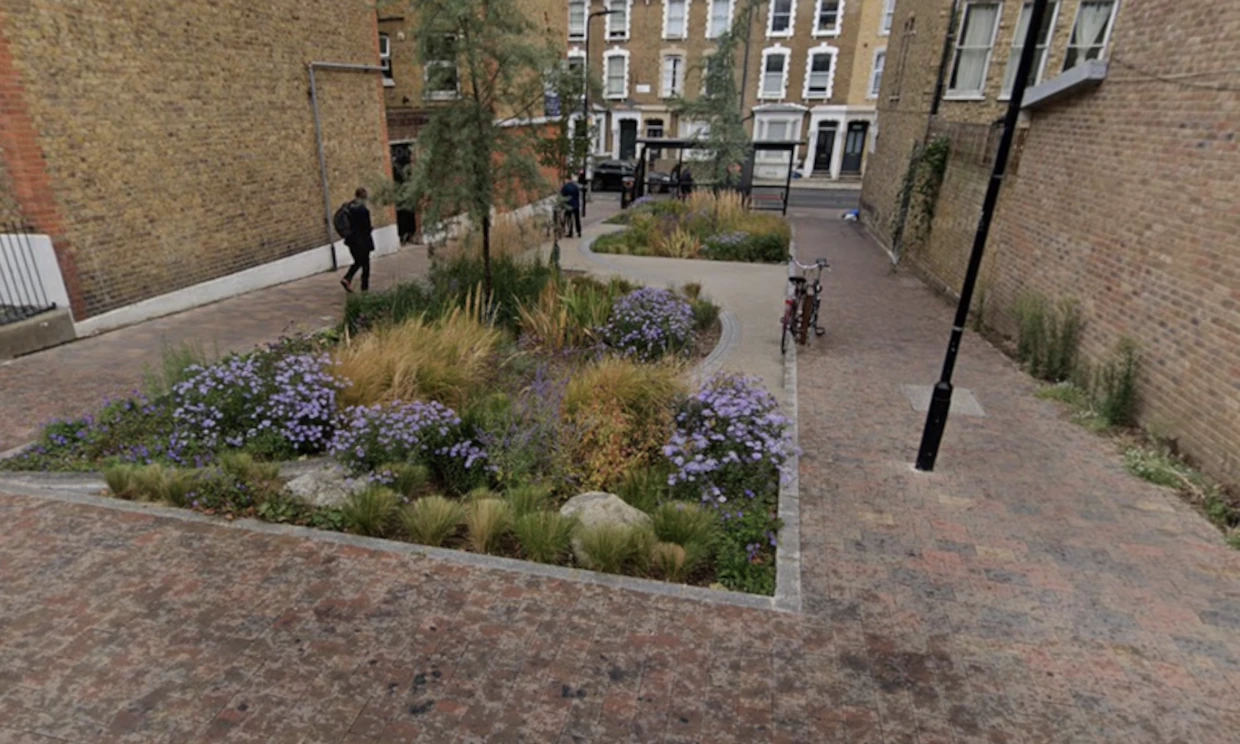
The scheme, announced on 26 June, would bring 11 new trees, new flowerbeds, wider footpaths and a clearer walking and cycling route to the estate. All 26 existing parking spaces would be kept but moved away from the central courtyard towards Cordelia House, freeing up space for planting.
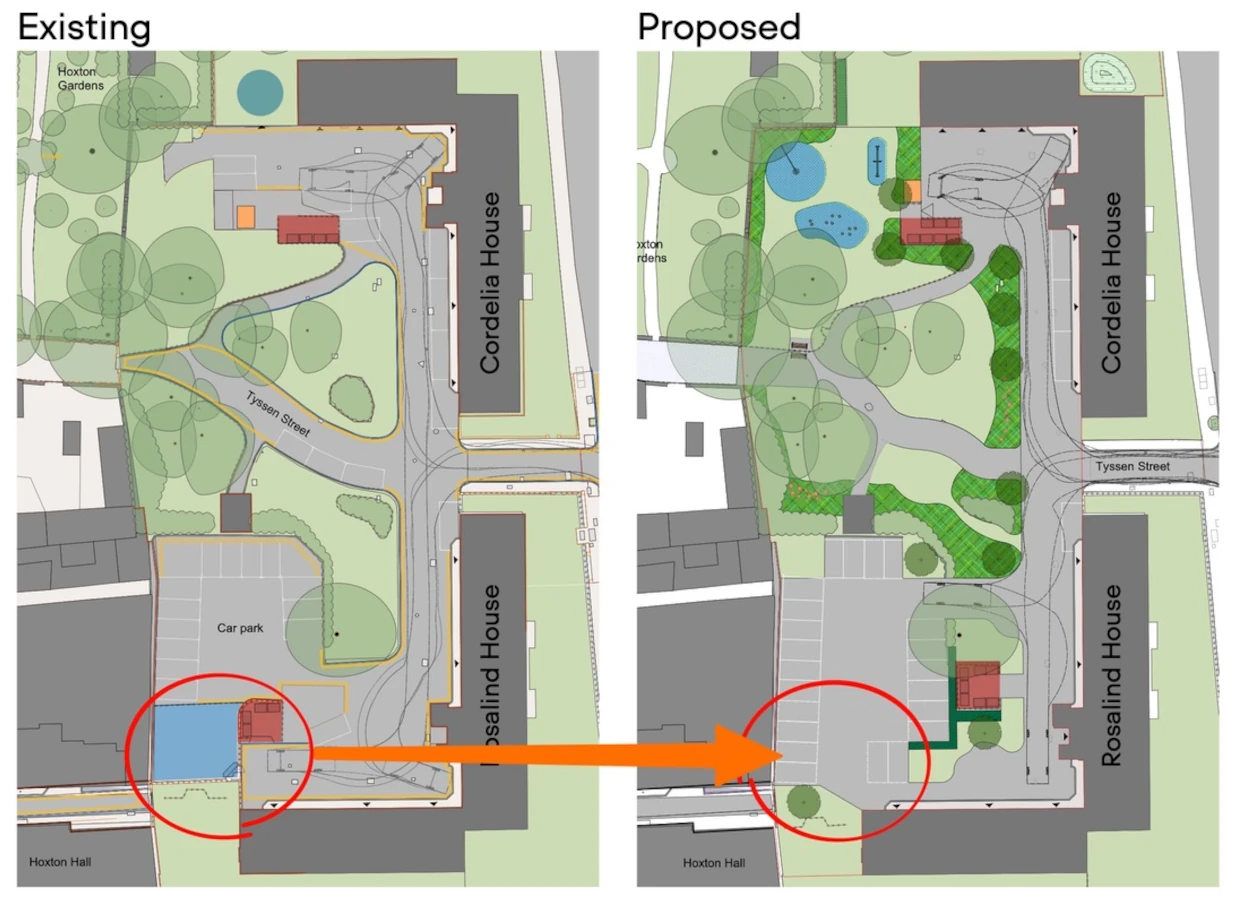
The play area, currently sited on the corner of the car park, would shift to an expanded green space nearby, with new swings and a see-saw. Older play equipment near Cordelia House, which the council describes as underused, would be removed.
The council said the changes responded to feedback from residents, who had asked for more trees and plants, traffic calming to protect pedestrians, extra seating and no cut to the number of parking spaces.
Campaigners object
The plans have drawn criticism from Low Traffic Hackney, a local campaign group focused on reducing motor traffic in the borough.
In a statement published on 29 June, the group welcomed several elements of the scheme, including the new trees, benches and wider footpath, but objected to the demolition of the existing play area to make way for new parking spaces.
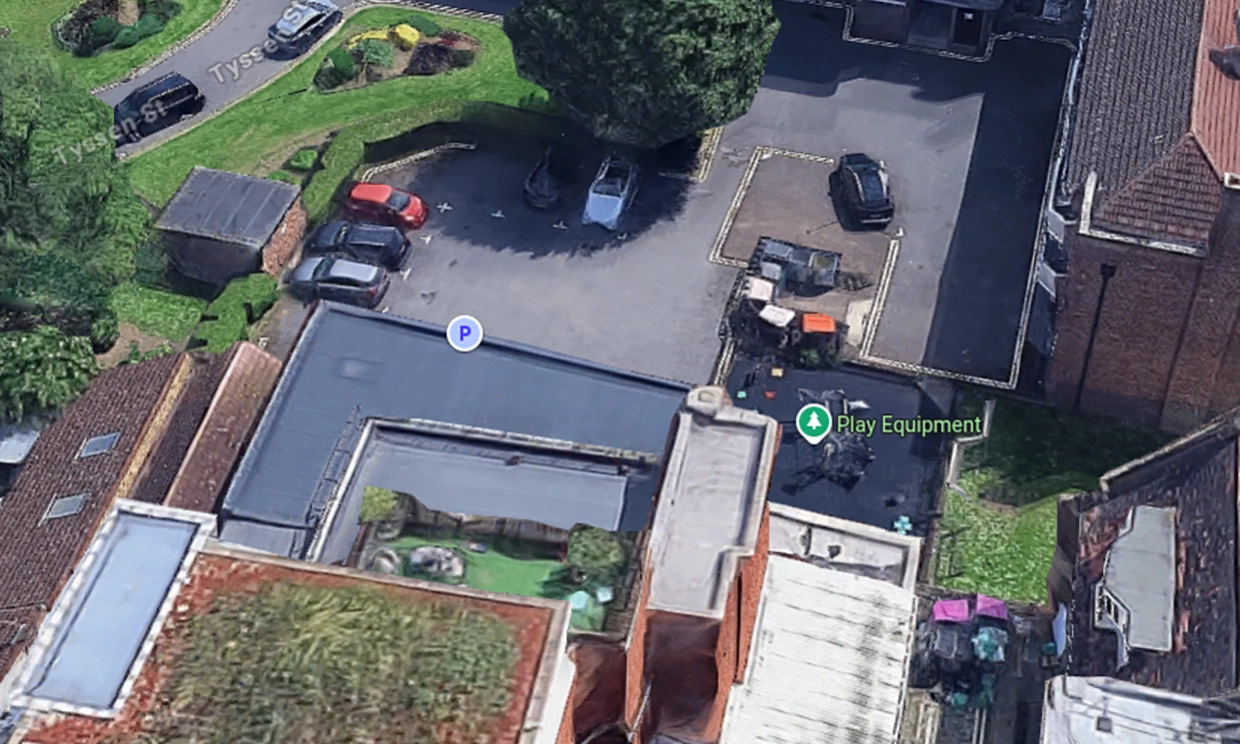
The group called the council’s description of the change as simply moving parking bays, rather than creating new ones, misleading. It argued that the council was not excavating the existing bays and carrying them to a new location; instead, old bays were being turned into green space while a separate community asset, the play area, was being demolished to build new parking elsewhere.
“The false premise behind the proposal is that in order for the community to acquire additional green space it must pay for it by sacrificing valuable space for the community elsewhere,” the statement said.
A question of space
Low Traffic Hackney also raised broader concerns about how space is used, arguing that cars were used by relatively few people for a small part of the day, while a play area served the whole community throughout the day.
The group cited a figure suggesting 79 per cent of households in the immediate area do not own a car, and said public realm decisions in the borough remained disproportionately shaped by a minority of car-owning residents.
Rather than opposing the scheme outright, the group proposed alternatives, including converting the space to cycle parking instead of car parking, or using it for greenery, a rain garden or seating. It called for a 50 per cent net reduction in all-purpose bays, through a mix of removals and conversions to disabled-only, loading and electric-charging bays.
Have your say
The consultation is open until Monday 27 July. Residents can respond via an online form, by emailing consultation@hackney.gov.uk, or by phone on 020 8356 3000.
Hackney Council and Low Traffic Hackney were approached for comment.
Update: 1.40pm, Friday 10 July 2026:
A Hackney Council spokesperson, stated: “We’ve listened closely to residents’ views on our plans for Tyssen Street, which include the extra green space and improved play area that they have told us are important, while keeping the same amount of parking space.
“By moving parking bays from Rosalind House, we can create a better, more accessible play area beside Cordelia House while adding more high-quality green spaces.
“However, these plans are still proposals at the moment, and we welcome feedback from residents so that we can create an inclusive space for everyone.”
Maybe the council could convert low traffic neighbourhoods into no traffic neighbourhoods so that residents can only have their extra green spaces if they sacrifice their own car use and therefore genuinely reduce the number of cars in the borough?
Perhaps LTN’s is simply a manifestation of a more widespread gentrification of Hackney. Just as they are squeezing the same number of cars onto fewer streets to give themselves more space, so they are squeezing the same number of people into fewer houses to gain more room for themselves and even at the lido in London Fields they are squeezing the same number of people into fewer lanes again to give themselves more room in a public space?
LTN’s are simply a manifestation of a wider gentrification of Hackney
Given that over 2/3 of residents do not own a car or drive in Hackney (cars are very expensive to buy and run!) its not logical to say that LTNs are a manifestation of gentrification. Given that car ownership and usage increases with wealth, its more logical to say that LTNs are a manifestation of support for lower income and deprived residents. See this blog post:
https://www.lowtraffichackney.org/latest-news/do-ltns-favour-rich-people
Your argument is scientifically incorrect. I will try to be brief (and I invite you to correct me). The same traffic distribution will result in the same distribution in air pollution so a decrease in one neighbourhood will result in an equal increase in another neighbourhood and the overall change in air pollution resulting from a redistribution of traffic as in LTN’s will be zero. However air pollution has steadily decreased across the Borough because of better public transport, cleaner engines and an increase in walking and cycling but to underline the point that LTN’s make no difference to air pollution Hackney Council reported in 2025 that, “while harmful emissions like nitrogen oxides have steadily fallen across the Borough since 2017, statistics show the rate of decline had not fallen any faster after 2020 when LTN’s were first introduced” So the council acknowledges that LTN’s have had zero effect on air pollution which is exactly the resident’s argument against the scheme all these travel difficulties for zero benefit to the community.
A question for Low Traffic Hackney:
Do you agree that redistributing traffic will simply result in redistributing it’s associated pollution and that there can be no change in the overall level of air pollution simply because of it?
Don’t you think you owe it to the low income and deprived residents that you represent to answer questions in public about your policies?
Wont anyone answer my question about the affect LTN’s have on air pollution, what about Jon Burke, the “Lord of the low traffic neighbourhood” who is presumably an expert on the subject?
Hi John,
Evidence shows LTNs reduce traffic with the areas without any negative impact (and sometimes a positive one) on boundary roads: https://www.sciencedirect.com/science/article/pii/S1361920922003625
They aren’t the biggest influence on air quality that is things like ULEZ and electrification but they have a role on a small scale.
All of Hackney’s roads have much better air quality since before LTNs, with main roads seeing the biggest improvements.
Evidence shows LTNs do not just move traffic around they actually reduce the number of journeys: https://docs.google.com/document/d/13Nsm_GFdH6CpIpPpOZ7hbhLZScgqCAP7ZGI0xi4qDqA/edit?tab=t.0
But they aren’t just about air quality. They make streets far healthier, allow more walking and cycling, kids playing etc and also much safer, saving literally hundreds of lives: https://injuryprevention.bmj.com/content/early/2025/07/17/ip-2024-045571
OK no Jon Burke, so what about Councillor Puech who I know is an enthusiastic advocate of LTN’s could she answer my question about the affect that LTN’s have had on the level of air pollution in Hackney ie none?
In the run up to the may election Ms Garbett said in an interview with the Hackney Citizen, “The people of Hackney own Hackney and we’re taking it back” so if no one from the Council can answer my question about LTN’s could I ask her, Can we please have our streets back?
@John Anthony. As important as air pollution is, I don’t think this article is about that. My comment previously was in response to your comment about gentrification, not air pollution.
Dear Rich, thank you for sending me the scientific paper published jointly by Imperial College and the LSE on the effect that LTN’s have on overall air pollution. Let me make the the following points, that it is the only peer reviewed paper on the subject and that it discusses 3 LTN’s in Islington (there are 100 LTN’s in London) so is a very small study and that even this meager data shows that while inside all three LTN’s NO2 levels fell, in two of them NO2 levels rose in the wider borough including in the boundary roads and in both cases that rise was significantly greater than the drop and in the third case NO2 levels fell inside the LTN and the boundary roads but it rose in the wider borough though this rise was less than the total fall and if you combine the changes in NO2 concentrations due to all three there is an overall rise of 1.9 micro grams per cubic meter which rise is a significant threat to human health. So the data is at best inconclusive and what there is supports my argument.
Dear Rich, thank you for sending me the scientific paper published jointly by Imperial College and the LSE on the effect that LTN’s have on overall air pollution. Let me make the the following points, that it is the only peer reviewed paper on the subject and that it discusses 3 LTN’s in Islington (there are 100 LTN’s in London) so is a very small study and that even this meager data shows that while inside all three LTN’s NO2 levels fell, in two of them NO2 levels rose in the wider borough including in the boundary roads and in both cases that rise was significantly greater than the drop and in the third case NO2 levels fell inside the LTN and the boundary roads but it rose in the wider borough though this rise was less than the total fall and if you combine the changes in NO2 concentrations due to all three there is an overall rise of 1.9 micro grams per cubic meter which rise is a significant threat to human health. So the data is meager and at best inconclusive
The gentry are desperately trying to hide their crafty designs on Hackney behind this flimsy stuff. They are a greedy self entitled thieves. “The people of Hackney own Hackney” Let the Mayor put her money where her mouth is on this.
Ok John – if you want to gaslight yourself into believing it shows the opposite of what it does then that is fine, but for the benefit of any readers in possession of their basic faculties, the study conclusion is this:
“We found that LTNs have the potential to substantially reduce air pollution and traffic in target areas, without increasing air pollution or traffic volumes in surrounding streets. These results provide sound arguments in favour of LTNs to promote health and wellbeing in urban communities”
Seems pretty conclusive and of course you offer no alternative evidence just the usual unfounded statements. Lets have this debate in reality not based on personal biases.
Dear Rich, You sent me a paper entitled “The evaluation of low traffic neighbourhood (LTN) impacts on NO2” which looks at the effect that introducing LTN’s has had on air pollution in Islington, see Table 2 on page 5 of the paper “Changes in average NO2 for each LTN situation pre and post LTN. I sent you my conclusions based on this data, and you have said that my conclusions are unfounded and that I am not in possession of my basic faculties, so could you please explain to me where my conclusions are incorrect and so help me to recover my faculties?
Do you accept that the whole of local government policy regarding LTN’s is based on this single small study and so people are quite entitled to question its validity . I have questioned it’s validity so if you can’t could the hackney Council Explain why the conclusions reached in this paper are valid and since it is public policy in terms that those who are still in possession of their basic faculties can understand?