
Sadiq Khan rejects New York-style air conditioning rules

City Hall will not follow New York in ordering local businesses to keep their doors and windows shut while air conditioning (AC) is running, officials have confirmed.
All stores in the Big Apple have been prohibited from doing so since 2015, with Department of Consumer and Worker Protection (DCWP) Commissioner Vilda Vera Mayuga branding it an “irresponsible practice that comes at the cost of our environment”.
With sweltering temperatures continuing to hit London – along with the relentless debate around air conditioning in homes – questions have also been raised around the conduct of businesses in the capital.
There is currently no rule against the ‘open door’ policy in London, with some retailers and hospitality firms using it to attract customers in need of respite from the heat.
But officials confirmed there were no plans to change the laws, despite the Mayor’s aim of making the capital a net zero carbon city as soon as possible.
Split opinions on the London Assembly
While Sir Sadiq Khan’s own party didn’t go so far as to call for him to impose new regulations on businesses, Labour colleagues suggested an awareness campaign could help owners be more environmentally friendly.
Leonie Cooper AM, London Assembly Member for Merton and Wandsworth and Labour’s environment spokesperson on the London Assembly, said; “When people use air conditioning, whether in the home or a car, leaving windows open leads to massively higher costs.
“So if people want to avoid waste and unnecessary costs, especially in these times of high energy charges, closing windows when using aircon makes total sense.
“City Hall does not have powers to enforce in this area, but does have the power to run awareness campaigns and can encourage more responsible and cheaper energy use across London.”
However, the City Hall Conservatives suggested that any interference with business practices would be overreaching.
Thomas Turrell, a Conservative Assembly Member who sits on the environment committee, said such a policy was far too overbearing on businesses.

“Our political leaders should focus on making the lives better of the people they represent, not sending dictacts to businesses,” he added.
“This kind of nanny state, snitch on thy neighbour nonsense undermines community spirit. The most vibrant high streets in London are the ones where businesses are a integral part of the local community; funding the Christmas lights, sponsoring local events.
“We should want small and local businesses to grow and succeed, not be burdening them under needless red tape about when they can and cant open the door. Nor should we be wasting money on a Door Squad for the Police to enforce it.”
A spokesperson for the Mayor of London said: “London has experienced the impact of the climate emergency first-hand in recent years, with soaring temperatures and flash floods.
“The Mayor is ensuring London is better prepared and more resilient to the impacts of climate change, which is why he commissioned the London Climate Resilience Review.
“The first heat risk action plan for London is to be launched in the summer, which will include actions to address cooling London’s infrastructure, and will be accompanied by a Heat Health Action Plan.”
AC debate
Soaring temperatures in the capital – combined with the ‘Urban Heat Island’ effect which makes London hotter than much of the rest of the country – have prompted calls to rethink the AC ban imposed by the government and Mayor of London in recent years.
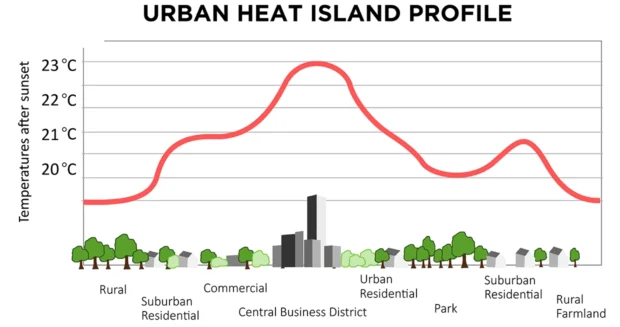
Currently, the London Plan encourages new developments to adopt “passive” cooling measures – such as trees, green roofs and shading – rather than “active” measures, such as AC. Across the country, just five per cent of buildings currently have AC installed.
Earlier this week the Conservative party pledged to overturn the ban, first introduced in planning regulations for new homes in 2021, to stop families “suffering unnecessarily” for the sake of reducing carbon emissions.
James Cowling, managing director of Next Gen Tories, a pressure group focused on helping the Conservative party win young voters, told the LDRS: “The policies of both Reform and Labour revolve around rationing.
“Rather than doing the difficult work to get building and ensuring there’s abundance, they prefer to limit – be it homes, energy, or infrastructure.
“London is worst hit – with policy that make the cost of living eye-wateringly expensive.
“The knock on effects make our lives worse – like not having enough power for AC.”
Last September, Samantha Dixon, the building safety minister, told MPs that air conditioning was “not a desirable or financially efficient solution due to the energy it consumes”.
In response to a written parliamentary question, she added: “Widespread reliance on mechanical cooling would place additional demand on the national grid, slowing the transition to a zero-carbon system and requiring further generation capacity.”
The government was contacted for comment.