
London’s ‘AC gap’ could cost £200 million a year in productivity
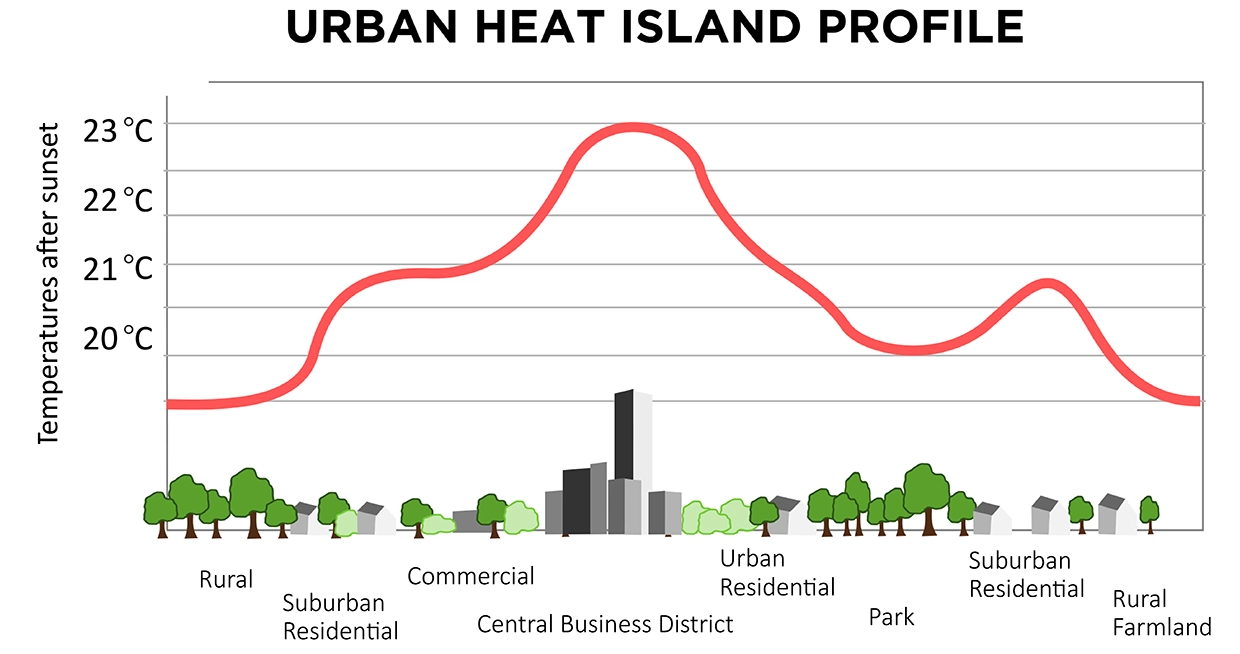
The urban heat island effect is greatest in the central business district. Local features such as parks can have a big effect. Image: Met Link
A lack of air-conditioning could cost London millions per year, as experts warn that current “passive” cooling policies are leaving the city’s economy and residents at risk.
London’s lack of preparedness for extreme heat could see more than £200 million lost in productivity annually by 2030, new research has suggested.
The capital’s decision to deprioritise the installation of air conditioning (AC) in both commercial and residential buildings means it is particularly vulnerable as temperatures continue to rise.
Researchers from Climate X, a risk analytics firm, have now said that upgrading high-priority buildings around London could carry a £440 million price tag.
Research seen by the Local Democracy Reporting Service (LDRS) suggests that £458.5 million needs to be spent on adaptation measures in total across the city.
Currently, the London Plan encourages new developments to adopt “passive” cooling measures – such as trees, green roofs and shading – rather than “active” measures, such as AC.
Across the country, just five per cent of buildings currently have AC installed.
But London’s increasing density of buildings and roads have caused an “Urban Heat Island”, meaning it is hotter than surrounding towns and countryside.
This overheating risk, which has already caused hundreds of heat-related excess deaths in London, has prompted City Hall to draft a Heat Risk Delivery Plan to safeguard the capital in future.
Failing to do so quickly, however, will put strain on London’s economy as commuters, outdoor workers, office staff and those who keep the city moving need liveable conditions, according to Lukky Ahmed, CEO of Climate X.
He told the LDRS: “This isn’t just a future risk. This is today. There is currently not the urgency that is needed. This problem has been flagged in red every single year – something has to give.
“We have a combination of the Urban Heat Island effect with the fact that temperature control and cooling measures are not common within properties in the UK as a whole – developers have only just started to factor that in.
“If you look at all of these things, we get the unfortunate reality that people are losing their lives as a result of heat in London.
“In addition, we have second order effects like lost productivity – commuters choosing to stay home as opposed to going into the city and spending on local businesses.
“There’s still not really the urgency that’s needed to deal with this, however. This issue is just being accepted without any outcry or outrage.”
Ahmed said not enough was being done primarily for political and funding reasons.
“If City Hall invest in the right things – for example, flood defences, heat measures – people’s lives won’t get worse, but they won’t perceive it as better, either,” Mr Ahmed said. “Will they feel that benefit and take it to the voting booth – or will investment in education, for example, resonate with more people?”
He said the “reality” was that any changes to the London Plan for new developments would also need to be backed up by a retrofit programme for London’s existing buildings.
Climate X’s research also looked at New York City, where AC coverage is installed in around 90 per cent of buildings. Their cost of adaptation will only be £120.5 million, most of which will go on cooling measures.
“New York’s numbers show the value of acting early on climate adaptation. The city has already invested in key foundations like air conditioning and drainage, and that gives it a crucial head start,” said Laura Xu, product lead (adaptation finance) at Climate X.
“Our data shows that with just £18 million in further flood resilience investment, New York could avoid over £159 million in future annual losses, delivering a 762 per cent return on investment. London, by contrast, is still exposed – especially to extreme heat.
“The message is clear: the sooner cities invest in climate resilience, the greater the long-term return.”
Last month, the London Assembly’s planning and regeneration committee was told by experts that active and passive cooling should work together, rather than in a hierarchy.
Ed Hezlet, Head of Energy at the Centre for British Progress, said that as temperatures increase, a failure to encourage efficient active cooling systems means “people will go out and buy lots of inefficient devices”.
Sir Sadiq Khan, mayor of London. Photograph: Noah Vickers
A spokesperson for the Mayor of London told the LDRS: “London has experienced the impact of the climate emergency first-hand in recent years, with soaring temperatures and flash floods.
“The Mayor is ensuring London is better prepared and more resilient to the impacts of climate change, which is why he commissioned the London Climate Resilience Review and has already implemented several of its recommendations.
“The first heat risk action plan for London is to be launched in the summer, which will include actions to address cooling London’s infrastructure, and will be accompanied by a Heat Health Action Plan.”