
London’s heat network customers need ‘urgent price protection’, ministers warned
Around 30 per cent of UK households connected to a heat network are in the capital, it is estimated. Photograph: Julian Hochgesang / Unsplash
London’s heat network customers need “urgent price protection” amid volatile gas and electricity costs due to the US-Iran war, ministers have been told.
Around 30 per cent of over 477,000 households – representing more than 1.1 million people in the UK – connected to a heat network nationwide are believed to be in London.
While older heating systems use fossil fuels to generate energy, the most efficient, low-carbon heat networks use ambient heat (heat stored in the air or water), or waste heat (such as from the London Underground, energy-from-waste plants, or data centres).
They form part of the Mayor of London’s strategy to ensure the capital has Net Zero emissions by 2030, with City Hall suggesting last year that 460,000 new heat network connections are needed.
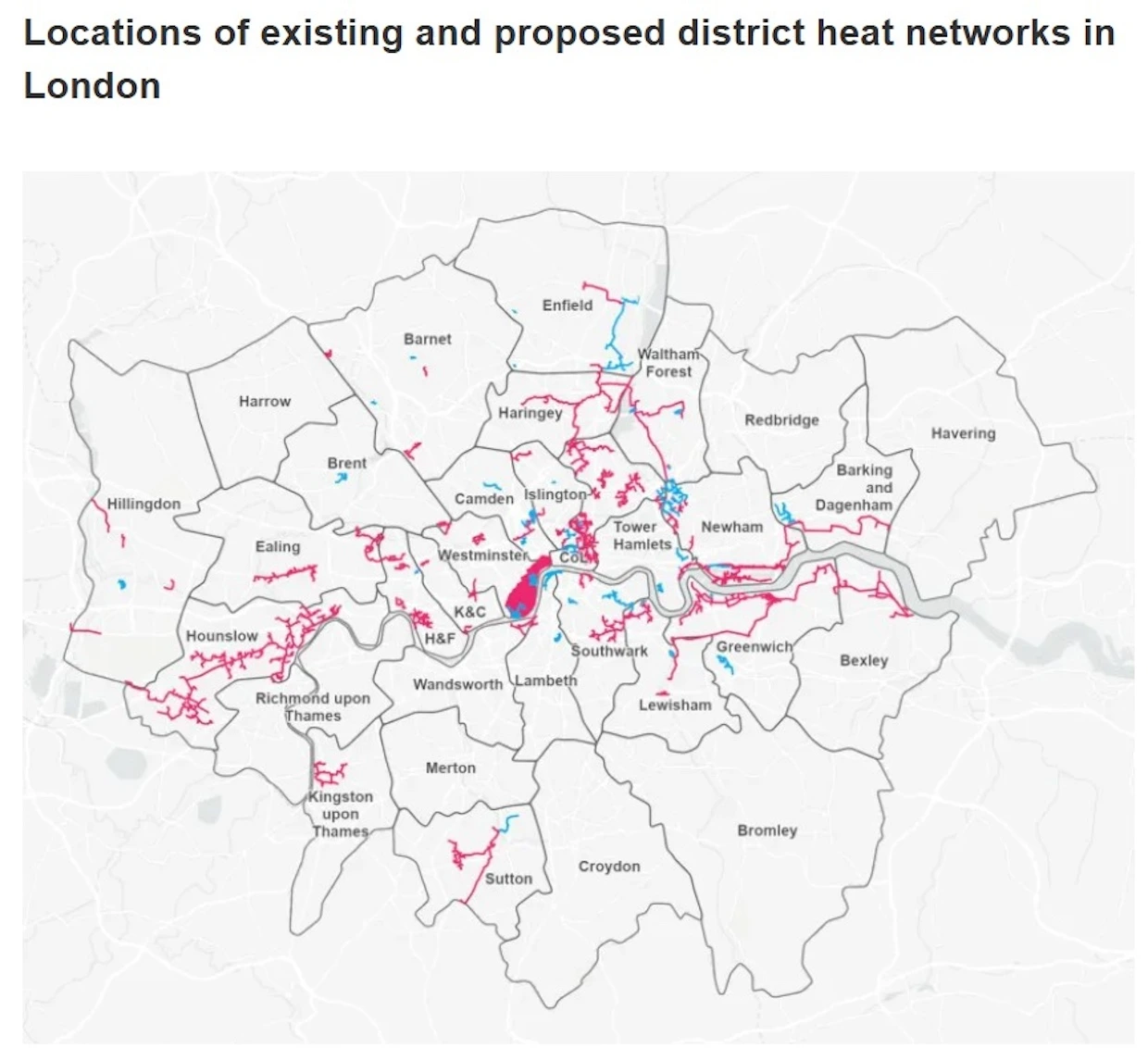
Location of heat networks in London. Image: City Hall
However, there is currently no provision for energy regulator Ofgem to impose a price cap for heat network customers the same way that traditional gas and electricity consumers can be protected.
Leonie Cooper, Chair of the London Assembly Environment Committee, has now written to Energy Secretary Ed Miliband warning that the US-Israel conflict with Iran could lead to similar price shocks for heat network consumers that were seen after the Russian invasion of Ukraine in 2022.
She said recent reforms strengthening protections for such customers “do not go far enough to shield” them and that a price cap was needed as an “urgent priority”.
“The escalating conflict in the Middle East and the closure of the Strait of Hormuz to shipping has brought into sharper focus the vulnerability of heat network customers to rising costs”, she wrote.
“Even prior to recent price rises, gas prices for customers in the United Kingdom were expected to be 50 per cent higher in March 2026 than in the winter of 2021-22. The case for equivalent price protections for heat networks is now even more urgent.
“While decarbonised heat networks potentially improve energy security through the use of waste heat and renewable energy, most are currently still affected by price shocks while electricity prices are still linked to gas.
“Ofgem should implement price protections for heat network customers as an urgent priority. This needs to be simple and understandable and give equivalent protections as domestic gas and electricity customers receive”.
The Environment Committee, which is due to publish a report on heat networks in May, heard from Citizens Advice that the experience of people on heat networks has been “really quite stark in comparison to people on gas and electricity”.
The experience of some Londoners on heat networks – including outages and spiralling costs – sparked calls for City Hall to address what they feel is the root problem with the system.
One heat network customer in Hackney told the Local Democracy Reporting Service (LDRS): “We’re not protected now, so what difference does it make?
“We’re all charged differently in the block no matter what we use – what’s the point of writing to Ed Miliband when they’re not aware of what we’re facing now where the ones who pay compensate the ones who don’t?
“The whole of London is set to become a heat network – when there’s a problem, thousands of properties are affected, why not just hook us up to our own system? The system is not fair. It’s going to get worse [because of the war] – but the actual heating system is the main problem”.
A spokesperson for the Department for Energy Security and Net Zero told the LDRS: “Tackling the affordability crisis is the Government’s number one priority. In January, we gave Ofgem new powers to regulate heat networks and shield people from unfair price spikes.
“We are taking action to ensure communities are able to benefit from low-cost and efficient heat networks, with better service and pricing”.