
Mixed-gender Hackney football league watched by FA as they lead charge for inclusive sport

Red Stripe FC form part of Hackney’s Power League. Photograph: Gabriel Stewart
A mixed-gender Hackney football league could be paving the way for more inclusivity in the sport.
The FA (Football Association)’s research partner, Brunel University, recently attended a seven-a-side mixed Power League match to compile data on duels, tackles, goals and assists.
The research is being conducted with a view to potentially introducing mixed adult football as part of the FA’s affiliated game from the 2026-27 season.
Hannah Morris, captain of the Hackney league’s newest and most serious contenders – Red Stripe FC – believes the benefits of a mixed game are obvious.
She said: “People just love playing mixed. I love it because I’m always being pushed and stretched, and I think it’s improving my football a lot.
“We’re growing as a team in the sense that the guys have to play a different kind of football that they have to learn how to play a bit, maybe less physically”.
Morris’ experience is backed up by Brunel’s research, led by Dr Laura Hills. A previous study by the team on youth football found younger girls were at no greater risk of injury than boys in their age group, and that playing mixed-gender football helped to build girls’ confidence and hone their technical skills.
The research prompted the FA to raise the age limit for mixed youth teams from Under-11s to Under-18s by 2015.
Now, they are looking to go one step further. The England Football website reads: “In recent seasons, The FA has been piloting mixed adult football in a range of settings including one-off tournaments, corporate competitions and LGBTQIA+ leagues.
“The purpose of the pilot programme is to respond to growing participant interest and to test whether, and how, mixed adult football could be delivered as part of the FA affiliated game”.
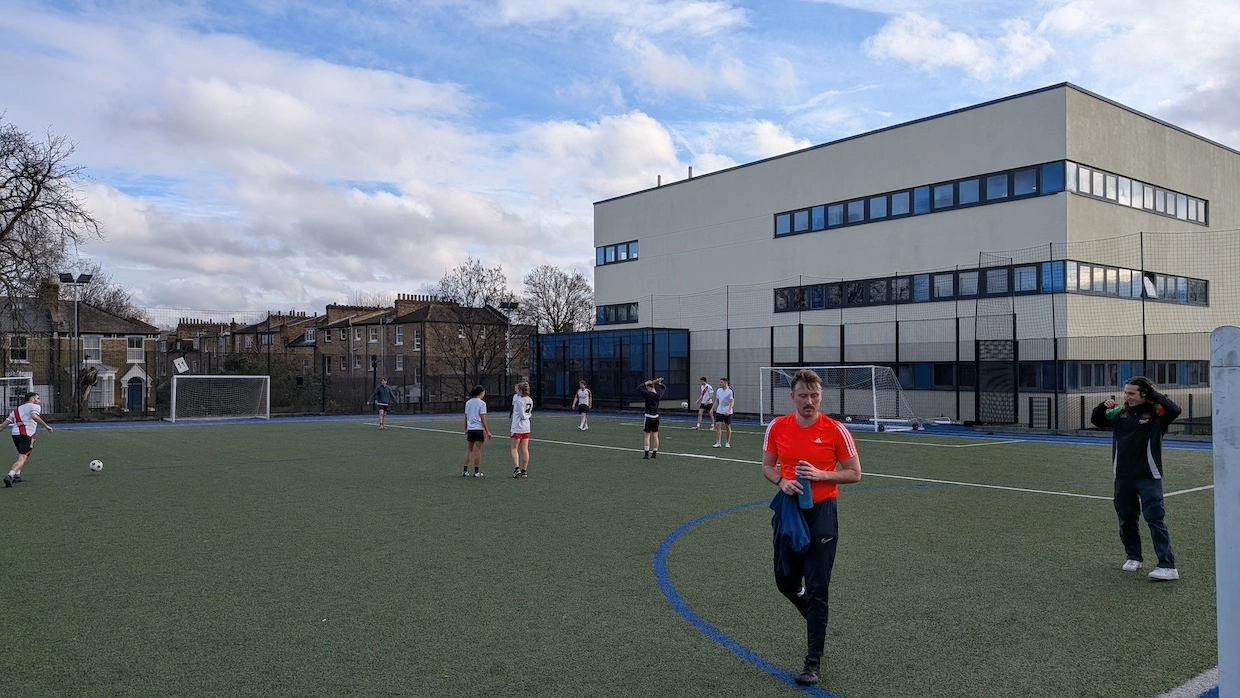
Red Stripe FC on the pitch. Photograph: Gabriel Stewart
Red Stripe’s league is not under the FA’s jurisdiction, meaning it can set its own rules. One states three women or non-binary players must be on the pitch at all times.
Jack Jacob, Morris’ teammate, said of the FA’s research: “It’s just cool that they’re taking an interest at the grassroots level because there’s obviously this debate about whether mixed football is viable at the top level”.
But for Morris, playing for Red Stripe isn’t just about promoting mixed-gender football. She added: “For me right now, the most important thing is the community aspect and the social aspect.
“Loneliness is quite a big thing among our generation, and I really would like to encourage more people to just get involved and pick up sports. It’s such a good way to connect and relax”.
Founded last year, the team was formed by a group of friends looking for a space to play together in a fun but competitive environment.
The team was named in honour of the Argentinian side River Plate – supported by Morris’ Argentinian boyfriend and teammate – who play in a red-striped kit.
Red Stripe are currently top of their league, closely pursued by their rivals Judas FC. Not a single point separates the teams.
Judas FC themselves made headlines back in 2021 after their men’s side organised an open-top bus parade through the streets of Dalston to celebrate winning their local seven-a-side league.
The Power League also offers a space for trans athletes to take part following the FA’s ban on trans women’s participation in women’s football last June.
Morris said: “In the women’s league I play for, trans people can’t play in it anymore and maybe this would be a more inclusive alternative sport that everyone can play”.
The FA pointed The Citizen to the England Football website when contacted for comment. They have not confirmed whether the plans to introduce mixed football under their rules and regulations next season will go ahead.