
Council ‘leads energy revolution’ in pioneering scheme to install solar panels on social housing
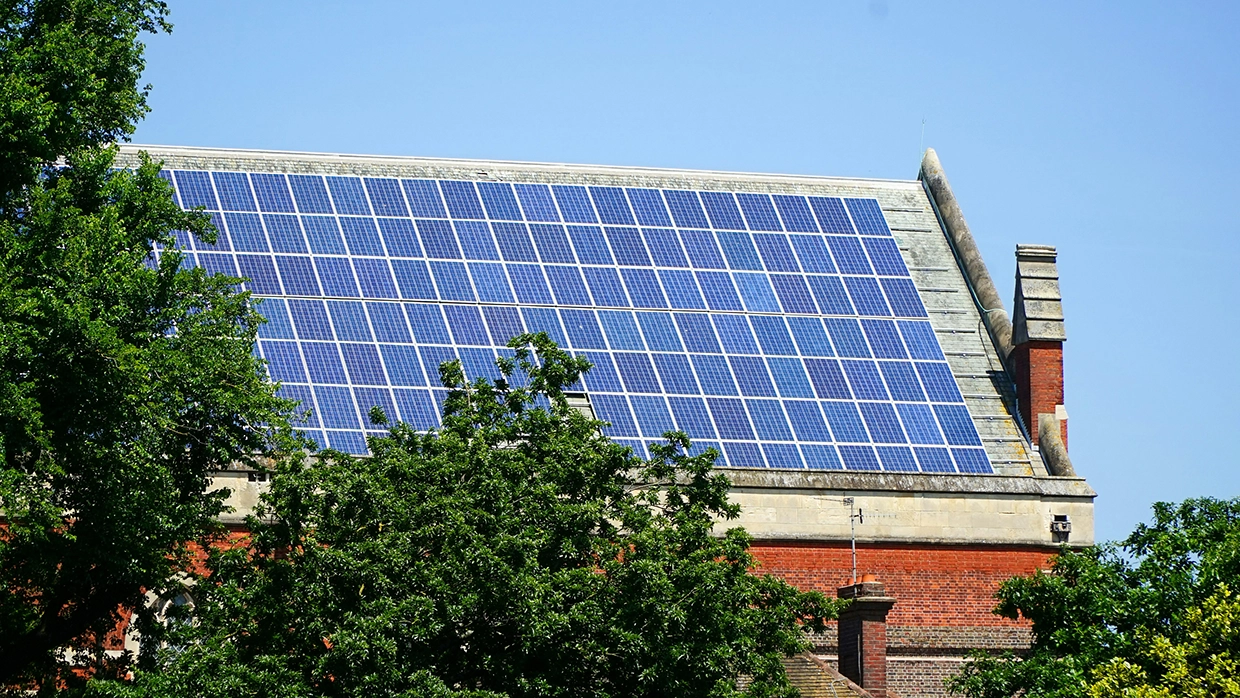
Energy specialists at Emergent aim to provide solar power in a way that is fair. Photograph: Watt A Lot / Unsplash
Residents in social housing in Hackney are set to benefit from a pioneering solar scheme that puts the borough at the forefront of an “energy revolution.”
In 1897, local authority Shoreditch Vestry opened a groundbreaking facility in Coronet Street which burnt waste to generate electricity to power street lamps, a church and a local infirmary, now St Leonards.
The system was replicated across the country; by 1905, 40 similar stations had been opened and 15 of London’s 28 Metropolitan boroughs were supplying their own electricity.
Now Hackney Council – in partnership with specialists Emergent Energy – seeks to do it all again.

Emergent Energy founder Reg Platt. Photograph: Gabriel Stewart
Emergent’s mission is to provide solar power in a way that is fair, including to people who may not be able to afford to install panels themselves. In Hackney, this involves partnering with the council to install solar panels on the roofs of social housing blocks, without asking residents to foot the bill.
In the first project of its kind in the UK, 750 households on the Frampton Park, Whiston and Wren’s Park estates have the opportunity to buy discounted energy supplied directly by solar panels on their rooftops.
Reg Platt, CEO of Emergent Energy, said: “We want to lead a local energy revolution like we did in the past.”
Historically, solar panels on blocks of flats could only be used to supply electricity to the national grid or power communal areas. This has prevented many social housing residents from benefitting from solar energy.
The scheme uses an Ofgem-approved microgrid solution to supply rooftop-generated solar electricity directly to residents of the building, developed by Emergent Energy in partnership with Hackney Council’s energy services arm, Hackney Light and Power (HLP).
As well as providing cleaner energy for 27 blocks across the three estates, HLP hopes it will deliver electricity bill savings of around 15% compared with market rates.
“It’s a different relationship with energy than we’re used to,” Platt said. “We all have a relationship with the big national suppliers where every household is treated as one single customer regardless of what’s going on in your area.
“As a customer of our scheme, you have a direct relationship with a renewable technology and it’s literally on your roof. You’re a customer of that with your neighbours.”

Platt at Hackney Light and Power and Emergent Energy’s Christmas outreach day at Wren’s Park estate. Photograph: Gabriel Stewart
Around 4,000 solar panels have been installed generating around one megawatt of electricity – approximately one fifth of the blocks’ energy needs. Communal services such as lighting and lifts are now powered by the panels, and the scheme is now being rolled out to individual properties.
The scheme has only been active for a few months, and approximately 10% of households have signed up so far. Platt added: “The more customers sign up, the more solar that’s used, the more money comes back into the scheme and the more we can reduce the bills,” Platt added.
“The guiding mission of Emergent is to give everyone access to the benefits of solar regardless of how much money you’ve got, or the type of house you live in.”
Residents who join the scheme will switch their energy provider to HLP, essentially creating a public local energy company like those which existed before the energy system was nationalised in 1948.
The power generated will be topped up by solar energy from the National Grid. A key part of the agreement between Emergent and HLP is that the customers’ long-term price is protected, meaning unprecedented price rises – like those seen following the start of the Ukraine war – will impact them less.
Platt said: “If prices doubled, we’re not just suddenly going to double the price of the solar, the solar is going to basically stay what it is today. So the savings that customers can gain will increase.”
Last year the council commissioned Emergent Energy for £1.96million to carry out the project, using money from their carbon offset fund – which developers are required to pay into to mitigate emissions from new projects.
Emergent oversees the operation of the microgrid while Hackney Council owns the assets and recoups investment through electricity sales and exports to the grid, reinvesting any profits into council services.
The project is key for the council to meet its target of becoming a net-zero borough by 2040, and contributes to Hackney’s Climate Action Plan target of six MW of solar on council housing by 2030.
Jason Powell, Head of Operations at Hackney Light and Power, said: “Our hope is that we prove it works here and then we scale it up both in Hackney – where there’s another 15 megawatts capacity potential available for us – but also as a blueprint for a national rollout of projects like this.
“It’s the largest private wire microgrid operation that’s been rolled out at scale across the country and scale matters because you need to prove it at scale to be able to then roll it out.”
When asked about the timescale of rolling out of the project further, Powell said the aim was to do it “as soon as we can”. “We’re already in the process of looking at what scaling up looks like,” he said.
Scaling up would first require further sign-ups from residents, however. Alexander Thomas, resident of Wren’s Park Estate and a member of its Tenants and Residents Association (TRA), believes initial communication could have been better.
He said: “There’s not been a real understanding of it. There’s not been an engagement until now with the TRA. I think that’s something they could learn from this estate.
“Come through the TRA, because they’re trying to get people’s trust. If there are pre-existing networks, build in from that.”
Thomas was an early sign-up himself after chatting to the engineers installing the panels. “To feel so closely connected to it… I like the feeling. It’s local energy for local people.”
Platt believes localised solutions are the key to fixing the energy crisis. He said: “You’ve gone from publicly owned municipal local [energy] to nationally publicly owned to nationally privatised.”
“Now we’re in this position where all these new technologies are coming along, which are not large-scale technologies, they’re small-scale – but the energy sector is struggling. The chronic problems in the electricity sector [arise] because we’re still treating it like a national system, but the technologies aren’t [like] that anymore.”
If the scheme proves successful, there is ample potential for expansion. As of 2024, there were around 4.1million social and affordable homes in the UK.
If scaled up, experts estimate the approach could deliver as much as 6.75GW of solar energy, worth up to £13.5bn in clean energy investment.
If you are a resident of the Frampton Park, Whiston and Wren’s Park estates, you can register for further information here.