
‘Mould kills! Safe council homes now!’ – Protesters call for housing reform on first day of Awaab’s Law
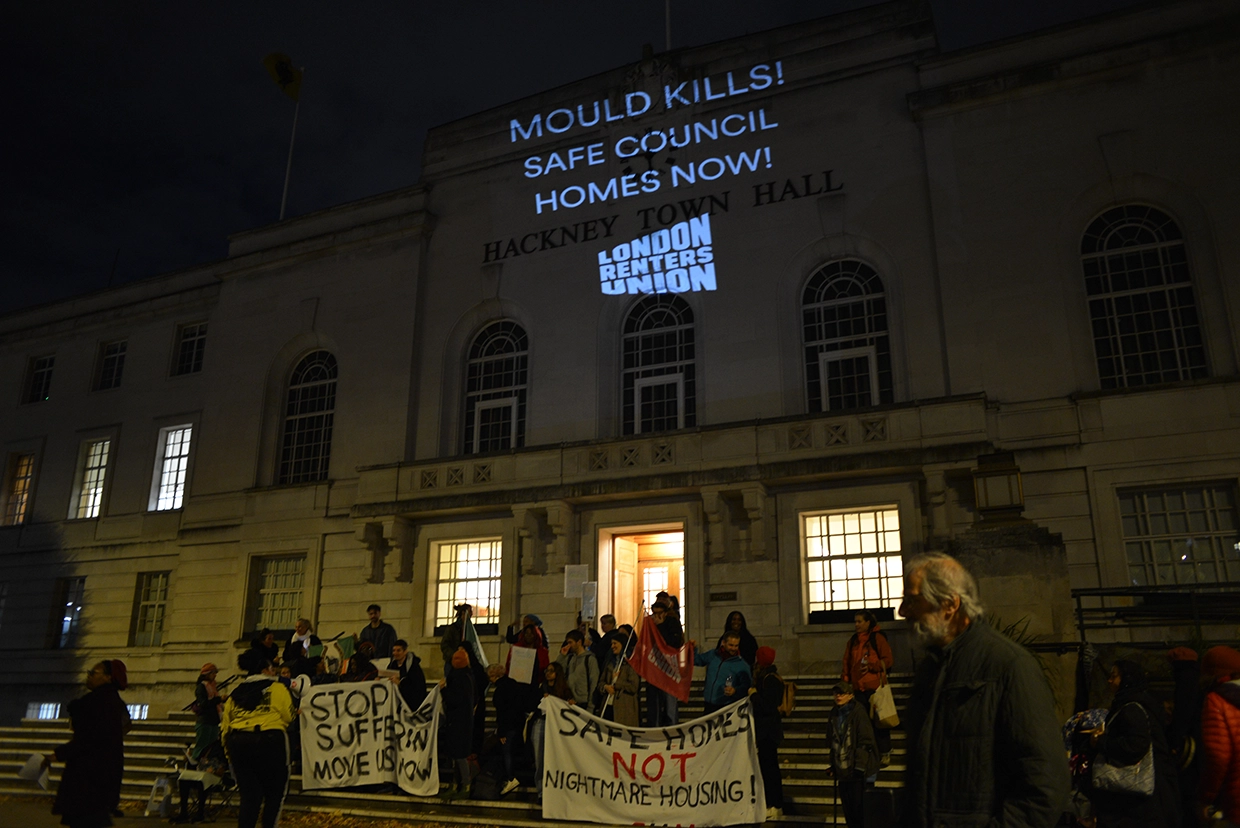
Protestors projected warnings on Hackney Town Hall to mark the start of Awaab’s Law. Photograph: London Renters’ Union
Dozens of protesters gathered outside Hackney Town Hall calling for safer social housing in the borough on Monday night (27 October), the day Awaab’s Law came into effect.
Around 80 members of the London Renters’ Union (LRU) held up banners and placards which read “stop the suffering, rehouse us now”, with some holding pictures of their dire living conditions.
Despite chasing repairs for years on end, tenants say they are being ignored and continue to face problems which have exacerbated their health conditions including sarcoidosis, sickle cell, and chronic asthma.
One protestor, Mariama, said that the mould in her council flat had “significantly” worsened the health of her daughter, 16, who suffers from sickle cell anaemia – a genetic condition that leads to a compromised immune system.
She told the Citizen: “I’m so fearful. This is having such an impact on her health, her social life and her education.”
Mariama moved into her council property in 2010, when her daughter was just one year old.
But shortly after getting settled, she said black mould began to spread across the walls and over the ceiling.
She said: “My child has had chest infections which can be life threatening with their condition. She has had several hospital admissions due to extremely painful episodes and the doctors say it’s linked to the water damage and mould in our home.
“We have both experienced palpitations, inflammation, joint pain, extreme fatigue, brain fog, skin rashes and many other problems.”
Mariama has also paid for private tests which found that her daughter had “high” levels of ochratoxin in her system – a mycotoxin caused by certain mould – as well as fluid on her lungs.
The 42-year-old said she first reported the problems to the council in 2013, and has made several complaints since.
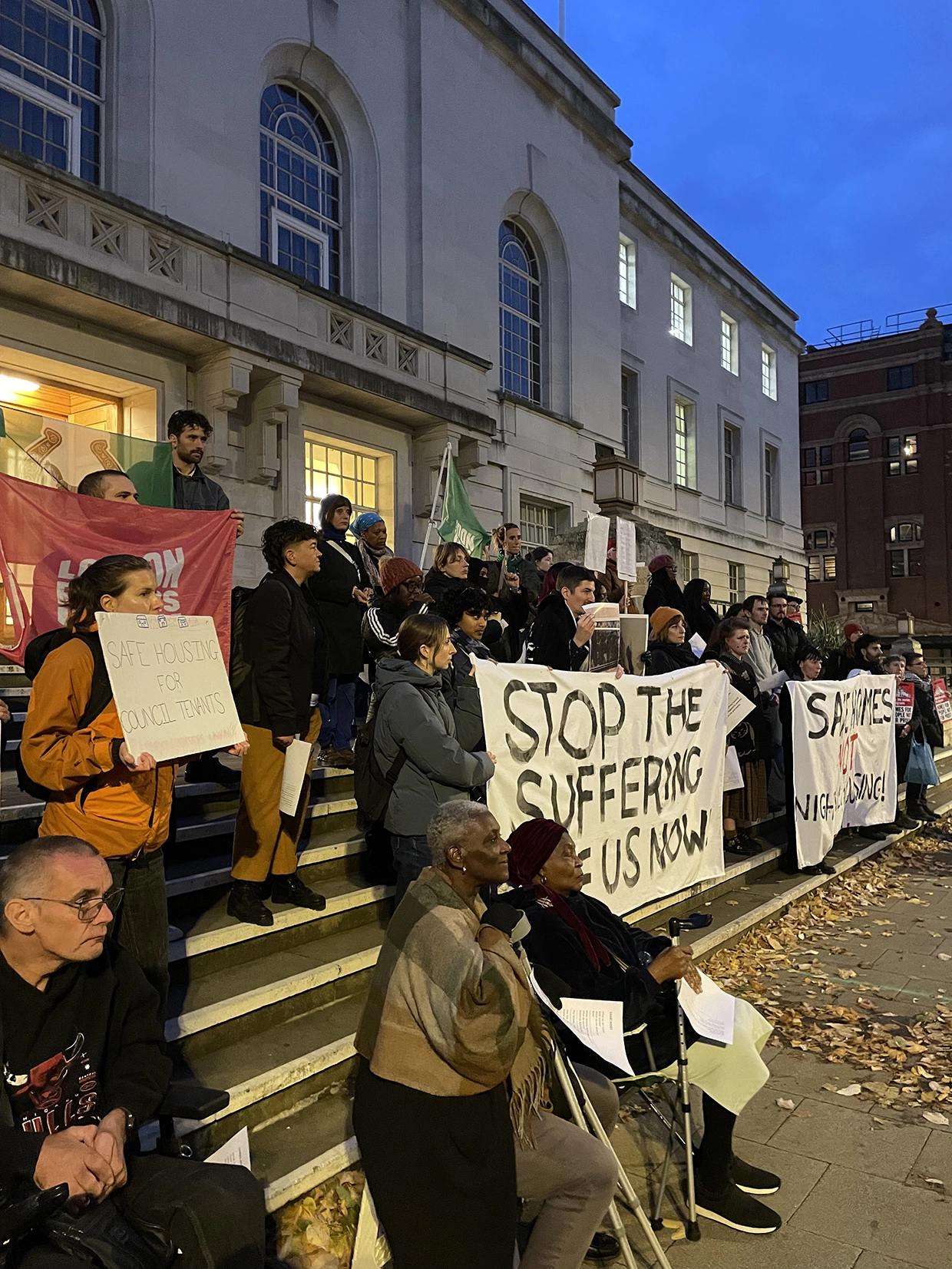
Many tenants reported living in unsafe and hazardous conditions. Photograph: London Renters’ Union
The council has also been contacted by MP Diane Abbott and a hospital to highlight the health risks to Mariama’s daughter.
She said: “The council have done a number of no-shows after saying they would come and sort out the mould.
But even when they do come it’s just a temporary fix – cleaning and painting over – and the mould comes back in a few months.”
The same problems plague her neighbours’ properties, leading Mariama to believe there are structural issues with the council-owned estate.
She said: “People are getting sick, there are children with pneumonia. This environment is literally harming us and despite all of the evidence the council do not seem to care. All we want is a suitable, safe and secure home.”
At the protest many shared similar stories, reporting chronic leaks, damp and mould as well as accessibility issues.
Hackney Council’s housing service receives around 80,000 requests a year for repairs from tenants and leaseholders.
The council says it responds to these “as quickly as possible”, and has launched a housing repairs action plan which sets out rules to respond to all reports of damp and mould “within ten working days” and ensure complaints are prioritised based on the severity, age and health of residents.

Cllr Guy Nicholson, deputy mayor and cabinet member for housing management and regeneration. Photograph: Hackney Council.
Councillor Guy Nicholson, deputy mayor and cabinet member for housing management and regeneration, said: “As a landlord, the council will always respond to every tenants’ needs and it is committed to meeting the challenges of demand for affordable council homes and the repairs generated by large numbers of ageing homes.”
But for many, reforms are needed more than ever.
Earlier this year the Housing Ombudsman launched a special investigation into Hackney Council.
Its report highlighted repeated poor practice in dealing with complaints, especially those relating to vulnerable tenants.
Another protestor and Hackney Council tenant, Lisa Reilly said: “Hackney Council has been ignoring my family for six years.
“My seven-year-old son has spent most of his life in this flat which has been riddled with damp and black mould. He has chronic asthma and I’ve been told by medical professionals that it’s unsafe for him to live here. Now, I have no lights in half the flat because of problems with the leaks.
“I don’t want to be worried about my family’s health any longer. It’s time for the council to make sure that my children have somewhere safe to grow up.”
During the demonstration a letter was handed to Cllr Nicholson demanding a meeting to negotiate a resolution to the tenants’ issues.
Cllr Nicholson said: “Hackney is one of the country’s largest local authority social landlords. It is responsible for over 30,000 homes and takes its role as landlord seriously. It is working with the Housing Ombudsman and the Regulator for Social Housing to provide good homes for all tenants and leaseholders.
“The introduction of Awaab’s Law will help improve both the wellbeing of residents and help the council manage and maintain its homes.”
To mark the first day of Awaab’s Law, the message ‘Mould Kills! Safe Council Homes Now!’ was projected onto the Town Hall building at 6pm.
Awaab’s Law is named after Awaab Ishak, a two-year-old boy who died in a mould-ridden social home in Rochdale in 2020.
The new legislation sets strict timelines for landlords to address hazards, of which the LRU accuse Hackney Council to be in breach.
Jae Vail, A spokesperson for the London Renters’ Union, said: “Nobody should have to pay for housing that makes them sick. It’s outrageous that our members have spent years battling disrepair and fearing for their health.
“The shocking conditions in Hackney show just how far councils and social landlords still have to go to guarantee basic safety at home.
“Awaab’s Law is a vital step forward, but across the country tenants remain trapped in hazardous housing, unable to get the repairs they need.
“To make these new rules a reality, we need major investment to fix our public homes and tenants must have the legal right to withhold rent when our safety is at risk. Only then will we have the power to challenge mistreatment and demand the safe homes we all deserve.”
The local government & social care ombudsman has launched a new video to explain what to do if you need to complain about your local council.
The video explains what steps you need to take before you complain and how to explain what has gone wrong when you need to raise a complaint.
Update: this article was updated at 11:50 on Tuesday 4 November 2025 to include the Local Government & Social Care Ombudsman video.