
Plan for secure children’s home progresses despite opposition from Save Lea Marshes
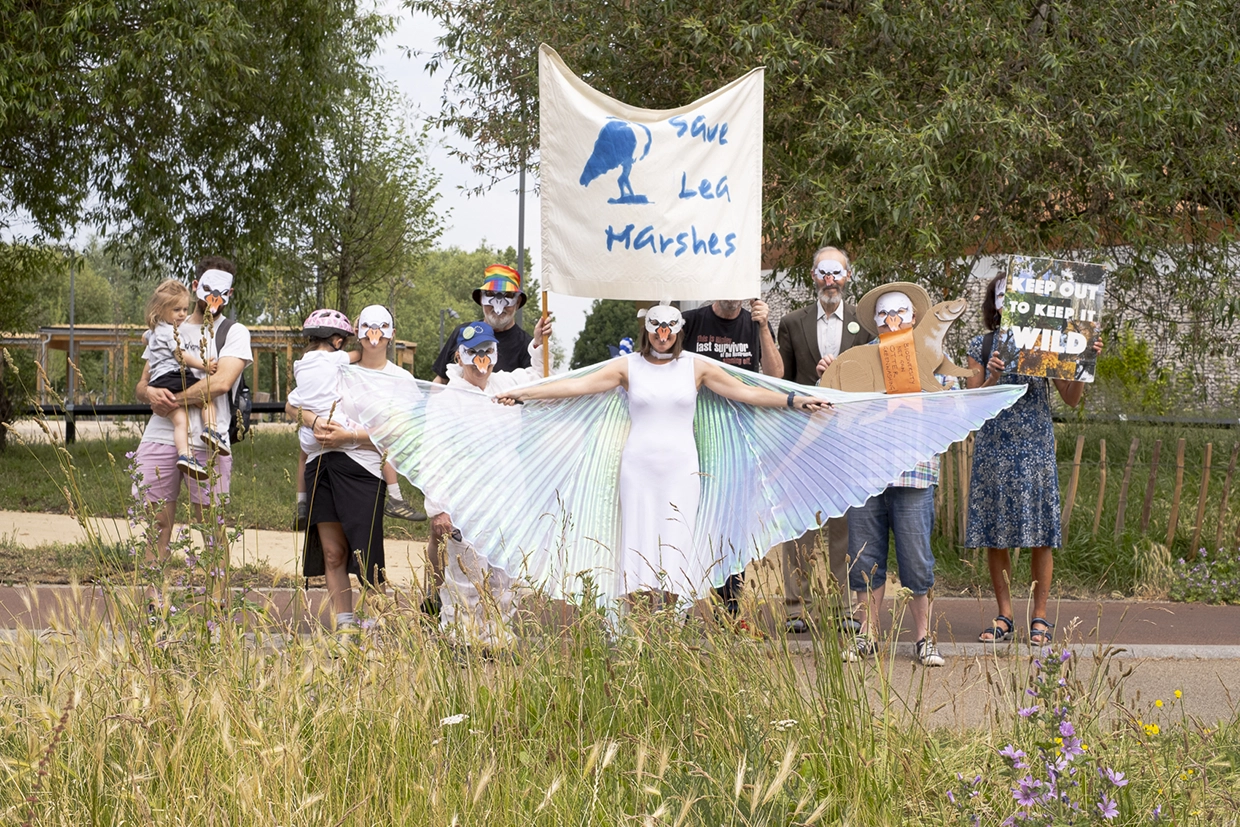
‘Keep it wild’: Save Lea Marshes’ swan protest in front of the ice centre. Photograph: Save Lea Marshes
Plans for London’s only secure children’s home are moving forward, but campaigners have doubled down on their opposition.
The Pan-London Secure Children’s Home, situated on the 14-acre Thames Water depot in Lea Bridge Road, will look after up to 24 vulnerable young people aged between ten and 17.
Waltham Forest Council will formally oversee its design and construction, having agreed to take over from Barnet Council at a cabinet meeting last week after a year-long review.
The secure home has not yet been approved, and campaigners continue to call for alternative uses of the site.
Campaign group Save Lea Marshes argue that the proposal is “the wrong project in the wrong place”.
A spokesperson said: “There are concerns about the suitability of secure units for treating the problems of vulnerable and disturbed children.
“We consider investment in care in the community to be a more fruitful approach.”
First proposed in 2022, the project is being overseen by London Councils and funded by the Department for Education (DfE).
A total of £3.7 million has been allocated to cover the cost of designing the home, surveys and consultants.
London Councils, which represents the capital’s 32 boroughs and the City of London, said the service was needed to help “alleviate serious national capacity issues”.
Local authorities place children in secure children’s homes when no other type of care placement can keep the child safe.
They provide a safe environment where children can receive specialist care, education and support.
There are currently no secure children’s units in London, which means vulnerable children are relocated outside the capital.
A spokesperson for London local authorities said: “Delivering a secure children’s home in London, for some of the capital’s most vulnerable children and young people, remains a key priority for London local authorities and the Department for Education.
“There is still a national shortage of welfare placements in secure children’s homes and currently there is no service of this kind in London.
“This means some of London’s most vulnerable children and young people are still waiting too long for the specialist care they need, or they are placed hundreds of miles away – far from their families, carers, friends and other people that are important to them.
“This distance has a negative impact on the work that local authorities, health and education services do to help children and young people make a successful transition from secure care back into the community.”
A deprivation of liberty (DoL) order is a court order authorising the lawful restriction of a child’s freedom, to prevent significant harm where no other legal option exists.
The orders are the most extreme intervention the state can make to keep children and others safe and typically involve placement in unregistered settings.
Amidst a shortage of registered children’s accommodation, DoL orders are becoming increasingly used.
According to the BBC, in 2017/18, there were 103 DoL applications in England, while in 2023/24, there were 1,238.
The former Thames Water depot was identified as the “only suitable location” to build a secure children’s home out of a shortlist of 70 sites, according to London Councils.
Save Lea Marshes submitted an Environmental Information Regulations (EIR) request to query this.
They told the Citizen: “We were provided with a statement by the project leader that the depot was the ‘most suitable’ site for the project. The promoters therefore misled the public in their public consultation by claiming it was the ‘only’ suitable site. Plainly there are other possible locations for this project.”
The government-owned land is classed as metropolitan open land (MOL) and is not for sale, the housing ministry previously said, which makes the required planning application “complex”.
Councils are required to ensure MOL sites are protected from “inappropriate” development except in “very special circumstances”.
Developers who want to build on metropolitan open land must also prove there was “no other suitable site”.
The East London Waterworks Park (ELWP) group has also put forward its own informal plans for an open-water pool and café, which they say would be more suitable for the site.
Save Lea Marshes said: “This proposal would provide public open air swimming along with rewilding of the site to the benefit of the site’s ecology and the enjoyment of nature for the local population.
“The depot is situated on floodplain, zones two and three, which means that Marshes are at increased risk of flooding, particularly flash flooding. The ELWP project is far more compatible with this flood risk than any other construction on this site.”
London Councils have also assured that the proposals are “sensitive and respectful of the surrounding area and local context”.
A formal planning application was due to be submitted to Waltham Forest Council last September, but it was put on hold that month so the DfE could review the project.
With the scheme now delayed by 13 months, London Councils says a new timeline will be unveiled in due course.
Note: This article was amended at 12:10 on Tuesday 21 October 2025. It originally stated that Save Lea Marshes initially proposed the site be used for two free schools. This statement was incorrect and has been removed. It was further amended at 18:40 on Tuesday 21 October 2025 to include an updated quote from the spokesperson for London local authorities.