
Pas de Chats? How Hackney’s unsung Arkestra inspired a mural for the ages
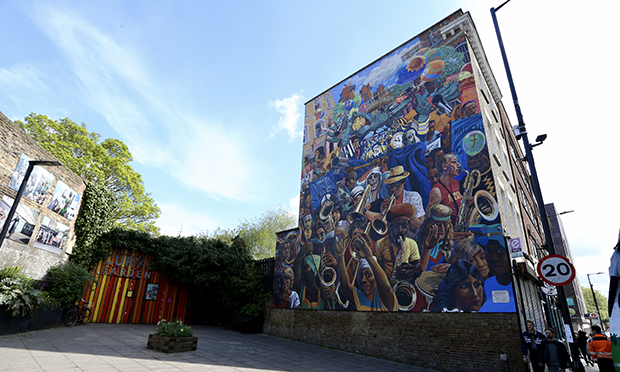
The Peace Carnival mural by Ray Walker. Photograph: courtesy Hackney Archives
Making local history is a strange feat.
Hackney often gets callouts from its famous progenies—one thinks of Idris Elba and others full of razor-edged reports from the rose-red empire that always offer more than a hint of nostalgia.
But those who don’t achieve quite the same notoriety outside the borough often end up etched into its walls, or are left hiding in plain sight.
Or both, as it was for artist and musician Alan ‘Al’ May, who, strolling down Dalston Lane, suddenly found himself towering above the other pavement-plodders.
His sinewy face soaked in sunshine, Al’s inordinate hands were now caressing a magnificent saxophone, slap bang in the middle of a carnival with his mates, the anti-nuclear Catholic priest Bruce Kent and Mahatma Gandhi.
The year was 1984 and, to his surprise and delight, May had just discovered he and fellow regulars from community arts collective Chats Palace had achieved literal new heights as the centrepiece of Hackney’s striking mural, Peace Carnival.
It was the brainchild of artist Ray Walker, who along with May and the stars of the artwork, shared a hunger for community art that had led to them meeting on the day of a peace march through the borough.
“I remember this bloke asking to have my photo taken, and that would have been Ray,” says the rakish May, his grin infectious as he recalls the “lovely day” he and others marched for peace from the Town Hall, woodwind and brass in hand.
Whether intended this way or not, what became of this brief encounter is a fitting tribute. Both the mural and the celebrants it captures emerged from a countercultural experiment that flourished in Hackney during the ’70s and ’80s, when the streets were the real galleries.
Inspired by carnivals as far as Trinidad and as close as Canning Town, May could not escape what he saw across London at that time: a thirst for improvisational music, experimental dance and avant-garde performance.
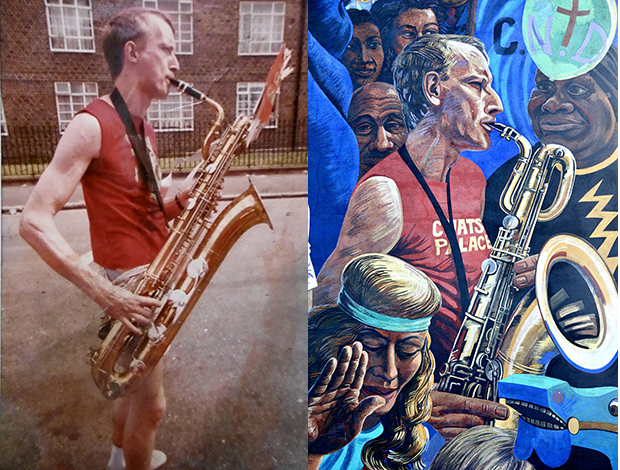
Alan ‘Al’ May on the peace march and in the mural. Images: courtesy Hackney Archives
Rather than being “parachuted in and out” of places, May and others ran film, music and mosaic workshops from the pavement, with style subordinate to creative collaboration.
“It was about looking at ways of drawing, working collectively with a group of people to draw out whatever we were working towards.”
Alongside groups Pyramid Arts and Freeform Arts Trust, the latter headed up on Dalston Lane by Martin Goodrich, May wanted to see his art rejuvenate people’s lives—hence the emphasis on having “great fun”.
Goodrich explains his guiding philosophy at the time was about creating memories for people.
“Your sense of community is the stories that people share.”
Taking over the Carnegie Library on Chatsworth Road, Chats Palace became a citadel of experimentation, fuelled by courage and encouragement.
Spearheaded by artist Alan Rossiter, patrons could get drama, music, comedy and the chance to bring their own ideas.
The ‘Arkestra’ (pinching its portmanteau from the equally theatrical Sun Ra) were serious about equal opportunity.
“There was never an audition. Everybody had to play, and everybody had to do a solo, no matter how bad they did it,” says May. “It was all ages, all abilities.”
The group’s core talent—including May, Jah Globe and Steve Murray— helped stop things getting too messy.
“We had quite a strong rhythm section, so we could always support an inexperienced brass player’s dodgy playing.”
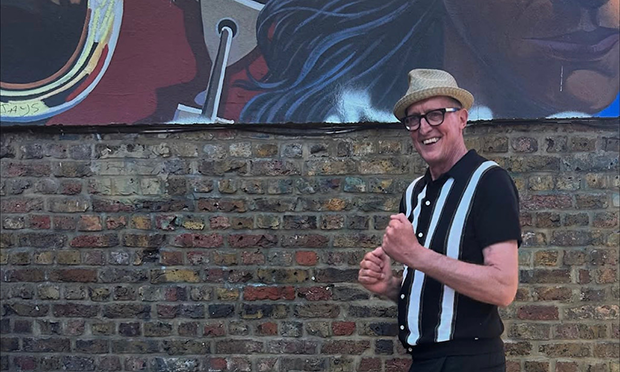
Alan May pictured by the mural in which he features. Image: courtesy: Hackney Archives
Leaning on classics like ‘Harlem Shuffle’, ‘Hit the Road Jack’, and the songs of South African pianist Abdullah Ibrahim, Chats Palace Arkestra earned local fame as the backing band for costumed Christmas shows and regular workshops.
But getting an audience would be “hit and miss”, May says.
The sprawling band’s most popular gigs were the Sunday lunchtime jazz sessions.
The Palace was not shy of stars either, with figures like Geno Washington, Alexei Sayle, John Agard, Alison Moyet and even the Muppets passing through.
The muralist, meanwhile, was just as disillusioned with the modern gallery, stacked with commodities.
Ray Walker’s approach has invited comparisons to Mexican muralists Diego Rivera and José Clemente Orozco, who envisioned ‘art for the people’ which could emancipate the left-behinds through bold painterly narratives.
For Walker and the other London Muralists for Peace, under the auspices of a sympathetic Greater London Council, the dishevelled streets excluded from Thatcher’s market ‘liberation’ became canvases for a similarly colourful yearning.
Walker’s murals, of which only two survive, sifted through the capital’s unsung fascist and anti-fascist histories, with one painting in Bow capturing the oft-forgotten Peasants’ Revolt.
But with Peace Carnival, he seems to fuse cultural memory, community and global politics into a much more local iconography. Featuring not just the Arkestral players but other Chats Palace regulars like Daisy Carradice, the painting freezes this ecstatic troupe mid-flight, emblems of the bohemian milieu they helped create.
Indeed, the more names May attributes to the faces crowding the mural, the more it resembles the Sgt. Pepper album cover than it does a Englishman’s take on Rivera.
The tragic poetry here is that everyone did end up pitching in, whether they liked it or not.
By the time Alan discovered Peace Carnival, he had just moved to Bristol and its author had died of a heart attack aged just 39, some time before the mural was completed.
In his sudden absence, Ray’s wife Anna and artist Mick Jones had taken the reins.
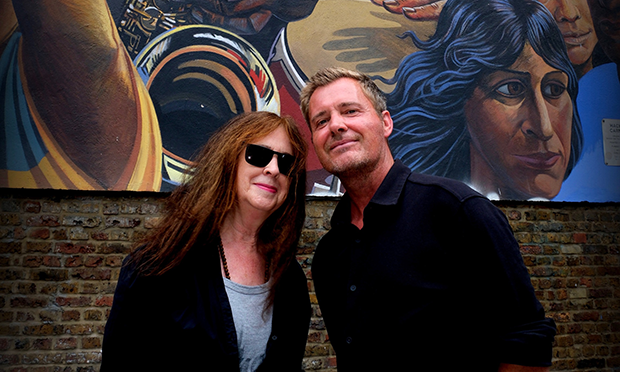
Ray Walker’s wife Anna and son Roland in front of the mural. Image: courtesy Dave McCairley
Peace Carnival has now bound together the fates of its creator and the wider constellation of artists he may have only orbited but certainly cleaved to in spirit.
And so, on 28 September, the band will reunite to mark the mural’s 40th birthday, again with fun for the whole family.
Among the planned setlist is ‘Celebration Day’, a Jah Globe original written especially for the eponymous peace march, infused with yet more melancholy following the saxophonist’s passing.
Honouring its intricate, fragile histories, one expects the party will recapture the rambunctious energy that inspired the artwork, though the event still needs crowdfunding – highlighting the uncertainty of the next 40 years, not just for the painting but for community art more generally.
On the phone, the new manager of Chats Palace, Mark Francis-Vasey, tells me he wants to put the centre back at the heart of Hackney’s culture and champion the voiceless after a decade of “mothballing”.
Having been hobbled by the loss of council funding last year, Chats’ remaining pots have just about dried up.
But the new boss is determined.
“There are many groups today, for example the trans community, that people just won’t touch. Suddenly they’ve been marginalised, victimised and unheard,” he says.
“Through theatre, music and performance, we can share uncomfortable messages with people in an artistic and fun way, and challenge those injustices.”
Meanwhile, Roland Walker keeps a close eye on the mural’s pigment after its restoration over a decade ago, and praises Hackney Council for gifting it a new plaque.
The paint may lose its vibrancy from time to time, but the community it captured certainly won’t—even if the collective and experimental arts that put it there face a harsher landscape now.
In that sense, this particular piece of Hackney’s jagged history has become timeless.
The events celebrating Peace Carnival take place on 28 September around the Mural’s forecourt and the Curve Garden between 11am and 3pm. You can visit the crowdfunder campaign page here.
A free community street party will follow on Ashwin Street from 3pm until 8pm, with an after party scheduled at Netil 360 from 7–10pm.
Meanwhile, Hackney Archives will host an explainer talk on the mural’s history between 3.30pm and 5pm at the Hackney Archives inside CLR James Library.
Chats Palace encourages people to drop by and see what they’re up to, or send them a suggestion for what they’d like to see.