
‘Once a young person feels seen, they start to dream differently’
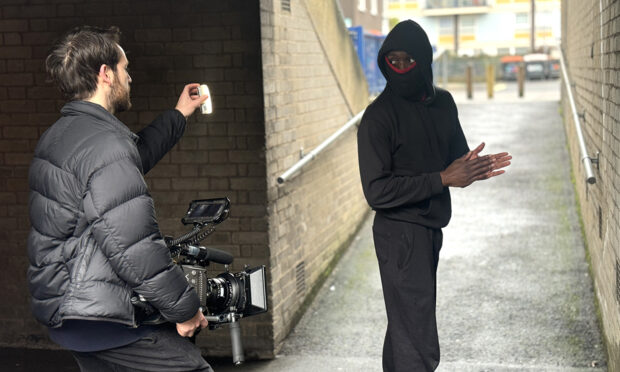
On location in Hackney: Stolen Dreams 2: Redemption.
In the confines of a prison cell, Trey has plenty of time to think about the gangland crime he committed.
Through sessions with a psychologist, he gradually unpacks the searing events that led him there.
Soon to be released, the second season of a short film series by Hackney-based Emeka Egbuonu taps into universal themes of reflection, regret and atonement.
Stolen Dreams 2: Redemption includes a series of flashback scenes shot on location in De Beauvoir and Hackney Wick.
Like Egbuonu, lead actor Michael Adurson lives locally, and I chatted with them recently about the film’s relation to life in the borough.
Adurson, who has appeared in the Masters of the Air series on Apple TV+ and starred in the feature film Crazy Fun in Serbia, was only 17 when he was stabbed and seriously injured on a night out.
SB: You have been a victim of violence yourself. How has acting the role of a perpetrator of crime shaped your understanding of your own experience?
MA: I don’t usually label myself as a victim, but stepping into the shoes of a perpetrator gave me a different kind of perspective. It made me reflect on both sides of the story, the person who causes harm and the one who suffers from it.
I started to wonder whether the feelings of remorse and regret I portrayed in the character might, in some way, mirror those felt by the person who hurt me. It’s been a powerful experience.
SB: What would be your advice to those setting out in life on how to avoid doing things they might seriously regret?
MA: Life doesn’t give you redos. One moment, one decision, can affect not just your life but the lives of everyone around you. My advice? Think long-term. Understand the weight your actions carry before you make a move you can’t take back.
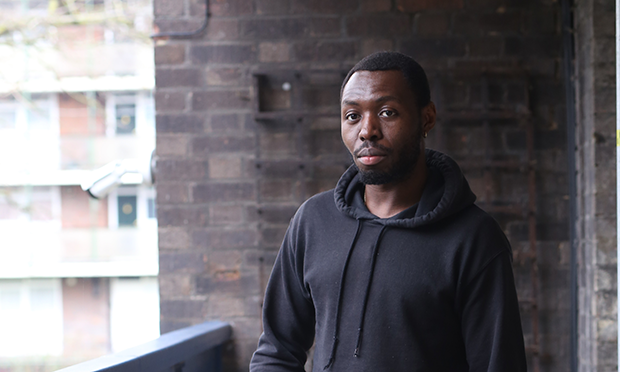
Lead actor Michael Adurson.
Talking to Egbuonu, I wanted to probe the film’s relation to the neighbourhoods it portrays.
SB: I understand that Stolen Dreams 2 is shot partly on location in Hackney. How did you decide where to shoot?
EE: Having lived and worked in Hackney for many years, the area holds deep personal and professional significance for me.
De Beauvoir, in particular, was a natural choice. The estate’s tower blocks offer a raw, authentic backdrop that aligns perfectly with the story we’re telling in Stolen Dreams 2. It’s also the very estate where I worked with hundreds of young people over nearly a decade, delivering intervention programmes and mentoring.
That connection adds another layer of meaning to the project. It’s not just a location, it’s familiar ground, a place filled with real stories, energy, and emotion.
De Beauvoir has also become a popular filming location. While we were shooting, there was actually a Netflix production filming just across from us, which speaks to its cinematic appeal.
Beyond its visual suitability, filming in Hackney helped us keep production costs manageable. As an independent filmmaker, it’s important to work resourcefully without compromising on quality or authenticity, and Hackney allowed us to do just that.
Ultimately, this is home. It made sense creatively, practically, and emotionally.
SB: One of the great things about making this film here is that you were able to involve local young people. How did you find people to help with the production?
EE: Working with young people is what makes telling these stories truly special. It’s not just about representation on screen, but also about creating opportunities behind the scenes.
Ellis, who played the lead in the first Stolen Dreams film, returned for Stolen Dreams 2, but this time also as a producer. His growth as a creative has been incredible to witness, and he brought with him a network of talented young people eager to gain hands-on experience.
Through Ellis and our wider networks, we were able to involve local young people in various production roles, from script supervisors to production assistants, and even as background actors. Some had never been on a film set before, while others were already exploring careers in media.
For many of them, this was more than just a credit, it was a chance to learn, build confidence, and see what’s possible. My hope is that experiences like this help spark or solidify their aspirations in film, storytelling, or any path that allows them to use their voice creatively.
Ultimately, we’re not just making a film, we’re building belief.
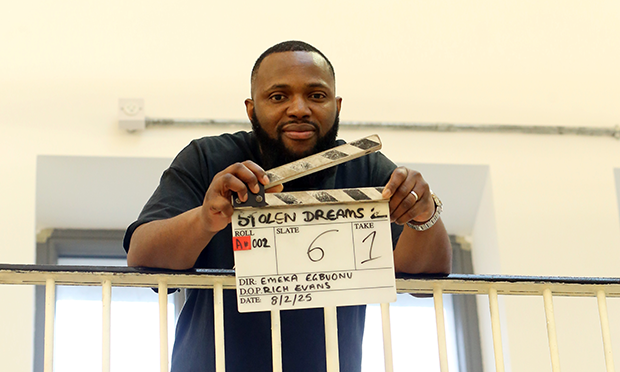
Director Emeka Egbuono on set.
SB: Living in Hackney, you’ll know what a culturally vibrant environment it is, and a great place for people to have good clean fun. But when we see it on the screen, the area is so often associated with crime. How do you see your depiction of the inner city as shaping the image people have of places like Hackney?
EE: That’s exactly why we don’t reference Hackney, or any specific area, by name in Stolen Dreams: Redemption. Hackney is a vibrant, diverse, and inspiring place to live. There’s so much good happening here, community work, creativity, culture, and we’re intentional about not letting the narrative of violence define the borough.
But the reality is, even in places full of promise, there are still deep-rooted issues affecting young people. Ignoring that does more harm than good. These stories exist, whether or not we choose to show them. So when we do tell them, we make sure to do so responsibly.
I remember back in 2011, when Top Boy was about to air for the first time. The Observer gave some of the young people I worked with an advance screening. Their biggest concern? A real gang had been featured in the series, and it gave that group even more notoriety in the community. That moment really stuck with me.
So, for us, we make a clear choice: if a location doesn’t serve the story, we fictionalise it. We might film in Hackney, and locals may recognise the tower blocks or streets, but we don’t name the area. We want to tell the truth, but with care. It’s about reflecting lived experiences without sensationalising or branding entire communities.
Closing the conversation, Egbuonu made a powerful claim: “If there’s one thing I’d like readers to take away, it’s the power of storytelling, not just as entertainment, but as a tool for healing, understanding, and change.
“Stolen Dreams: Redemption isn’t just a film it’s a reflection of the conversations I’ve had with young people over the last 20 years. Many of them feel unseen, unheard, and trapped by circumstances beyond their control. Storytelling gives them a mirror to see themselves differently, and sometimes, for the first time, to imagine a new future.
“I believe every young person has a purpose. Sometimes they just need the right environment, a little belief, and the opportunity to express themselves.
“That’s what I’ve tried to create, on screen, in classrooms, and through every project I take on. Because once a young person feels seen, they start to dream differently. And that’s where real change begins.”
Stolen Dreams 2: Redemption will premiere on 20 September at the Genesis Cinema in Whitechapel.
For more information, see storiesbyemeka.com.