
Hackney has highest male lung and bladder cancer death rates in London
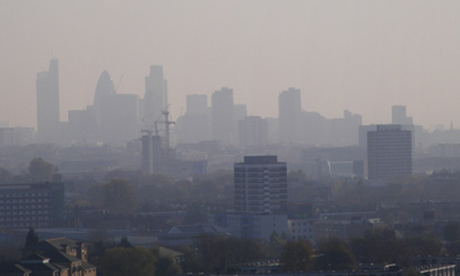
Smog over East London: a detail from a view over the city. Photograph: monkeywing/flickr
Death rates from lung and bladder cancer among men are higher in Hackney than in any other part of London.
Figures obtained by campaign group Clean Air in London show the borough was the second worst affected for female deaths caused by coronary heart disease.
Smoking and pollution are possible causes of the alarmingly high disease rates.
Hackney Council has identified smoking as “one of the biggest killers” in Hackney.
The Green Party says the borough’s roads are the dirtiest in London.
‘Shout out’
Maria Arnold of London Fields-based charity the Healthy Air Campaign said the figures highlighted the “invisible public health crisis” of air pollution.
She added: “Not only does it seriously damage our respiratory health but is also a cause of heart disease, strokes, lung cancer and even low birthweight in babies.
“Because it can’t be seen governments try to ignore it, but there is plenty that can be done.
“Hackney residents need to shout out and demand their right to breathe clean air.”
In 2012 cancer of the trachea, bronchus and lung caused more than seven deaths in every 10,000 Hackney residents – far more than in the second worst affected borough, Islington.
Five in every 10,000 women in Hackney died of coronary heart diseases in 2012 – meaning the borough came close to overtaking Tower Hamlets as the worst affected in London.
Though these figures sound low they represent worryingly high death rates and compare unfavourably with the situation elsewhere in the capital.
Dirty habit
Cancer Research UK said there is a strong link between lung cancer and cigarettes.
Nine out of 10 cases of the disease are linked to cigarettes.
A Cancer Research UK spokesperson said: “Smoking cigarettes definitely increases the risk of bladder cancer. Your risk if you currently smoke is up to four times that of someone who has never smoked.”
The NHS defines smoking as one of the five main causes of coronary heart disease.
A quarter of over-18s in Hackney smoke and 28 per cent of 18-19 year olds are smokers – figures that have alarmed Hackney Council health chiefs.
Councillor Jonathan McShane, Cabinet member for Health, Social Care and Culture, said: “These statistics are a stark reminder of the danger of smoking to our health.
“Helping people to quit and preventing them from starting smoking are among our top priorities to improve the health of people in Hackney.
“Free help and advice is available at drop in services across the borough.”
Hackney Council holds more than £10.5million of investments in tobacco stocks – a fact that has led some to accuse the Town Hall of sending mixed messages.
Big smoke
Pollution is another politically charged issue.
Green Party research suggests 70 per cent of roads in Hackney will exceed legal limits for harmful nitrogen dioxide air pollution within 10 years.
Last year the World Health Organisation announced it was classifying air pollution as carcinogenic to humans, indicating it is directly linked to incidences of cancer, particularly bladder cancer.
Cllr McShane added: “Air quality is a London-wide issue and we are working with the Greater London Authority, Transport for London and other boroughs to make improvements across the capital.
“We are currently reviewing our Air Quality Action Plan and will be consulting with residents on the new plan in early 2014.”
Last summer an initiative was launched to support Shoreditch businesses in reducing energy consumption by trialling zero or low emission vehicles and offering free advice from Zero Emissions Network consultants.
Cllr Feryal Demirci, Cabinet Member for Neighbourhoods, then said: “It is vital that through initiatives like ZEN Shoreditch we are able to tackle air pollution which causes health difficulties for thousands of people throughout the UK.
“I hope that many more forward-thinking businesses will take advantage of the support and advice on offer which will not only help to improve air quality but also to reduce company overheads.”
Hackney Council is looking to reduce traffic, and the borough has the highest number of people cycling to work in London.
Local help and advice is available from 0800 169 1943, smokers-clinic@qmul.ac.uk or smokefreecityandhackney.nhs.uk
Related:
Hackney Council’s tobacco investments back in spotlight
Hackney Council pumps taxpayer millions into tobacco firms
Hackney Council admits debate on its tobacco investments is needed
http://en.wikipedia.org/wiki/Miasma_theory – By saying ‘Air Pollution’ is a cause for cancer is simply going back to a gross exaggeration or generalisation made from the old term, ‘miasma’. Without proper analysis by scientists to identify what the independent toxicological components are accurately, there can be no charge or justification of penalty. It would be a huge strain on everyone to pay for a regulatory regime by only mix, general references and possible relationship – comparison, link/ estimate. Does the toxicological analysis and portable source monitoring need funding? Yes it does. Should it be required from all tax payers? Not necessarily. It depends on what the direct priorities and economic ability by location, and if it is industry that is to be charged, then by locality and independent monitoring and tests – investigation of health problems in the direct area of the industry and other data collected specifically for the industry. A one-size-fits-all approach hasn’t enough certainty – obviously for taxpayers across the board. Industries directly linked to findings of independent toxins in this ‘air pollution’ mix should be the ones paying for the research and technological adaptions. If it means temporary increases in costs from that industry so be it. It should not otherwise be an additional expense to the tax payer by any means – not on a generalised ‘miasma’ ruling.
What connects diesel fumes, PAH’s , nanoparticles , cancer, asthma, heart disease, placental function, brain pathology and the immune system?
The AHR receptor.
http://www.sciencedirect.com/science/article/pii/S0091674998702696
http://intl.pharmrev.org/content/65/4/1148.short
http://onlinelibrary.wiley.com/doi/10.1111/imm.12046/full
The AHR receptor alters immune cell DNA to change cell populations and properties.
http://intimm.oxfordjournals.org/content/early/2013/04/09/intimm.dxt011.full
http://www.jacionline.org/article/S0091-6749%2810%2901175-9/abstract
Millions of individuals worldwide are afflicted with acute and chronic respiratory diseases, causing temporary and permanent disabilities and even death. Often these diseases occur as a result of altered immune responses. The aryl hydrocarbon receptor (AhR), a ligand-activated transcription factor, acts as a regulator of mucosal barrier function and may influence immune responsiveness in the lungs through changes in gene expression, cell–cell adhesion, mucin production, and cytokine expression. This review updates the basic immunobiology of the AhR signaling pathway with regards to inflammatory lung diseases such as asthma, chronic obstructive pulmonary disease, and silicosis following data in rodent models and humans.
http://link.springer.com/article/10.1007/s00281-013-0391-7
Recent epidemiological studies have demonstrated associations between air pollution and adverse effects that extend beyond respiratory and cardiovascular disease, including low birth weight, appendicitis, stroke, and neurological/neurobehavioural outcomes (e.g., neurodegenerative disease, cognitive decline, depression, and suicide). To gain insight into mechanisms underlying such effects, researchers mapped gene profiles in the lungs, heart, liver, kidney, spleen, cerebral hemisphere, and pituitary of rats immediately and 24h after a 4-h exposure by inhalation to particulate matter and ozone.
Pollutant exposure provoked differential expression of genes involved in a number of pathways, including antioxidant response, xenobiotic metabolism, inflammatory signalling, and endothelial dysfunction. The experimental data are consistent with epidemiological associations of air pollutants with extrapulmonary health outcomes and suggest a mechanism through which such health effects may be induced.
http://toxsci.oxfordjournals.org/content/135/1/169.short
Smoking rates as causal too easy a get out for public health doctors,as they are merely toeing the pro motor industry/oil government line.Meanwhile, in the real world:
http://environmentalresearchweb.org/cws/article/yournews/55830
Jan 8, 2014
New compounds discovered that are hundreds of times more mutagenic
Researchers at Oregon State University have discovered novel compounds produced by certain types of chemical reactions – such as those found in vehicle exhaust or grilling meat – that are hundreds of times more mutagenic than their parent compounds which are known carcinogens.
These compounds were not previously known to exist, and raise additional concerns about the health impacts of heavily-polluted urban air or dietary exposure. It’s not yet been determined in what level the compounds might be present, and no health standards now exist for them.
The findings were published in December in Environmental Science and Technology, a professional journal.
The compounds were identified in laboratory experiments that mimic the type of conditions which might be found from the combustion and exhaust in cars and trucks, or the grilling of meat over a flame.
“Some of the compounds that we’ve discovered are far more mutagenic than we previously understood, and may exist in the environment as a result of heavy air pollution from vehicles or some types of food preparation,” said Staci Simonich, a professor of chemistry and toxicology in the OSU College of Agricultural Sciences.
“We don’t know at this point what levels may be present, and will explore that in continued research,” she said.
The parent compounds involved in this research are polycyclic aromatic hydrocarbons, or PAHs, formed naturally as the result of almost any type of combustion, from a wood stove to an automobile engine, cigarette or a coal-fired power plant. Many PAHs, such as benzopyrene, are known to be carcinogenic, believed to be more of a health concern that has been appreciated in the past, and are the subject of extensive research at OSU and elsewhere around the world.
The PAHs can become even more of a problem when they chemically interact with nitrogen to become “nitrated,” or NPAHs, scientists say. The newly-discovered compounds are NPAHs that were unknown to this point.
This study found that the direct mutagenicity of the NPAHs with one nitrogen group can increase 6 to 432 times more than the parent compound. NPAHs based on two nitrogen groups can be 272 to 467 times more mutagenic. Mutagens are chemicals that can cause DNA damage in cells that in turn can cause cancer.
For technical reasons based on how the mutagenic assays are conducted, the researchers said these numbers may actually understate the increase in toxicity – it could be even higher.
These discoveries are an outgrowth of research on PAHs that was done by Simonich at the Beijing Summer Olympic Games in 2008, when extensive studies of urban air quality were conducted, in part, based on concerns about impacts on athletes and visitors to the games.
Beijing, like some other cities in Asia, has significant problems with air quality, and may be 10-50 times more polluted than some major urban areas in the U.S. with air concerns, such as the Los Angeles basin.
An agency of the World Health Organization announced last fall that it now considers outdoor air pollution, especially particulate matter, to be carcinogenic, and cause other health problems as well. PAHs are one of the types of pollutants found on particulate matter in air pollution that are of special concern.
Concerns about the heavy levels of air pollution from some Asian cities are sufficient that Simonich is doing monitoring on Oregon’s Mount Bachelor, a 9,065-foot mountain in the central Oregon Cascade Range. Researchers want to determine what levels of air pollution may be found there after traveling thousands of miles across the Pacific Ocean.
Source: Oregon State University