
Homes plan means Children’s Hospital buildings face wrecking ball
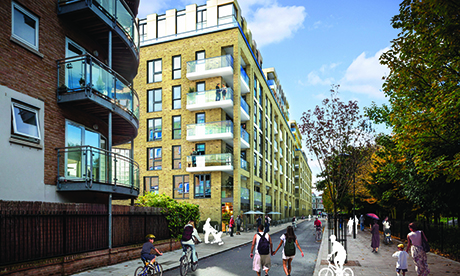
How it will look: the housing development on the hospital site. Image: Rydon
Historic hospital buildings will be demolished to make way for new homes despite protests from residents.
All but the façade of a derelict complex of buildings on Hackney Road that once housed the Queen Elizabeth Children’s Hospital will be swept away and replaced with 188 new residential units – many affordable – as part of plans by developers Rydon and housing association Family Mosaic.
Opponents who live nearby do not doubt the dire need for affordable housing, but many cite the historic importance of the architecture facing the wrecking ball, some of which dates from 1868.
Lucy Rogers, who lives near the 0.64 hectare former hospital site, said: “We have to remember quite an important fact, which is that the process to choose the developer was private. We have not been allowed to scrutinise how the decision was made, which is bad for democracy.
“One of the other developers tendering favoured a scheme that retained the buildings, so it’s not like a sort of cloud cuckoo land idea.”
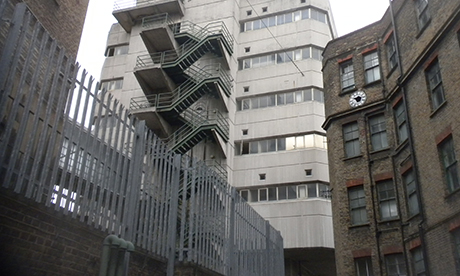
How it looks now: part of the hospital site (obscured from Hackney Road) including Victorian buildings and the ‘New Brutalist’ 1960s extension. Photograph: Josh Loeb
Houston, we have a problem
She added: “We are losing London’s built heritage at such a pace we won’t have anything left. We will be left with this generic environment. If we want that, we might as well all move to Houston in Texas.”
Part of the complex was once a Victorian workhouse, while a more recently-built extension designed by firm Lyons Israel Ellis in the ‘New Brutalism’ style in 1965 is also worthy of preservation, according to amenity group The Hackney Society
In an article about the development in the most recent issue of The Hackney Society’s newsletter Spaces, David Shaw wrote: “The site, which had been empty for many years, cries out for development, but it is disappointing that the collection of buildings that currently occupies the site will be replaced by such an uninspired, unlovely and unimaginative proposal.
“Disappointing as well that other options and designs were not fully explored and the views of the objectors so readily dismissed.”
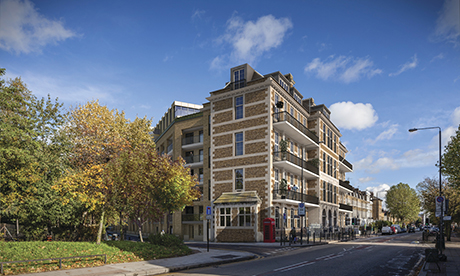
How the frontage of the former Queen Elizabeth Children’s Hospital will look when restored. Image: Family Mosaic
Resident Oliver Lazarus said he was still speaking to planners in the hope they would alter their plans to take on board suggestions that they include more ground floor retail units as part of the scheme.
He added that the imposing height of seven-storey block planned to replace the hospital was also an issue for other residents.
Mr Lazarus said: “Personally I wasn’t upset about the height of the building because I think that is just the way London’s going, but a lot of people were upset because it was totally maxed out.
“You couldn’t have built any higher or any denser, and there is going to be overshadowing of Haggerston Park.”
‘No greater priority’
The project is due for completion in 2015 and includes 38 per cent affordable housing for both renting and buying, comprising larger three or four bedroomed family homes as well as smaller units.
Shared ownership or mixed tenure options for buying are available through Family Mosaic.
The Queen Elizabeth Children’s Hospital complex lies just over the border from Hackney in Tower Hamlets and has been derelict since 1997.
The development plans won approval from Tower Hamlets Council in August and are being backed by the Mayor of London.
Richard Blakeway, Deputy Mayor for Housing, Land and Property, said: “There is no greater priority than tackling London’s housing needs and it is imperative that long-standing empty sites are put back into use.”
He added: “The Mayor has ensured the design incorporates some of the original architecture of the former hospital, retaining the historic front façade as a permanent reminder of the site’s heritage.”
Whats a wrenching ball?
If you go and take a look, the existing buildings are really pretty grim. The proposed building also looks rather un-lovely. It therefore seems to me as if the proposal would replace something ugly with something else ugly. This being the case, I don’t see what all the fuss is about. After all, this being Hackney it’s pretty difficult to mess anything up to such an extent that it ends up worse than it already is.
Richard Blakeway is right. We need more homes. But better designed ones and more affordable ones.
On this huge site there will be just 38% affordable a fact the developers have only just admitted after arguing it was a higher 44% based on a bizarre “habitable rooms” calculation. Tower Hamlets minimum for affordable housing is 35% so this is a bad deal and a missed opportunity to build more/better.
As for the Mayor ensuring the design incorporates some of the original – baloney, tosh, tommy rot and rubbish – he had nothing to do with it. The facade was always to be retained so disingenuous nonsense from Blakeway. The fact is the GLA’s own heritage advisor & the independent heritage advisor called in by developers both recommended retention of existing buildings over this shoddy design. Again they admitted last Friday that the reason they have always favoured demolition is not about number of units or design or anything else but it would have cost more as it would have meant paying 20% in VAT a ludicrous govt anomaly that helps destroy heritage in the UK. This has always been about profit first and foremost.
Usual nimby work. Yawn.
@Near to Hackney – what’s nimby about this? Can’t see anyone saying don’t build anything but rather questioning if it couldn’t have been better. Personally all for seeing some better design rather than usual matchbox flats.
@Gareth – all subjective know people who hate the concrete block others love it..but if new building is rubbish design (I think it looks bland and bleargh) why couldn’t they do something better..no harm asking for it.
Rob – would you care to define “better”? Otherwise your comment is virtually meaningless.
The blandness comes from the planning process not the developer. The tower Hamlets Design Officer is involved through the process to ensure any interesting elements are eliminated. She does this to ensure the local nimby brigade don’t object so the developer has no opportunity to do anything interesting. It’s amazing they managed to get the current scheme through. I,m sure they had to push the design officer to get to this stage. The Cadap design committee employed by tower hamlets are a huge waste of space. They also ensure the design is watered down as they are a group of architects and don’t like other architects pushing the boat out.
@Ben well obviously all design is subjective but I would agree that looking for more affordable homes is better than minimum” numbers, retention of more of the original would make a more interesting addition to the streetscape, different materials, different design, different approach – bottom line is as @Tobias points out it is simply bland. If bland is the best we can expect or accept then it’s a poor state of affairs. Better comes from demanding more interesting approaches and designs so in relation to this scheme, we lose an interesting building that adds to the urban environment with yet another set of blandness. I think most people reading this would have a view as to whether this is the best we can expect or whether they could do “better” so not entirely meaningless.
Rob – you state;
“…more affordable homes is better than minimum numbers, retention of more of the original would make a more interesting addition…”.
Those two aspirations alone are probably economically contradictory. If you want to get the maximum number of “affordable” then you should be arguing for the complete demolition and construction of a high-density high-rise development.
If, however, you want to make housing expensive and limited, then go down the heritage route.
Taste is indeed subjective and so is “blandness”, but I agree with Tobias – its aesthetics are a result of politics and the planning process.
the two aspirations are not mutually exclusive – a small number of high end penthouses would allow more affordable…the political element there would no doubt be high spenders not wanting to rub shoulders with the affordable riff raff. For me this site offers is poor in design and having seen some of the plans would have liked to have seen other options and versions – I think it would have been possible to have made this site economically viable and not sure I agree it is totally down to politics and planning process as there is some very good innovative building and design being done. Sadly the design company behind this have a very average track record.
Design is done by numbers and tick boxes. To get through the planning and building control process each home needs to be x m2 big, x ceiling heights, x number of wheelchair users, x amount of outside space, x amount of play space, x meters away fro adjoining properties to avoid overlook, achieve code for sustainable homes, provide x number of affordable, have x dolt between intermediate and rented, no north facing dingle aspect family homes, only x units to share a core, secure by design accreditation, this list is endless but all developers have to meet the London Housing Design Standards bought in by Boris. Once an architect has ticked these boxes you end up with almost identical developments regardless of the architect as the room to innovate is limited. The London venacular is a result of the constraints of the planning process.
“Affordable housing” can be found outside London.
I am pleased that the hospital will be in use again after at least twenty years sitting idle. It is such a great pity that our local young people will be unable to afford to buy or rent these places. The so called ‘affordable rents’, are too high for most working class people who live in this area. It is just a shame where most young people are being priced out of this part of London.
Mayor Rahman will probably fill up the affordable housing portion with his Bangladeshi inner circle. While the Hipsters of Silicon Roundabout buy the rest. So if your white and working class…pack your bags.