

Mass retrofitting of London’s overheating homes must be done quickly to avoid putting over one million children at risk of health issues, the mayor has been warned.
This summer is on course to be the UK’s hottest since records began, according to the Met Office, with longer and more intense heatwaves predicted in future.
And London had the highest proportion of deaths attributable to both the hottest and coldest days of any region in England and Wales, according to ONS data released today (Wednesday 26 August 2026).
Max Anderson, head of communications at the Conservative Environment Network, said: “Whilst Labour continue to allow red tape to get in the way of air conditioning and greening up London, they are putting Londoners’ lives at risk.
“Without air conditioning, London homes are turning into ovens that are threatening everyone from new-borns to pensioners.
“There also must be more street trees in London to protect people from heat stroke or worse. The perverse, confusing rules on planting trees alongside roads make it nearly impossible for councils to green up cities.”
David Simmonds MP, the shadow minister for levelling up, housing and communities, added: “Londoners are dying because of hairshirt anti-air conditioning rules.
“Confusing regulations for planting trees alongside streets is leading to less greenery across the city, exposing more residents to the full harm of these heat waves.
“This is not only hurting people’s productivity and their day-to-day health, but is now killing Londoners at a disproportionate rate as our climate gets warmer.”
Heat Ready
City Hall has already acknowledged that major reforms are needed to prepare and future-proof the capital for extreme conditions.
The Greater London Authority’s (GLA) Heat Ready London strategy, unveiled in June, lays out plans to expand access to cool spaces and increase urban greening in a desperate bid to cool down the city.
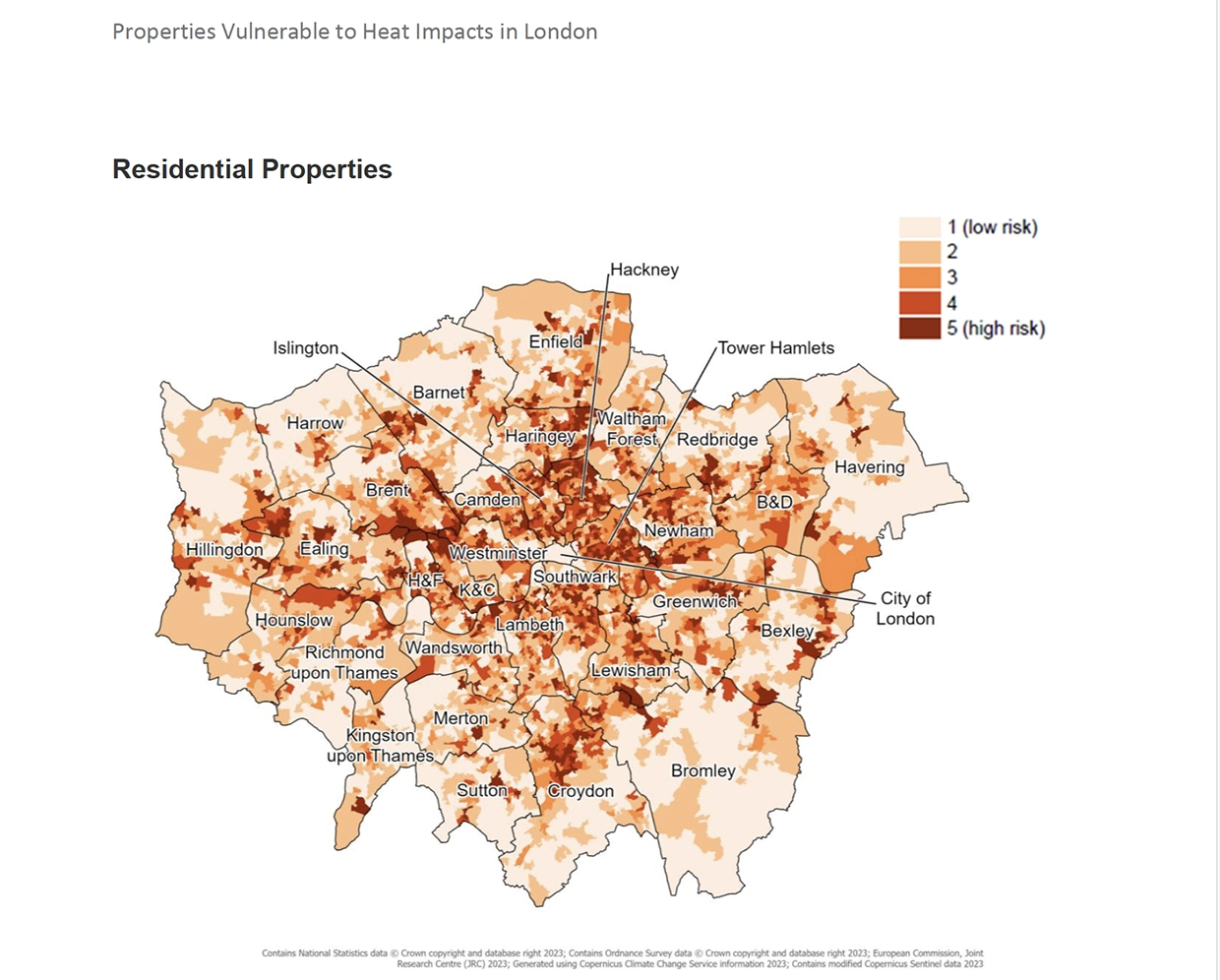
However, the London Assembly's planning and regeneration committee has now warned Sir Sadiq Khan that extra focus needs to be placed on accelerating the retrofitting of homes through passive cooling measures to ensure they are “fit for a warming climate”.
Seventy-five per cent of London’s social housing stock is considered at high risk of overheating, which could place more than one million children at increased risk, according to a new report from the cross-party group of assembly members.
A survey carried out by the committee shows 86 per cent of Londoners reporting overheating in their homes in 2025, with many unable to sleep and suffering negative impacts on their mental and physical health, and general wellbeing.
Radical action
To prevent more heat-related deaths in future, “more radical action” is needed, both when building new homes and retrofitting current stock, the committee concluded.
London’s homes are currently “ill-equipped to cope with the temperatures the capital is already experiencing, let alone those projected in future decades,” the report says.
“Improving the resilience of London’s housing will require greater attention at the earliest stages of design through to the management and retrofit of existing homes.
“We heard from many guests that external shading is an effective way to passively cool homes. Despite this, we heard from many guests that not enough modern buildings in London adopt shading and even include design features that exacerbate overheating.”
These include large areas of glazing, limited opportunities for natural ventilation and communal heating systems.
Cooling hierarchy
They say many buildings are still being developed without adequate passive cooling due to a lack of enforcement of the GLA’s ‘cooling hierarchy’.
During one committee session, Dr Tom Dollard told members that designers often jump straight to ventilation with only a “notional nod to the more passive measures such as reducing window elevations and shading”.
This is primarily because passive cooling systems can have higher upfront costs – and as such, developers that do not expect to retain long-term responsibility for homes face weaker incentives to invest in it.
Even where designers want to incorporate passive measures such as external shading, they can face design challenges in order to fit the building with London’s architectural character.
When it comes to retrofitting, the committee encouraged the GLA to “embed overheating adaptation within wider retrofit activity, ensuring that measures designed to improve energy efficiency also support Londoners to remain safe and comfortable during periods of extreme heat.”
They cited the example of the GLA and London Councils piloting shutters and awnings in their retrofit of 12,000 homes as a key example of good practice.
Passive cooling measures like these reduce indoor heat without consuming energy, while active cooling – air conditioning – should mostly only be adopted in “vulnerable” households.
Unbearable heat
Chair James Small-Edwards said: “Too many Londoners are living in homes that become unbearably hot in summer, with extreme temperatures tragically contributing to hundreds of deaths.
“Current trends suggest that heatwaves exceeding 40 degrees are now 20 times more likely than they were in the 1960s, and yet London’s homes have not adapted to this new reality.
“Our recommendations set out real and practical steps that the Mayor, Government and the housing sector can take to make London more resilient to rising temperatures, and help protect Londoners from the increasing threat of extreme heat.”
A spokesperson for the mayor of London told the Local Democracy Reporting Service (LDRS): “Extreme heat is a growing threat to Londoners’ health, with around one million homes potentially at high risk of overheating. The report and its recommendations will be carefully considered.
“Through Heat Ready London and the Draft new London Plan, the Mayor is already working to protect those most at risk, reduce overheating in new and existing homes and make the capital more resilient as our climate changes.”


